Rock Canyon in Provo in Utah County, Utah — The American Mountains (Southwest)
Rock Canyon Trailhead History
Photographed by Jeremy Snow, June 1, 2026
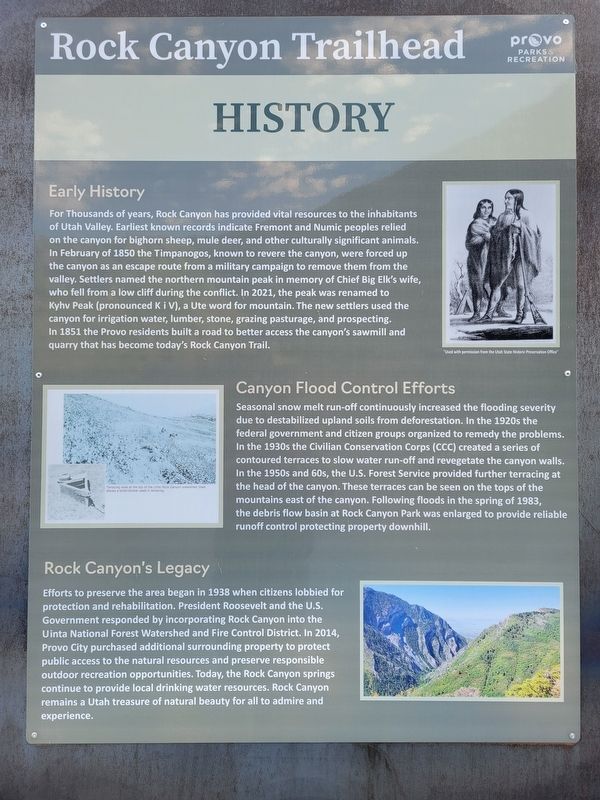
1. Rock Canyon Trailhead History Marker
For Thousands of years, Rock Canyon has provided vital resources to the inhabitants of Utah Valley. Earliest known records indicate Fremont and Numic peoples relied on the canyon for bighorn sheep, mule deer, and other culturally significant animals. In February of 1850 the Timpanogos, known to revere the canyon, were forced up the canyon as an escape route from a military campaign to remove them from the valley. Settlers named the northern mountain peak in memory of Chief Big Elk's wife, who fell from a low cliff during the conflict. In 2021, the peak was renamed to Kyhv Peak (pronounced K i V), a Ute word for mountain. The new settlers used the canyon for irrigation water, lumber, stone, grazing pasturage, and prospecting. In 1851 the Provo residents built a road to better access the canyon's sawmill and quarry that has become today's Rock Canyon Trail.
Canyon Flood Control Efforts
Seasonal snow melt run-off continuously increased the flooding severity due to destabilized upland soils from deforestation. In the 1920s the federal government and citizen groups organized to remedy the problems. In
this page online
Rock Canyon's Legacy
Efforts to preserve the area began in 1938 when citizens lobbied for protection and rehabilitation. President Roosevelt and the U.S. Government responded by incorporating Rock Canyon into the Uinta National Forest Watershed and Fire Control District. In 2014, Provo City purchased additional surrounding property to protect public access to the natural resources and preserve responsible outdoor recreation opportunities. Today, the Rock Canyon springs continue to provide local drinking water resources. Rock Canyon remains a Utah treasure of natural beauty for all to admire and experience.
Topics. This historical marker is
Photographed by Jeremy Snow, June 1, 2026
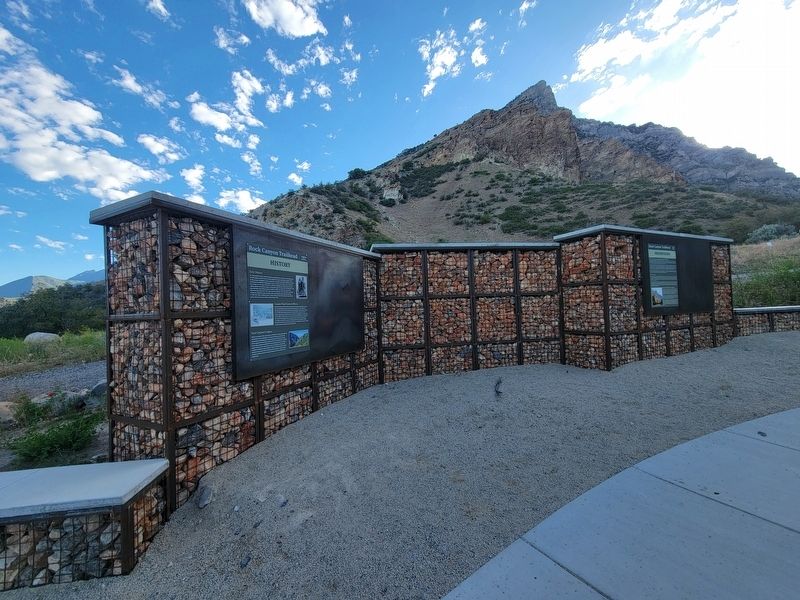
2. Rock Canyon Trailhead History Marker
Location. 40° 15.887′ N, 111° 37.813′ W. Marker is in Provo, Utah, in Utah County. It is in Rock Canyon. It can be reached from East 2300 North. Touch for map. Marker is at or near this postal address: 2284 E 2300 N, Provo UT 84604, United States of America. Touch for directions.

Regionally, this marker is in Utah’s Wasatch Front. It is also in the American Mountain West and on the Colorado Plateau. Globally, it is in North America, the Rocky Mountains, the Western Hemisphere, the Western World, and the Anglosphere. Historically, it finds itself in what was once New Spain and also Mexico’s Alta California.
Other nearby markers. At least 8 other markers are within walking distance of this marker: Creating the “Y” on the Mountain (approx. 0.4 miles away); Carp Not Native to Utah Lake; Introduced in 1882 (approx. 0.4 miles away); Army Troops Caused the “Provo Riot” in 1870 (approx. 0.4 miles away); Choosing the Site of Provo’s First Tabernacle Caused Some Controversy (approx. 0.4 miles away); Provo’s First Bank was Late in Coming but Didn’t Last Long (approx. 0.4 miles away); Provo’s North Park Had a Community Ice Skating Rink in the 1930s (approx. 0.4 miles away); Provo Had a “Pest House” for Those with Communicable Diseases (approx. 0.4 miles away); Proctor Academy Helped Educate Provo’s Youth (approx. 0.4 miles away). Touch for a list and map of all markers in Provo.
Credits. This page was last revised on June 3, 2026. It was originally submitted on June 2, 2026, by Jeremy Snow of Cedar City, Utah. This page has been viewed 27 times since then. Photos: 1, 2. submitted on June 2, 2026, by Jeremy Snow of Cedar City, Utah. • Andrew Ruppenstein was the editor who published this page.
