Cape Fear in Dunn in Harnett County, North Carolina — The American South (South Atlantic)
Confederate Commanders at Averasboro
⎯⎯⎯
Union Commanders at Averasboro
Photographed by Devry Becker Jones (CC0), May 24, 2026
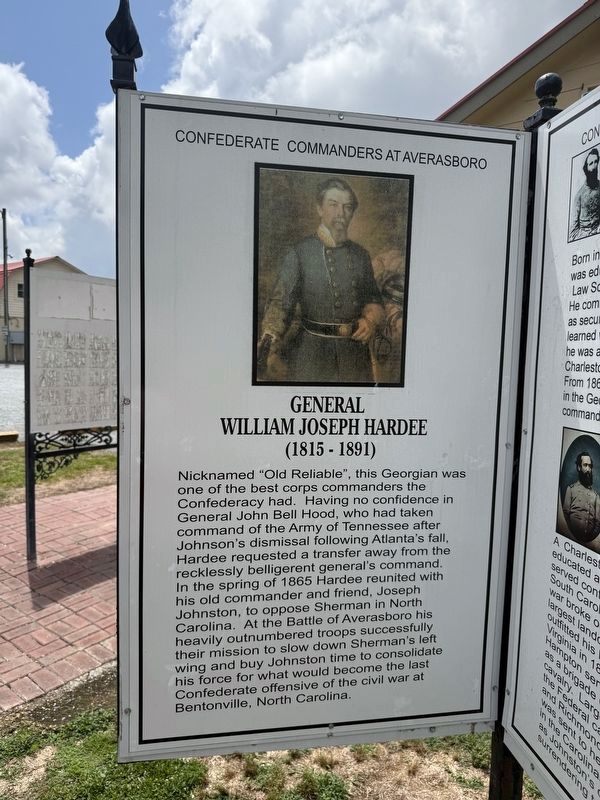
1. Confederate Commanders at Averasboro panel
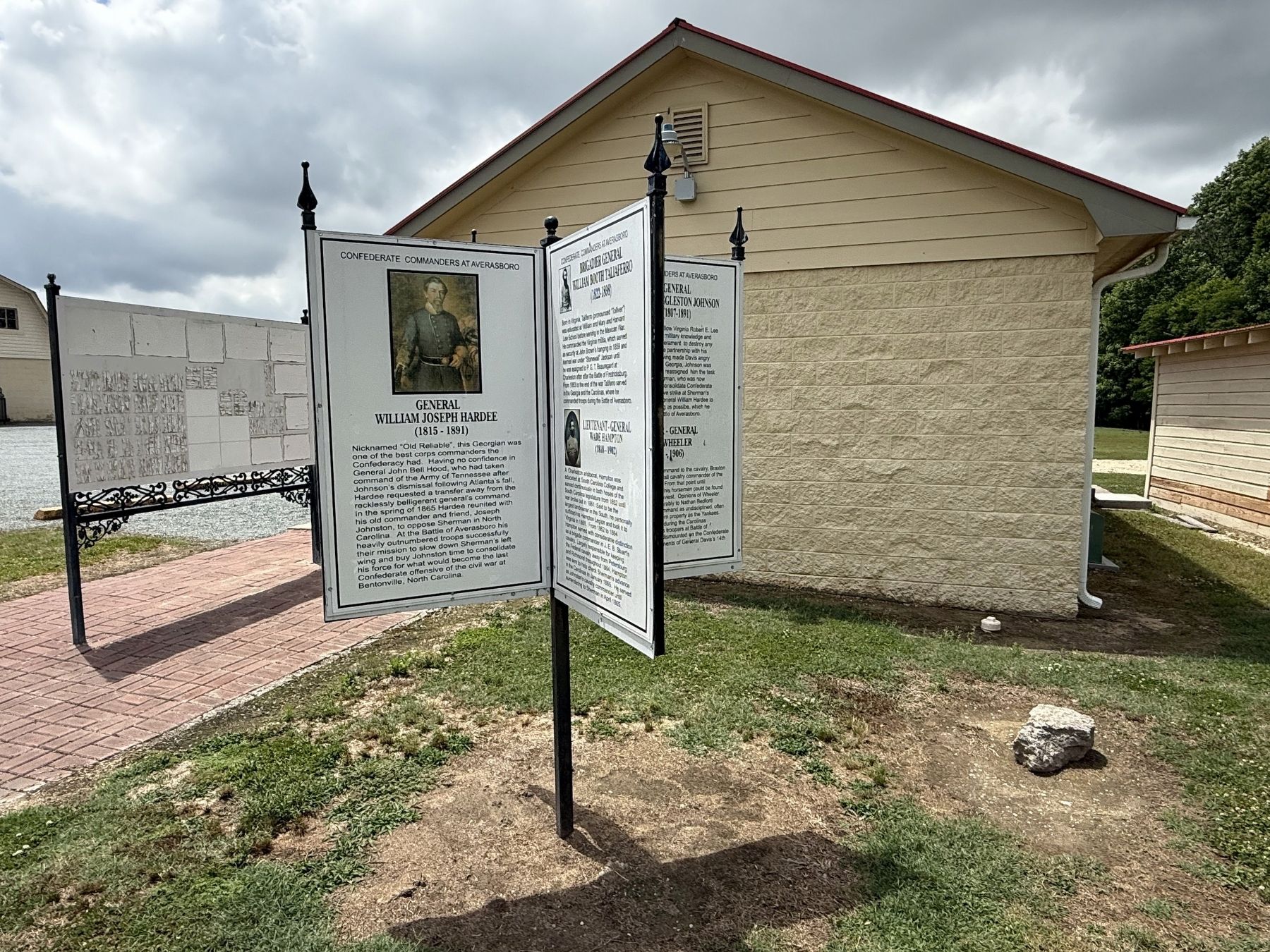
Nicknamed "Old Reliable", this Georgian was one of the best corps commanders the Confederacy had. Having no confidence in General John Bell Hood, who had taken command of the Army of Tennessee after Johnson's dismissal following Atlanta's fall, Hardee requested a transfer away from the recklessly belligerent general's command. In the spring of 1865 Hardee reunited with his old commander and friend, Joseph Johnston, to oppose Sherman in North Carolina. At the Battle of Averasboro his heavily outnumbered troops successfully their mission to slow down Sherman's left wing and buy Johnston time to consolidate his force for what would become the last Confederate offensive of the civil war at Bentonville, North Carolina.
Brigadier General William Booth Taliaferro (1822-1898)
Born in Virginia, Taliferro (pronounced "Tolliver") was educated at William and Mary and Harvard Law School before serving in the Mexican War. He commanded the Virginia militia, which served as security at John Bron's hanging in 1859 and learned war under "Stonewall" Jackson
this page online
Lieutenant-General Wade Hampton (1818-1902)
A Charleston aristocrat, Hampton was educated at South Carolina College and served continuously in both hoses of the South Carolina legislature from 1852 until war broke out in 1861. Said to be the largest landowner in the South, he personally outfitted his Hampton Legion and took it to Virginia in 1861. From 1862 to 1864 Hampton served with considerable distinction as a brigade commander in J. E. B. Stuart's cavalry. Largely responsible for keeping the Federal cavalry away from Petersburg and Richmond throughout 1864, Hampton was sent to help check Sherman's advance in the Carolinas in January 1865. He served as Johnston's cavalry commander until surrendering to Sherman in April 1865.
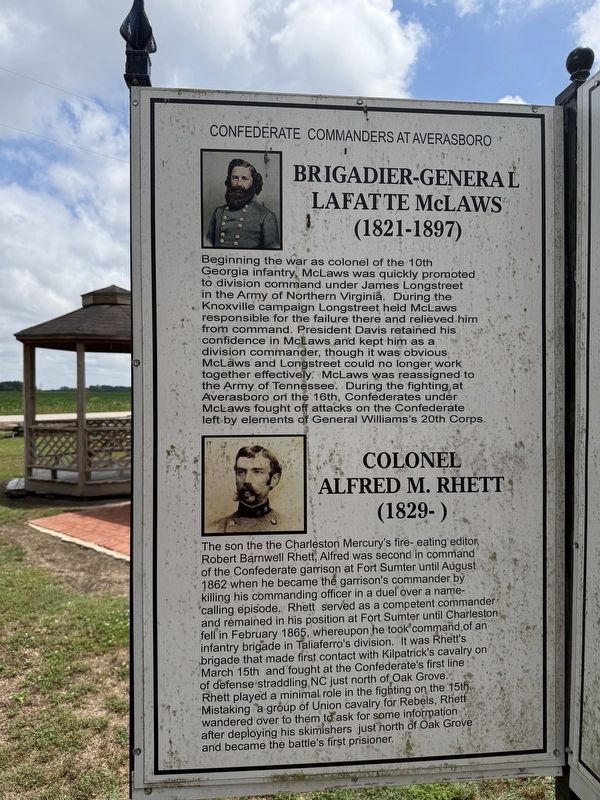
Brigadier-General Lafatte McLaws (1821-1897)
Beginning the war was colonel of the 10th Georgia infantry, McLaws was quickly promoted to division command under James Longstreet

Photographed by Devry Becker Jones (CC0), May 24, 2026
2. Confederate Commanders at Averasboro panel
Colonel Alfred M. Rhett (1829 - )
The son of Charleston Mercury's fire-eating editor, Robert Barnwell Rhett, Alfred was second in command of the Confederate garrison at Fort Sumter until August 1862 when he became the garrison's commander by killing his commanding officer in a duel over a name-calling episode. Rhett served as a competent commander and remained in his position at Fort Sumter until Charleston fell in February 1865, whereupon he took command of an infantry brigade in Taliaferro's division. It was Rhett's brigade that made his first contact with Kilpatrick's cavalry on March 15th and fought
Photographed by Devry Becker Jones (CC0), May 24, 2026
3. Confederate Commanders at Averasboro panel
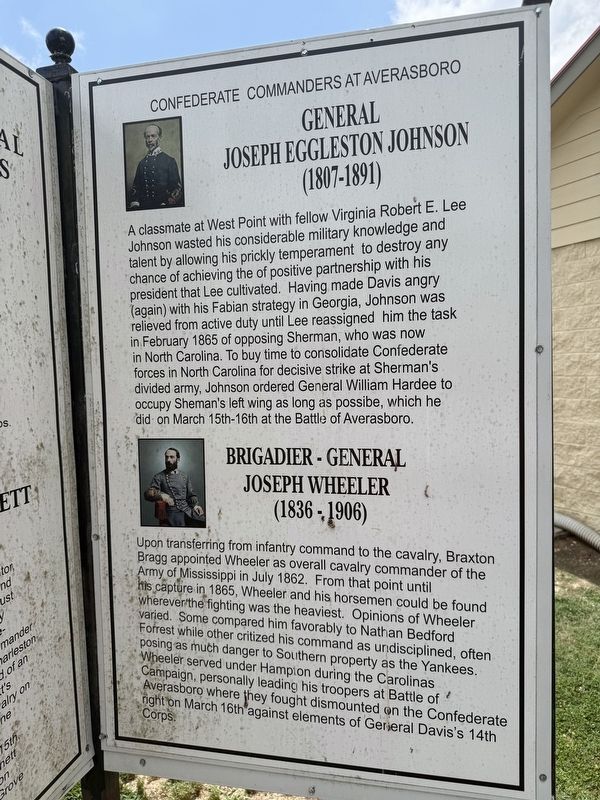
General Joseph Eggleston Johnson (1807 - 1891)
A classmate at West Point with fellow Virginia Robert E. Lee Johnson wasted his considerable military knowledge and talent by allowing his prickly temperament to destroy any chance of achieving the of positive partnership of president that Lee cultivated. Having made Davis angry (again) with his Fabian strategy in Georgia, Johnson was relieved from active duty until Lee reassigned him the task in February 1865 of opposing Sherman, who was now in North Carolina. To buy time to consolidate Confederate forces in North Carolina. To buy time to consolidate Confederate forces in North Carolina for decisive strike at Sherman's divided army, Johnson ordered General William Hardee to occupy Sherman's left wing as long as possibe, which he did on March 15th-16th
Photographed by Devry Becker Jones (CC0), May 24, 2026
4. Confederate Commanders at Averasboro panel
Brigadier-General Joseph Wheeler (1836-1906)
Upon transferring from infantry command to the cavalry, Braxton Bragg appointed Wheeler as overall cavalry commander of the Army of Mississippi in July 1862. From that point until his capture in 1865, Wheeler and his horsemen could be found wherever the fighting was the heaviest. Opinions of Wheeler varied. Some compared him favorably to Nathan Bedford Forrest while other criticized his command as undisciplined, often posing as much danger to Southern property as the Yankees. Wheeler served under Hamtpon during the Carolinas Campaign, personally leading his troopers at Battle of Averasboro where they fought dismounted on the Confederate right on March 16th against elements of General Davis's 14th Corps.
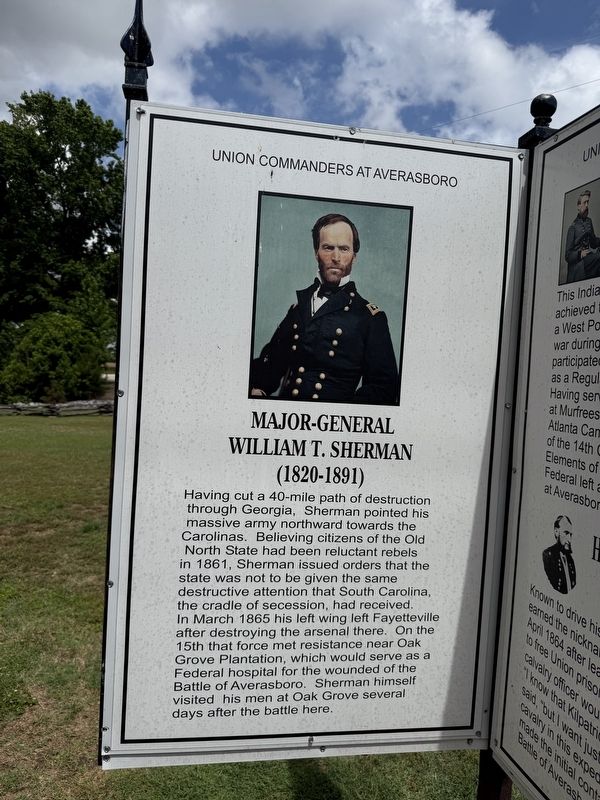
Having cut a 40-mile path of destruction through Georgia, Sherman pointed his massive army northward towards the Carolinas. Believing citizens of the Old North State had been reluctant rebels in 1861, Sherman issued orders that the state was not to be given the same destructive
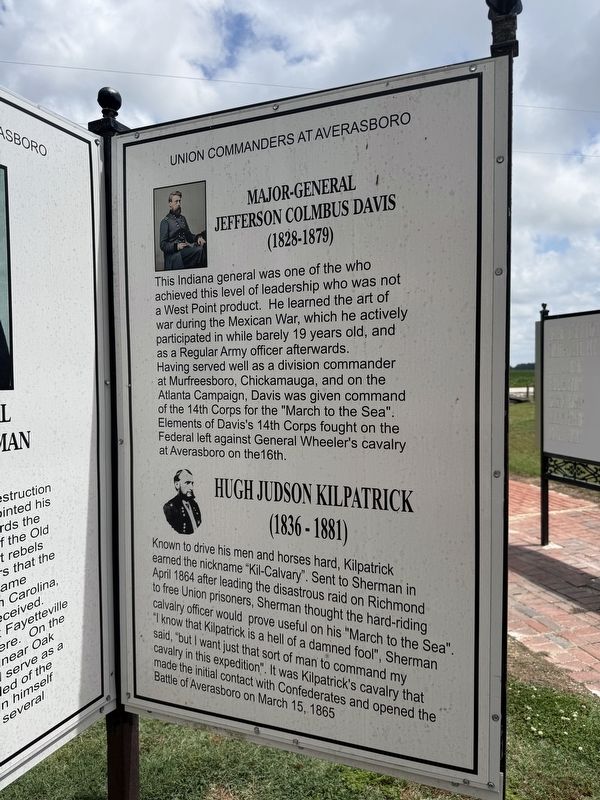
Major-General Jefferson Colmbus Davis (1828-1879)
This Indiana general was one of the who achieved this level of leadership who was not a West Point product. He learned the art of war during the Mexican War, which he actively participated in while barely 19 years old, and as a Regular Army officer afterwards. Having served well as a division commander at Murfreesboro, Chickamauga, and on the Atlanta Campaign, Davis was given command of the 14th Corps for the "March to the Sea". Elements of Davis's 14th Corps fought on the Federal left against General Wheeler's cavalry at Averasboro on the 16th.
Hugh Judson Kilpatrick (1836-1881)
Known to drive his men and horses hard, Kilpatrick earned the nickname "Kil-Calvary". Sent to Sherman in April 1864 after
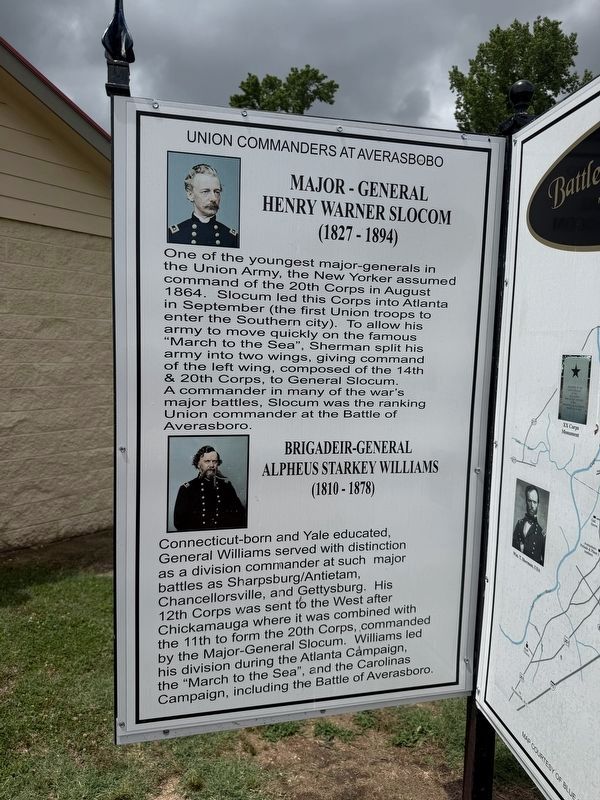
Major-General Henry Warner Slocom (1827 - 1894)
One of the youngest major-generals in the Union Army, the New Yorker assumed command of the 20th Corps in August 1864. Slocum led this Corps into Atlanta in September (the first Union troops to enter the Southern city). To allow his army to move quickly on the famous "March to the Sea", Sherman split his army into two wings, giving command of the left wing, composed of the 14th & 20th Corps, to General Slocum. A commander in many of the war's major battles, Slocum was the ranking Union commander at the Battle of Averasboro.
Brigadier-General Alpheus Starkey Williams (1810 - 1878)
Connecticut-born and Yale educated, General Williams served with distinction
Erected by Averasboro Battlefield and Museum.
Topics. This historical marker is listed in this topic list: War, US Civil. A significant historical date for this entry is March 15, 1865.
Location. 35° 15.999′ N, 78° 40.321′ W. Marker is in Dunn, North Carolina, in Harnett County. It is in Cape Fear. It is on North Carolina Route 82 south of Arrowhead Road, on the right when traveling south. Touch for map. Marker is at or near this postal address: 3274 Route 82, Dunn NC 28334, United States of America. Touch for directions.

Regionally, this marker is in North Carolina’s Coastal Plain and in the Piedmont. It is also in the American South and specifically in the Upper South. Globally, it is in North America, the Western Hemisphere, the
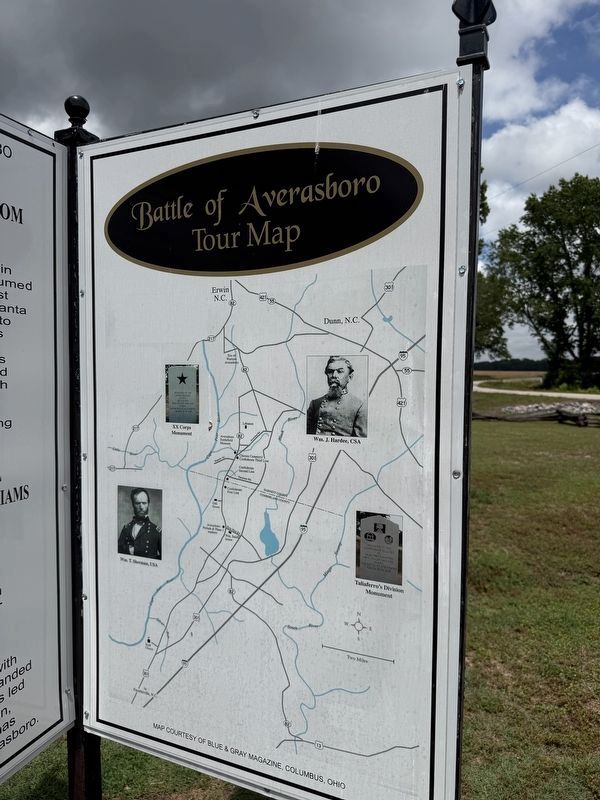
Other nearby markers. At least 8 other markers are within walking distance of this marker: Averasboro Battlefield Museum (here, next to this marker); Underground Barn Quilt Trail (a few steps from this marker); a different marker also named North Carolina (a few steps from this marker); Battle of Averasboro (a few steps from this marker); Confederate Women's Home (within shouting distance of this marker); North Carolina State Flag of 1861-1865 (within shouting distance of this marker); Model 1841 6-pounder Gun (within shouting distance of this marker); National Flag of the Confederacy (within shouting distance of this marker). Touch for a list and map of all markers in Dunn.
Another marker is no longer nearby. North Carolina (was a few steps from this marker but has been replaced with another marker now near it).
Photographed by Devry Becker Jones (CC0), May 24, 2026
9. Confederate Commanders at Averasboro / Union Commanders at Averasboro Marker
Credits. This page was last revised on June 2, 2026. It was originally submitted on June 2, 2026, by Devry Becker Jones of Washington, District of Columbia. This page has been viewed 25 times since then. Photos: 1, 2, 3, 4, 5, 6, 7, 8, 9. submitted on June 2, 2026, by Devry Becker Jones of Washington, District of Columbia.
