Centre in Cork in County Cork, Munster, Ireland — Irish South-West ((Éire) North Atlantic Ocean)
The Burning of Cork 1920
Photographed by Ian Lefkowitz, May 14, 2026
1. The Burning of Cork 1920 Marker
Inscription.
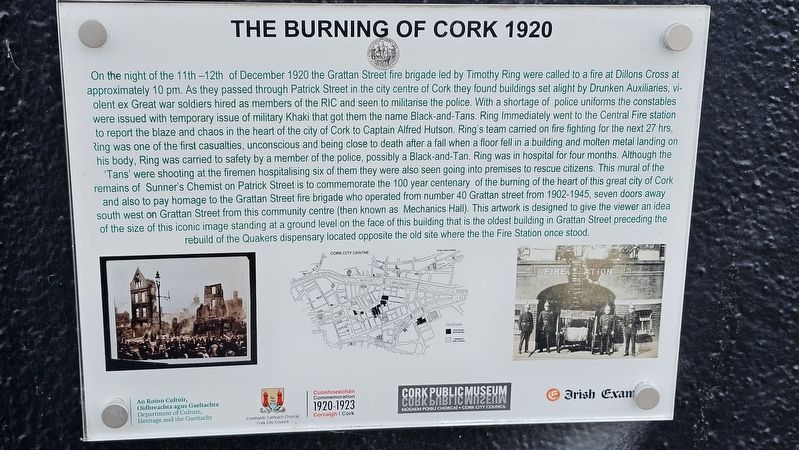
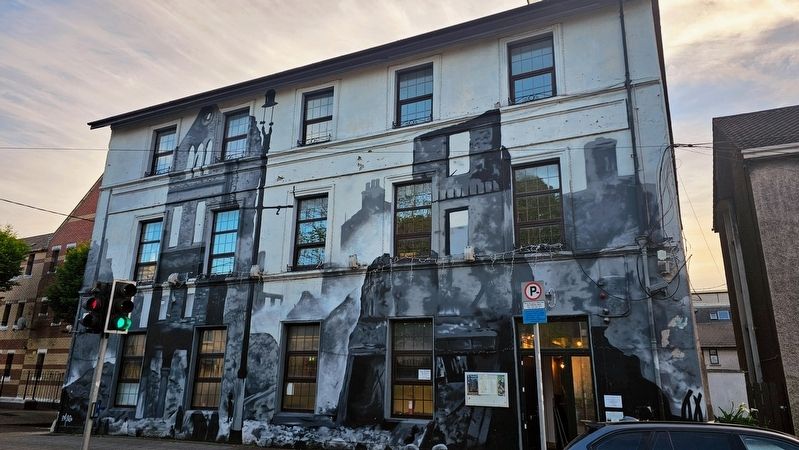
The Burning of Cork 1920. . On the night of the 11th–12th of December 1920 the Grattan Street fire brigade led by Timothy Ring were called to a fire at Dillons Cross at approximately 10 pm. As they passed through Patrick Street in the city centre of Cork they found buildings set alight by Drunken Auxiliaries, violent ex Great War soldiers hired as members of the RIC and seen to militarise the police. With a shortage of police uniforms the constables were issued with temporary issue of military Khaki that got them the name Black-and-Tans. Ring immediately went to the Central Fire station to report the blaze and chaos in the heart of the city of Cork to Captain Alfred Hutson. Ring’s team carried on fire fighting for the next 27 hrs, Ring was one of the first casualties, unconscious and being close to death after a fall when a floor fell in a building and molten metal landing on his body, Ring was carried to safety by a member of the police, possibly a Black-and-Tan. Ring was in hospital for four months. Although the ‘Tans’ were shooting at the firemen hospitalising six of them they were also seen going into premises to rescue citizens. This mural of the remains of Sunner’s Chemist on Patrick Street is to commemorate the 100 year centenary of the burning of the heart of this great city of Cork and also to pay homage to the Grattan Street fire brigade who operated from number 40 Grattan Street from 1902–1945, seven doors away south west on Grattan Street from this community centre (then known as Mechanics Hall). This artwork is designed to give the viewer an idea of the size of this iconic image standing at a ground level on the face of this building that is the oldest building in Grattan Street preceding the rebuild of the Quakers dispensary located opposite the old site where the Fire Station once stood.
On the night of the 11th–12th of December 1920 the Grattan Street fire brigade led by Timothy Ring were called to a fire at Dillons Cross at approximately 10 pm. As they passed through Patrick Street in the city centre of Cork they found buildings set alight by Drunken Auxiliaries, violent ex Great War soldiers hired as members of the RIC and seen to militarise the police. With a shortage of police uniforms the constables were issued with temporary issue of military Khaki that got them the name Black-and-Tans. Ring immediately went to the Central Fire station to report the blaze and chaos in the heart of the city of Cork to Captain Alfred Hutson. Ring’s team carried on fire fighting for the next 27 hrs, Ring was one of the first casualties, unconscious and being close to death after a fall when a floor fell in a building and molten metal landing on his body, Ring was carried to safety by a member of the police, possibly a Black-and-Tan. Ring was in hospital for four months. Although the ‘Tans’ were shooting at the firemen hospitalising six of them they were also seen going into premises to rescue citizens. This mural of the remains of Sunner’s Chemist on Patrick Street is to commemorate the 100 year centenary of the burning of the heart of this great city of Cork and also to pay homage to the Grattan Street fire brigade who operated from
Click or scan to see this page online
number 40 Grattan Street from 1902–1945, seven doors away south west on Grattan Street from this community centre (then known as Mechanics Hall). This artwork is designed to give the viewer an idea of the size of this iconic image standing at a ground level on the face of this building that is the oldest building in Grattan Street preceding the rebuild of the Quakers dispensary located opposite the old site where the Fire Station once stood.
Topics. This historical marker is listed in these topic lists: Charity & Public Work • Disasters • Wars, Non-US. A significant historical date for this entry is December 11, 1920.
Location. 51° 53.955′ N, 8° 28.811′ W. Marker is in Cork, Munster, in County Cork. It is in Centre. It is on Grattan Street north of Peter's Street, on the left when traveling north. Touch for map. Marker is at or near this postal address: 7 Grattan St, Cork, Munster, Ireland. Touch for directions.
Regionally, it is in the Atlantic Ocean, in the North Atlantic Region, on the Atlantic Arc, in Europe, on the Island of Ireland, on the Celtic Fringe, in the European Union, in Atlantic Europe, on one of the British Isles, in the Western World, and in the Anglosphere. Historically, it finds itself in what was once a British colony.
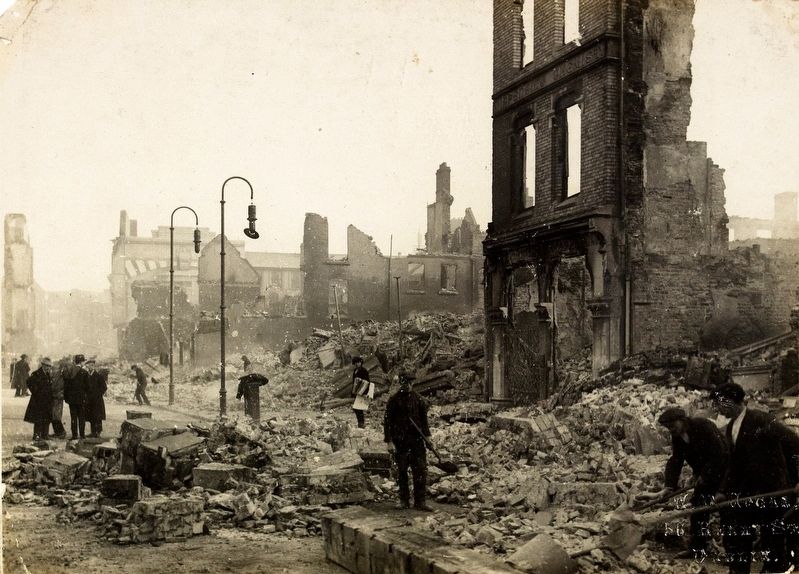
A Cork artist whose mural depicting the Burning of Cork is on display on Grattan Street has said that he wanted to “recreate one of the famous images of the ruins of Cork city after the fires”. Peter Martin who has created various works of art around the city which look at Cork’s history and identity was contacted by Chairman of the Middle Parish Community Centre George Patterson in early March.
(Submitted on June 4, 2026, by Ian Lefkowitz of New York, New York.)
In what the Cork Examiner called ‘a night of horror’, the burning of Cork on 11-12 December 1920 was the most devastating of the Crown force reprisals during the Irish War of Independence. Fifty-seven premises at the heart of the southern capital were destroyed by fire, twenty were badly damaged and twelve were wrecked and looted. Five acres of property – the
By National Library of Ireland on The Commons - The Burning of Cork, December 14, 1920
3. Workers clearing rubble on St Patrick's Street in Cork after the fires
equivalent of about three football pitches – were involved. While there was no loss of life as a result of the fires, some £2.5m worth of damage was caused and over 2,000 people lost their jobs.
(Submitted on June 4, 2026, by Ian Lefkowitz of New York, New York.)
Credits. This page was last revised on June 4, 2026. It was originally submitted on June 4, 2026, by Ian Lefkowitz of New York, New York. This page has been viewed 8 times since then. Photos:1, 2, 3. submitted on June 4, 2026, by Ian Lefkowitz of New York, New York. • Andrew Ruppenstein was the editor who published this page.