Zeeburg in Amsterdam, North Holland, Netherlands — Northwestern Europe
Het Zeeburgerdorp
| — | Geschiednis van de Indische Buurt | — |
Photographed by Andrew Ruppenstein, June 5, 2026
1. Het Zeeburgerdorp Marker

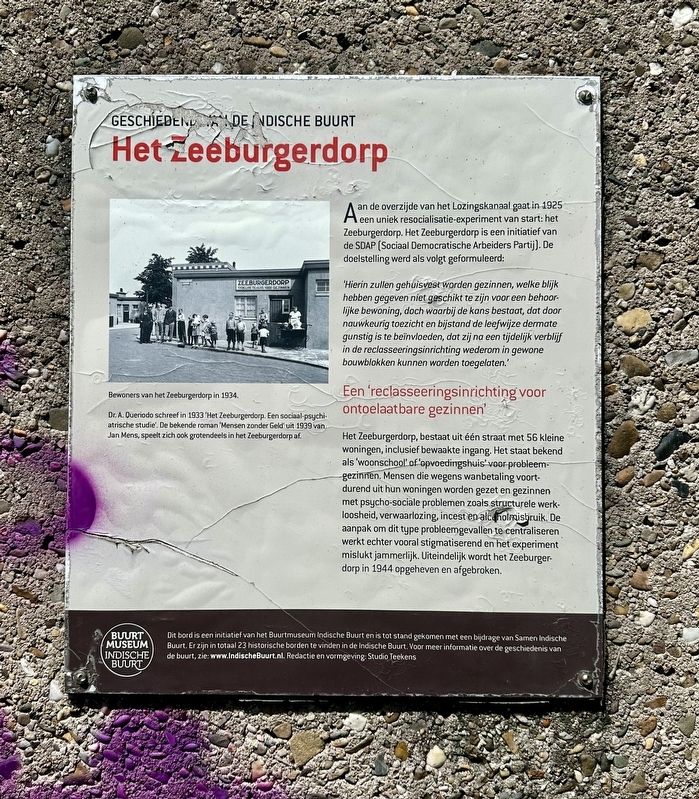
"Hierin zullen gehuisvest worden gezinnen, welke blijk hebben gegeven niet geschikt te zijn voor een behoorlijke bewoning, doch waarbij de kans bestaat, dat door nauwkeurig toezicht en bijstand de leefwijze dermate gunstig is te beïnvloeden, dat zij na een tijdelijk verblijf in de reclasseeringsinrichting wederom in gewone bouwblokken kunnen worden toegelaten.'
Een 'reclasseeringsinrichting voor ontoelaatbare gezinnen'
Het Zeeburgerdorp, bestaat uit één straat met 56 kleine woningen, inclusief bewaakte ingang. Het staat bekend als 'woonschool' of 'opvoedingshuis' voor probleemgezinnen. Mensen die wegens wanbetaling voortdurend uit hun woningen worden gezet en gezinnen met psycho-sociale problemen zoals structurele werkloosheid, verwaarlozing, incest en alcoholmisbruik. De aanpak om dit type probleemgevallen te centraliseren werkt echter vooral stigmatiserend
this page online
On the opposite side of the Lozingskanaal, a unique resocialization experiment was launched in 1925: the Zeeburgerdorp. The Zeeburgerdorp was an initiative of the SDAP (Social Democratic Workers' Party). The objective was formulated as follows:
"Families will be housed here which have shown themselves unsuitable for proper habitation, yet where there is a chance that, through close supervision and assistance, their way of life can be influenced so favorably that, after a temporary stay in the probation institution, they can be admitted to ordinary apartment blocks again."A 'probation institution for inadmissible families'
The Zeeburgerdorp consisted of a single street with 56 small houses, including a guarded entrance. It was known as a 'residential school' or 'upbringing house' for problem families: people who were constantly being evicted from their homes due to non-payment and families with psychosocial problems such as structural unemployment, neglect, incest, and alcohol abuse. However,
Photographed by Andrew Ruppenstein, June 5, 2026
2. Het Zeeburgerdorp Marker - wide view
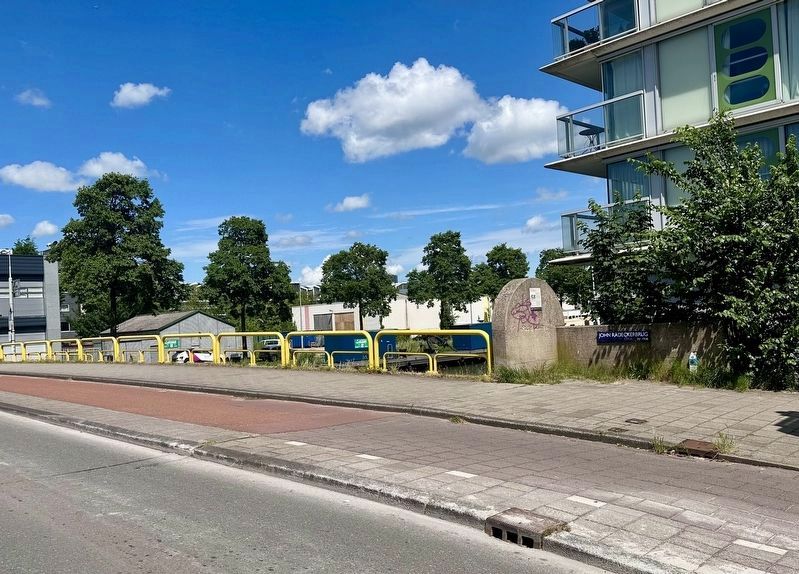
The marker is visible here on the approach to the John Radeckerbrug.
Erected by Buurt Museum Indische Buurt.
Topics. This historical marker is listed in these topic lists: Charity & Public Work • Roads & Vehicles. A significant historical year for this entry is 1925.
Location. 52° 21.989′ N, 4° 56.781′ E. Marker is in Amsterdam, Noord-Holland (North Holland). It is in Zeeburg. It is on Th. K. van Lohuizenlaan north of Zeeburgerdijk, on the right when traveling north. Touch for map. Marker is at or near this postal address: Th K van Lohuizenlaan 250, Amsterdam, Noord-Holland 1095 DW, Netherlands. Touch for directions.

Regionally, it is in Europe, the European Union, Atlantic Europe, the Benelux Low Countries, the Schengen Area, Western Europe, and the Western World. Historically, it finds itself in what was once the Holy Roman Empire.
Other nearby markers. At least 8 other markers are within walking distance of this marker: Wielerbaan Zeeburg / Zeeburg Velodrome (approx. 0.4 kilometers away); Het Badhuis / The Bathhouse (approx. 0.6 kilometers away); De 3de Ambachtsschool / The Third Vocational School (approx. 0.8 kilometers away); Archimedes (approx. 1.3 kilometers away); Laplace (approx. 1.3 kilometers away); Copernicus (approx. 1.4 kilometers away); Kepler (approx. 1.4 kilometers away); Isaac Newton (approx. 1.4 kilometers away). Touch for a list and map of all markers in Amsterdam.
Also see . . . Zeeburgerdorp (Wikipedia, in Dutch). Excerpt (in translation):
Zeeburgerdorp was a street in Amsterdam East.(Submitted on June 6, 2026.)
The village, dating from 1926, consisted of about fifty homes at the eastern end of Zeeburgerpad, overlooking the Zeeburg Pumping Station. The Municipality of Amsterdam had a village built there for dysfunctional families, a so-called residential school. These families came from (even) poorer parts of the city, where people sometimes lived in basement dwellings. Those homes and their residents were affected by dampness. Improvement was not an option; many of those small homes were in the hands of slum landlords. It was not uncommon for a large family to be involved, living in poverty, whether working or not. If the breadwinner then also became unemployed, the situation became untenable. The municipality wanted to do something about this and intended to house some of these residents in new housing developments. However, it was felt that the transition might be too abrupt, leading to even more disruption. To this end, they built Zeeburgerdorp. Families could catch their breath under the supervision of a supervisor before moving into an improved home or new housing development. Residents were accommodated under the motto “Temporary residence of families.”…
Credits. This page was last revised on June 6, 2026. It was originally submitted on June 6, 2026, by Andrew Ruppenstein of Lamorinda, California. This page has been viewed 16 times since then. Photos: 1, 2. submitted on June 6, 2026, by Andrew Ruppenstein of Lamorinda, California.
