
Monacnapa in Cork in County Cork, Munster, Ireland — Irish South-West ((Éire) North Atlantic Ocean)
Blarney Railway
Photographed by Ian Lefkowitz, May 15, 2026
1. Blarney Railway Marker
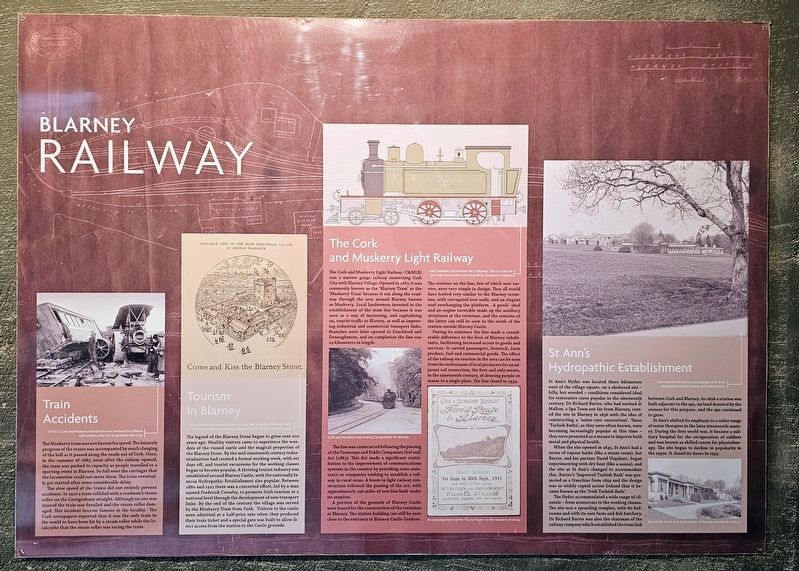
Train Accidents
In 1927 a Cork and Muskerry railway train was involved in a collision with a steam roller at Carrigrohane near Cork.
The Muskerry tram was not known for speed. The leisurely progress of the trains was accompanied by much clanging of the bell as it passed along the roads out of Cork. Once, in the summer of 1887, soon after the railway opened, the tram was packed to capacity as people travelled to a sporting event in Blarney. So full were the carriages that the locomotive could not move them. The train eventually got started after some considerable delay.
The slow speed of the trains did not entirely prevent accidents. In 1927 a train collided with a roadman’s steam roller on the Carrigrohane straight. Although no one was injured the train was derailed and the steam roller damaged. This incident became famous in the locality. The Cork newspapers reported that it was the only train in the world to have been hit by a steam roller while the locals joke that the steam roller was racing the train.
Tourism in Blarney
Such was the international fame of Blarney that a replica of Blarney castle was built for the Irish Industrial
this page online
Come and Kiss the Blarney Stone.
The legend of the Blarney Stone began to grow over 200 years ago. Wealthy visitors came to experience the wonders of the ruined castle and the magical properties of the Blarney Stone. By the mid-nineteenth century industrialization had created a formal working week, with set days off, and tourist excursions for the working classes began to become popular. A thriving tourist industry was established around Blarney Castle, with the nationally famous Hydropathic Establishment also popular. Between 1880 and 1915 there was a concerted effort, led by a man named Frederick Crossley, to promote Irish tourism at a national level through the development of new transport links. By the end of the century the village was served by the Muskerry Tram from Cork. Visitors to the castle were admitted at a half-price rate when they produced their train ticket and a special gate was built to allow direct access from the station to the Castle grounds.
The Cork and Muskerry Light Railway
Cork & Muskerry locomotive No. 9 ‘Blarney.’ This is a tank engine type locomotive and was built
Photographed by Ian Lefkowitz, May 15, 2026
2. Blarney Railway Marker
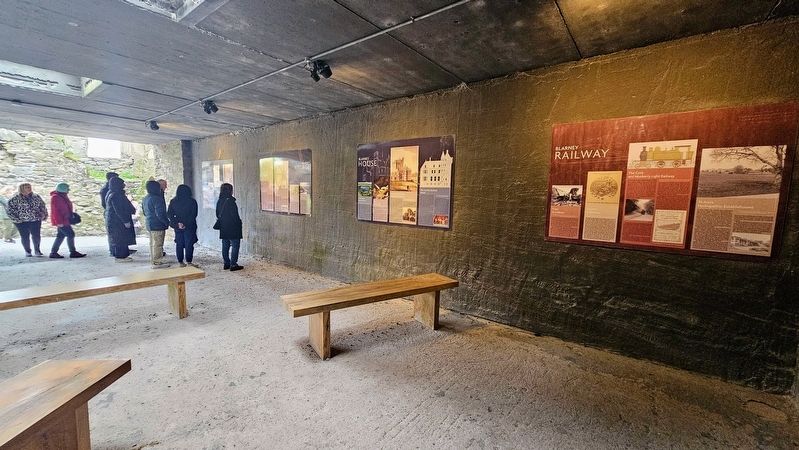
The marker is one of four located in an open-air alcove beneath Blarney Castle.
The Cork and Muskerry Light Railway (C&MLR) was a narrow gauge railway connecting Cork City with Blarney Village. Opened in 1887, it was commonly known as the ‘Blarney Tram’ or the ‘Muskerry Tram’ because it ran along the roadway through the area around Blarney known as Muskerry. Local landowners invested in the establishment of the tram line because it was seen as a way of increasing, and capitalising on, tourist traffic to Blarney, as well as improving industrial and commercial transport links. Branches were later opened to Coachford and Donoughmore, and on completion the line was 29 kilometers in length.
The line was constructed following the passing of the Tramways and Public Companies (Ireland) Act (1883). This Act made a significant contribution to the improvement of communications systems in the country by providing state assistance to companies wishing to establish a railway in rural areas. A boom in light railway construction followed the passing of the act, with approximately 296 miles of new line built under its auspices.
A portion of the grounds of Blarney Castle were leased for the construction of the terminus at Blarney. The station building can still be seen close to the entrance to Blarney Castle Gardens.
The stations on the line, few of which now survive, were very simple in design. They all would have looked very similar to the Blarney terminus, with corrugated iron walls, and an elegant roof overhanging the platform. A goods’ shed and an engine turntable made up the auxiliary structures at the terminus, and the remains of the latter can still be seen to the south of the station outside Blarney Castle.
During its existence the line made a considerable difference to the lives of Blarney inhabitants, facilitating increased access to goods and services. It carried passengers, livestock, farm produce, fuel and commercial goods. The effect of the railway on tourism in the area can be seen from the enthusiasm of local producers for an adjacent rail connection, the first and only means, in the nineteenth century, of drawing people en masse to a single place. The line closed in 1934.
Cork and Muskerry train leaving Carrigrohane for Blarney.
An advertisement for the ‘Tourist Route’ on the Muskerry Railway.
St Ann’s Hydropathic Establishment
Late nineteenth century photograph of St Ann’s Hydropathic Establishment and Turkish baths.
St Ann’s Hydro was located three kilometers west of the village square, on a sheltered site — hilly, but wooded — conditions considered ideal for restorative cures popular in the nineteenth century. Dr Richard Barter, who had worked at Mallow, a Spa Town not far from Blarney, rented the site in Blarney in 1836 with the idea of constructing a ‘water-cure sanatorium.’ These ‘Turkish Baths,’ as they were often known, were becoming increasingly popular at this time — they were promoted as a means to improve both moral and physical health.
When the site opened in 1843, St Ann’s had a series of vapour baths (a steam room), but Barter, and his partner David Urquhart, began experimenting with dry heat (like a sauna), and the site at St Ann’s changed to accommodate this. Barter’s ‘Improved Turkish Bath’ was promoted as a franchise from 1859 and the design was so widely copied across Ireland that it became known as the ‘Irish Turkish Bath.’ The Hydro accommodated a wide range of clientele — from aristocrats to the working classes. The site was a sprawling complex, with 80 bedrooms and with its own farm and fish hatchery. Dr Richard Barter was also the chairman of the railway company which established the tram link between Cork and Blarney. In 1898 a station was built adjacent to the spa, on land donated by the owners for this purpose, and the spa continued to grow.
St Ann’s shifted its emphasis to a wider range of water therapies in the later nineteenth century. During the first world war, it became a military hospital for the recuperation of soldiers and was known as a skilled centre for physiotherapy. The site began to decline in popularity in the 1930s. It closed its doors in 1953.
Part of the hotels at St Ann’s Hydro, in the late nineteenth century.
Topics. This historical marker is listed in these topic lists: Forts and Castles • Railroads & Streetcars • Science & Medicine. A significant historical year for this entry is 1887.
Location. 51° 55.743′ N, 8° 34.241′ W. Marker is in Cork, Munster, in County Cork. It is in Monacnapa. It can be reached from Blarney Castle Estate. The marker is located on the grounds of Blarney Castle & Gardens. Touch for map. Marker is at or near this postal address: Blarney Castle Estate, Cork, Munster, Ireland. Touch for directions.

Regionally, it is on the Atlantic Ocean, in the North Atlantic Region, on the Atlantic Arc, in Europe, on the Island of Ireland, on the Celtic Fringe, in the European Union, in Atlantic Europe, on one of the British Isles, in the Western World, and in the Anglosphere.
Other nearby markers. At least 8 other markers are within walking distance of this marker: Blarney House (here, next to this marker); Blarney Castle (here, next to this marker); Blarney Village (here, next to this marker); Murder Hole (here, next to this marker); Blarney Castle Timeline (here, next to this marker); The Court (here, next to this marker); Jefferyes & Colthurst Family History (here, next to this marker); Oubliette (here, next to this marker). Touch for a list and map of all markers in Cork.
Credits. This page was last revised on June 6, 2026. It was originally submitted on June 6, 2026, by Ian Lefkowitz of New York, New York. This page has been viewed 13 times since then. Photos: 1, 2. submitted on June 6, 2026, by Ian Lefkowitz of New York, New York. • Andrew Ruppenstein was the editor who published this page.
