
Monacnapa in Cork in County Cork, Munster, Ireland — Irish South-West ((Éire) North Atlantic Ocean)
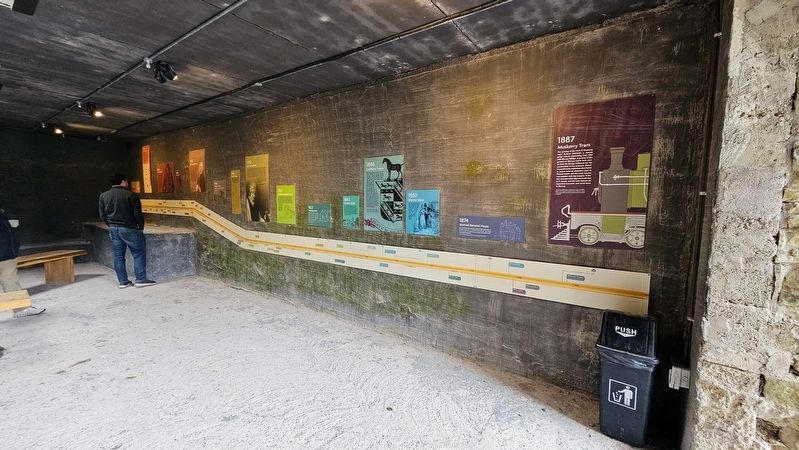
Blarney Castle Timeline
Photographed by Ian Lefkowitz, May 15, 2026
1. Blarney Castle Timeline Marker
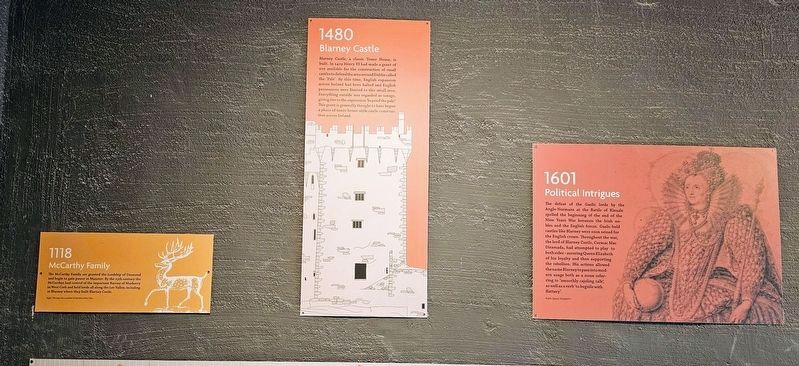
1118
McCarthy Family
The McCarthy Family are granted the Lordship of Desmond and begin to gain power in Munster. By the 15th century the McCarthys had control of the important Barony of Muskerry in West Cork and held lands all along the Lee Valley, including at Blarney where they built Blarney Castle.
Right: The stag was a symbol of the McCarthy Clan.
1480
Blarney Castle
Blarney Castle, a classic Tower House, is built. In 1429 Henry VI had made a grant of £10 available for the construction of small castles to defend the area around Dublin called the ‘Pale’. By this time, English expansion across Ireland had been halted and English possessions were limited to this small area. Everything outside was regarded as savage, giving rise to the expression ‘beyond the pale’. This grant is generally thought to have begun a phase of tower house-style castle construction across Ireland.
1601
Political Intrigues
Toabhe defeat of the Gaelic lords by the Anglo-Normans at the Battle of Kinsale spelled the beginning of the end of the Nine Years’ War between the Irish nobles and the English forces. Gaelic-held castles like Blarney were soon seized
this page online
Right: Queen Elizabeth I.
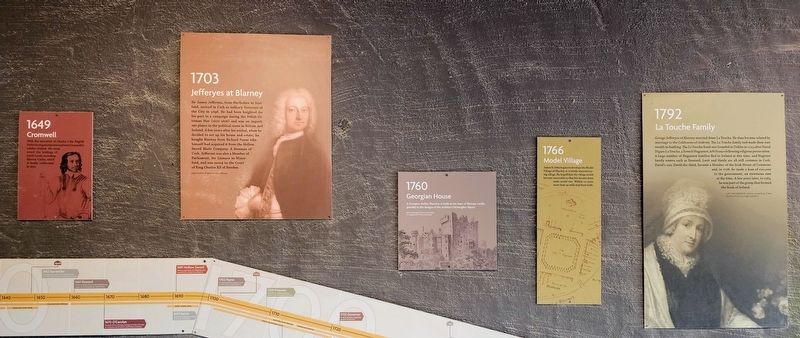
1649
Cromwell
With the execution of Charles I the English Parliament gained power and sent Cromwell to subdue Ireland. His army attack the holdings of the Irish lords, including Blarney Castle, which is finally confiscated in 1652.
1703
Jefferyes at Blarney
Sir James Jefferyes, from Perthshire in Scotland, arrived in Cork as military Governor of the City in 1698. He had been knighted for his part in a campaign during the Polish-Ottoman War (1672–1676) and was an important player in the political scene in Britain and Ireland. A few years after his arrival, when he decided to set up his home and estate, he bought Blarney from Richard Payne who himself had acquired it from the Hollow Sword Blade Company. A freeman of Cork, Jefferyes was also a Member of
Photographed by Ian Lefkowitz, May 15, 2026
2. Blarney Castle Timeline, 1118-1601
Right: Portrait of James St. John Jeffereyes.
1760
Georgian House
A Georgian Gothic Mansion is built at the base of Blarney Castle, possibly to the designs of the architect Christopher Myers.
1766
Model Village
James St. John began to develop the Model Village of Blarney as a textile manufacturing village. He hoped that the village would become successful so that his income from rents would rise. Within 10 years more than 30 mills had been built.
1792
La Touche Family
George Jefferyes of Blarney married Anne La Touche. He thus became related by marriage to the Colthursts of Ardrum. The La Touche family had made their vast wealth in banking. The Le Touche Bank was founded in Dublin in 1713 after David Digues La Touche, a French Huguenot, left France following religious persecution. A large number of Huguenot families fled to Ireland at this time, and Huguenot family names such as Bestard, Lavit and Hardy are all still common in Cork. David’s son, David the third, became a Member of the Irish House of Commons and, in 1798, he made a loan of £20,000 to
Photographed by Ian Lefkowitz, May 15, 2026
3. Blarney Castle Timeline, 1649-1792
Left: Late eighteenth century oil painting of Mrs. David LaTouche by Hugh Hamilton.
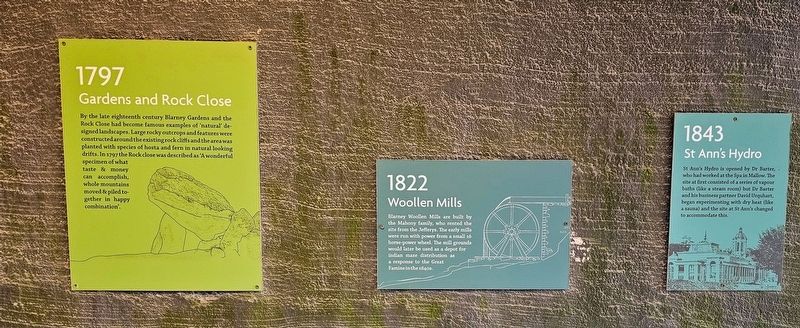
1797
Gardens and Rock Close
By the late eighteenth century Blarney Gardens and the Rock Close had become famous examples of ‘natural’ designed landscapes. Large rocky outcrops and features were constructed around the existing rock cliffs and the area was planted with species of hosta and fern in natural looking drifts. In 1797 the Rock Close was described as “A wonderful specimen of what taste & money can accomplish, whole mountains moved & piled together in happy combination.”
1822
Woollen Mills
Blarney Woollen Mills are built by the Mahony family, who rented the site from the Jefferys. The early mills were run with power from a small 16 horse-power wheel. The mill grounds would later be used as a depot for indian maize distribution as a response to the Great Famine in the 1840s.
1843
St Ann’s Hydro
St Ann’s Hydro is opened by Dr Barter, who had worked at the Spa in Mallow. The site at first consisted of a series of vapour baths
Photographed by Ian Lefkowitz, May 15, 2026
4. Blarney Castle Timeline, 1797-1843
1846
Colthurst Family
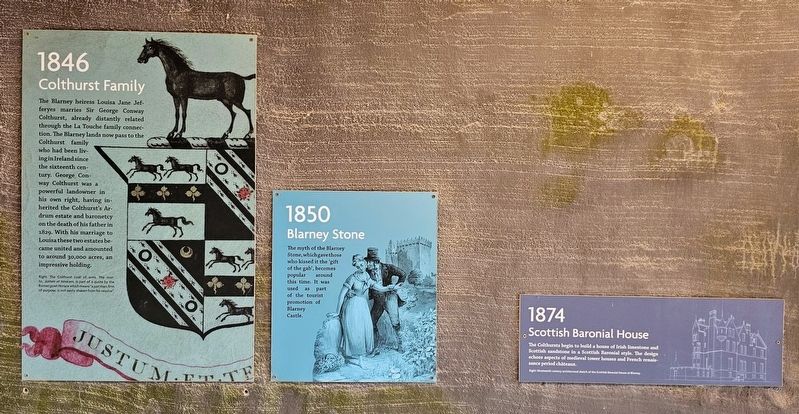
The Blarney heiress Louisa Jane Jefferyes marries Sir George Conway Colthurst, already distantly related through the La Touche family connection. The Blarney lands now pass to the Colthurst family who had been living in Ireland since the sixteenth century. George Conway Colthurst was a powerful landowner in his own right, having inherited the Colthurst’s Ardrum estate and baronetcy on the death of his father in 1829. With his marriage to Louisa these two estates became united and amounted to around 30,000 acres, an impressive holding.
Right: The Colthurst coat of arms. The motto, Justum et Tenacem, is part of a quote by the Roman poet Horace which means “a just man, firm of purpose, is not easily shaken from his resolve.”
1850
Blarney Stone
The myth of the Blarney Stone, which gave those who kissed it the ‘gift of the gab’, becomes popular around this time. It was used as part of the tourist promotion of Blarney Castle.
1874
Scottish Baronial
Photographed by Ian Lefkowitz, May 15, 2026
5. Blarney Castle Timeline, 1846-1874
The Colthursts begin to build a house of Irish limestone and Scottish sandstone in a Scottish Baronial style. The design echoes aspects of medieval tower houses and French renaissance period châteaux.
Right: Nineteenth century architectural sketch of the Scottish Baronial House at Blarney.
1887
Muskerry Tram
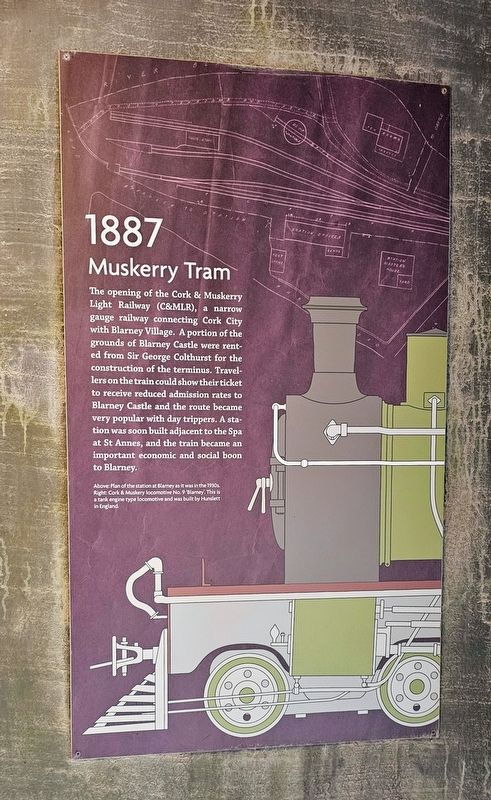
The opening of the Cork & Muskerry Light Railway (C&MLR), a narrow gauge railway connecting Cork City with Blarney Village. A portion of the grounds of Blarney Castle were rented from Sir George Colthurst for the construction of the terminus. Travellers on the train could show their ticket to receive reduced admission rates to Blarney Castle and the route became very popular with day trippers. A station was soon built adjacent to the Spa at St Annes, and the train became an important economic and social boon to Blarney.
Above: Plan of the station at Blarney as it was in the 1930s. Right: Cork & Muskerry locomotive No. 9 ‘Blarney’. This is a tank engine type locomotive and was built by Hunslett in England.
Topics. This historical marker is listed in these topic lists: Forts and Castles • Industry & Commerce •
Photographed by Ian Lefkowitz, May 15, 2026
6. Blarney Castle Timeline, 1887
Location. 51° 55.743′ N, 8° 34.241′ W. Marker is in Cork, Munster, in County Cork. It is in Monacnapa. It can be reached from Blarney Castle Estate. The marker is located on the grounds of Blarney Castle & Gardens. Touch for map. Marker is at or near this postal address: Blarney Castle Estate, Cork, Munster, Ireland. Touch for directions.

Regionally, it is on the Atlantic Ocean, in the North Atlantic Region, on the Atlantic Arc, in Europe, on the Island of Ireland, on the Celtic Fringe, in the European Union, in Atlantic Europe, on one of the British Isles, in the Western World, and in the Anglosphere.
Other nearby markers. At least 8 other markers are within walking distance of this marker: Blarney House (here, next to this marker); Blarney Railway (here, next to this marker); Blarney Castle (here, next to this marker); Blarney Village (here, next to this marker); Murder Hole (here, next to this marker); The Court (here, next to this marker); Jefferyes & Colthurst Family History (here, next to this marker); Oubliette (here, next to this marker). Touch for a list and map of all markers in Cork.
Credits. This page was last revised on June 9, 2026. It was originally submitted on June 6, 2026, by Ian Lefkowitz of New York, New York. This page has been viewed 24 times since then. Photos: 1, 2, 3, 4, 5, 6. submitted on June 6, 2026, by Ian Lefkowitz of New York, New York. • Andrew Ruppenstein was the editor who published this page.
