
Lawrence Township near Princeton in Mercer County, New Jersey — The American Northeast (Mid-Atlantic)
Slavery in Maidenhead: Two Paths to Freedom
| — | Lawrence Hopewell Trail | — |
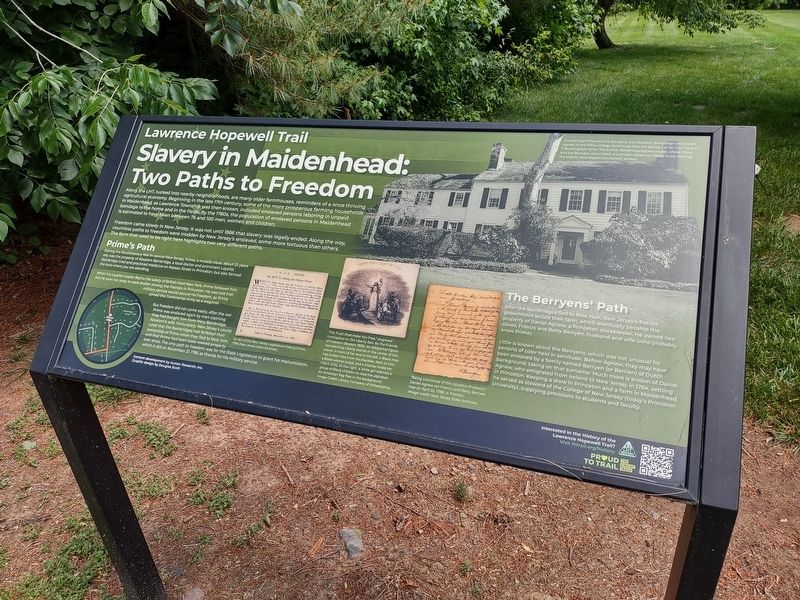
Photographed by Richard Peterson, June 7, 2026
1. Slavery in Maidenhead: Two Paths to Freedom Marker
Along the LHT, tucked into nearby neighborhoods, are many older farmhouses, reminders of a once thriving agricultural economy. Beginning in the late 17th century, some of the more prosperous farming households in Maidenhead, as Lawrence Township was then known, included enslaved persons laboring in unpaid bondage in the home and in the fields. By the 1780s, the population of enslaved persons in Maidenhead is estimated to have been between 75 and 100 men, women and children.
Freedom came slowly in New Jersey. It was not until 1866 that slavery was legally ended. Along the way, countless paths to freedom were trodden by New Jersey’s enslaved, some more tortuous than others. The farm that used to be right here highlights two very different paths.
Prime’s Path
During the Revolutionary War in central New Jersey, Prime, a mulatto slave, about 22 years old, was the property of Absalom Bainbridge, a local doctor and prominent Loyalist. Bainbridge lived and practiced medicine on Nassau Street in Princeton, but also farmed the land where you are standing.
When his Loyalist master fled to the safety of British-held New York,
this page online
But freedom did not come easily. After the war Prime was enslaved again by men claiming they had bought him from Mary Bainbridge, Absalom’s wife. Fortunately, New Jersey’s courts ruled that the Bainbridges had forfeited their ownership of Prime when they fled to New York, and that Prime had been state-owned property ever since. The only path to freedom was for the State Legislature to grant his manumission, which it did on November 21, 1786 as thanks for his military service.
The Berryens’ Path
After the Bainbridges fled to New York, New Jersey's Patriot government seized their farm, which eventually became the property of Daniel Agnew, a Princeton storekeeper. He owned two slaves, Francis and Betty Berryen, husband and wife (who probably knew Prime).
Little is known about the Berryens, which was not unusual for persons of color held in servitude. Before Agnew, they may have been enslaved by a family named Berryen (or Berrien)
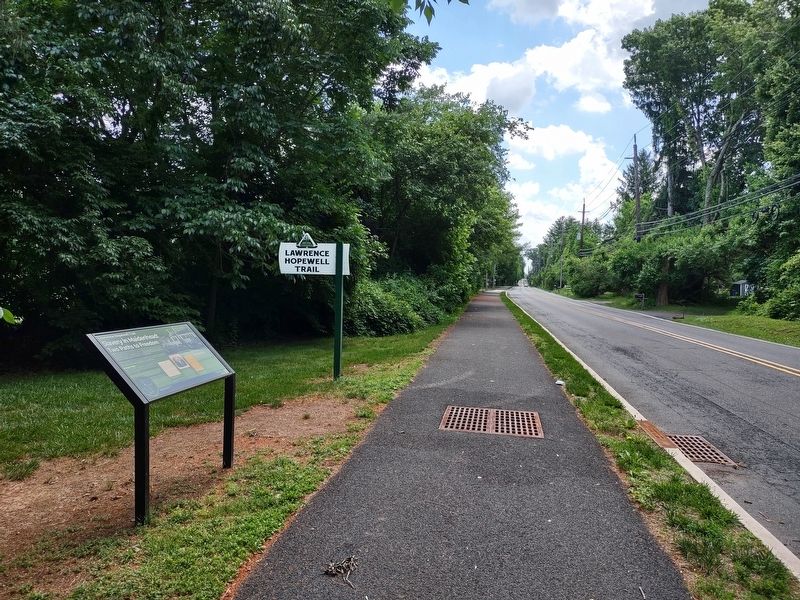
Photographed by Richard Peterson, June 7, 2026
2. Slavery in Maidenhead Marker along Province Line Road
[Captions]
Connecting Prime and the Berryens, and Absalom Bainbridge and Daniel Agnew, is the 1760s-vintage farmhouse that still stands not far from here at 11 Buckingham Drive. The former Bainbridge/Agnew house, where Prime and the Berryens once toiled, is a private residence. Please enjoy viewing the exterior and respect the owners' privacy.
An Act of the New Jersey Legislature freeing Prime, 1786 (New Jersey State Archives).
“The Truth Shall Make You Free,” engraved frontispiece to The Liberty Bell. By the Friends of Freedom (Boston, 1839). An allegorical figure representing Liberty stands in the center of the scene. In front of her and to the left, a Black man has broken free from his shackles. Next to him, a Black woman prays, and a mother holds her infant child. At the right, a white girl teaches a group of Black children to read the alphabet. An American flag flies in the background. Image Credit: Library Company of Philadelphia.
“Being convinced of the injustice of slavery,” Daniel Agnew set Francis and Betty Berryen free on April 22, 1788, in Trenton. Image credit: New Jersey State Archives.
Content development by Hunter Research, Inc. Graphic design by Douglas Scott
Interested in the History of the Lawrence Hopewell Trail? Visit lhtrail.org/history
Erected by The Lawrence Hopewell Trail.
Topics. This historical marker is listed in these topic lists: Abolition & Underground RR • African Americans • War, US Revolutionary. A significant historical date for this entry is November 21, 1786.
Location. 40° 18.956′ N, 74° 41.834′ W. Marker is near Princeton, New Jersey, in Mercer County. It is in Lawrence Township. It is on Province Line Road 0.1 miles north of Buckingham Drive South, on the right when traveling north. Touch for map. Marker is at or near this postal address: 4414 Province Line Rd, Princeton NJ 08540, United States of America. Touch for directions.

Regionally, this marker is in New Jersey’s Central Jersey. It is also in the American Northeast and in the Mid-Atlantic. Globally, it is in North America, the Western Hemisphere, the Western World, and the Anglosphere. Historically, it finds itself in what was once New Netherland and also one of the original Thirteen Colonies.
Other nearby markers. At least 8 other markers are within 2 miles of this marker, measured as the crow flies: From Indian Path to Asphalt Highway (approx. 0.4 miles away); Route of Washington’s March (approx. one mile away); a different marker also named Route of Washington’s March (approx. 1.1 miles away); a different marker also named Route of Washington’s March (approx. 1.2 miles away); Richard Stockton (approx. 1.3 miles away); Stony Brook Meeting House (approx. 1.3 miles away); Welcome to the Institute Lands (approx. 1.4 miles away); The Stony Brook Quakers and the Battle of Princeton (approx. 1½ miles away). Touch for a list and map of all markers in Princeton.
Another marker is no longer nearby. The British Occupation of New Jersey (was approx. 1½ miles away but has been permanently removed).
Also see . . . History along the LHT. An annotated list of historical markers currently installed along the Lawrence Hopewell Trail. (Submitted on June 7, 2026, by Richard Peterson of East Windsor, New Jersey.)
Credits. This page was last revised on July 14, 2026. It was originally submitted on June 7, 2026, by Richard Peterson of East Windsor, New Jersey. This page has been viewed 16 times since then. Last updated on July 13, 2026, by Richard Peterson of East Windsor, New Jersey. Photos: 1, 2. submitted on June 7, 2026, by Richard Peterson of East Windsor, New Jersey. • Devry Becker Jones was the editor who published this page.
