Near Cape Charles in Northampton County, Virginia — The American South (Mid-Atlantic)
Archaeology

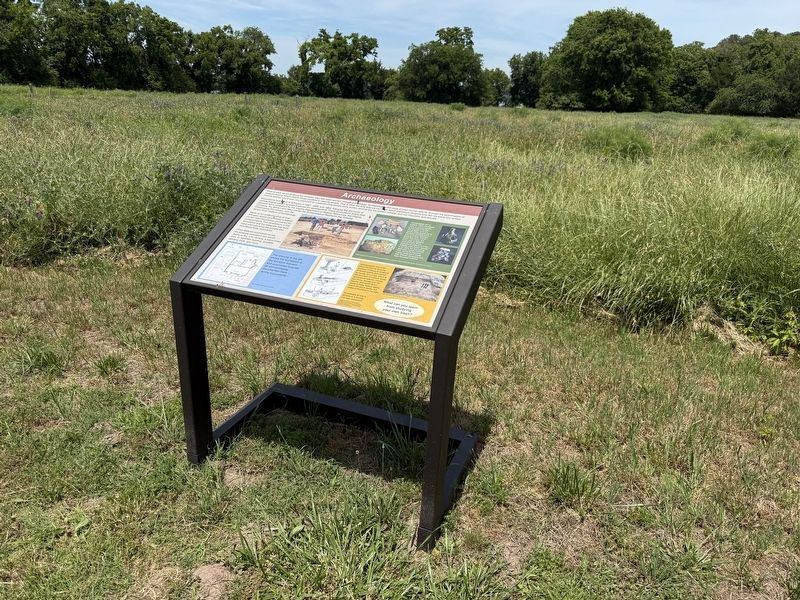
Most of what we know about the Arlington Site has been learned through archaeology. Archaeology is the study of past human activity through the examination of material culture, which means things modified or used by people. This is often the only way we can learn about prehistoric peoples who did not leave any written records behind, and it is also very important for understanding history since written records are not always reliable, and not everyone was literate.
Excavations took place at Arlington in 1987, 1988, and 1994, following the discovery of archaeological sites in an area proposed for development. These excavations and further research were conducted by the Virginia Department of Historic Resources, the Virginia Company, the William and Mary Center for Archaeological Research, the Colonial Williamsburg Foundation, and the James River Institute for Archaeology.
Much of our understanding of how Arlington would have looked is based on the intact foundation uncovered by archaeologists. The dimensions of the foundation and the materials that were used informed what the second and third floors likely resembled.
Other
this page online
[Sidebars:]
Archaeologists rely on artifacts, which are objects made or used by people, to learn about the past. The artifacts found are usually things people lost or discarded including items such as broken ceramics, glassware, nails, animal bones from meals, and items used for personal ornamentation. Some examples of artifacts from the Arlington site (shown starting in the upper left and moving clockwise) include ceramics, shell, glass fragment; a glass bottle with a Custis Seal, Rhenish stoneware, and finely-decorated masonry.
The drawing to the left shows the foundation of the Arlington mansion and associated features as archaeologists documented them during excavations.
Archaeologists also learn about the past by studying features. A feature is evidence of human activity that cannot be moved from a site, which is different from an artifact. Some examples of features include post holes, storage pits, fire hearths, and house floors. Some of these features stains, where the soil is darker, are visible in the photo to the right.
An example of how a pit feature is formed and later excavated.
What can you learn from studying your own trash?
Erected by The
Topics and series. This historical marker is listed in this topic list: Anthropology & Archaeology. In addition, it is included in the Virginia Department of Historic Resources (DHR) series list. A significant historical year for this entry is 1987.
Location. 37° 13.716′ N, 76° 0.183′ W. Marker is near Cape Charles, Virginia, in Northampton County. It is on Arlington Chase Road (County Road 644) north of Arlington Chase Lane, on the right when traveling north. Touch for map. Marker is at or near this postal address: 2157 Arlington Chase Road, Cape Charles VA 23310, United States of America. Touch for directions.

Regionally, this marker is on the Eastern Shore. It is also in the American South, specifically in the Upper South, on the Delmarva Peninsula, in the Tidewater, and on the Eastern Seaboard. Globally, it is in the North Atlantic Region, North America, the Western Hemisphere, the Western World, and the Anglosphere. Historically, it finds itself in what was
Photographed by Devry Becker Jones (CC0), June 5, 2026
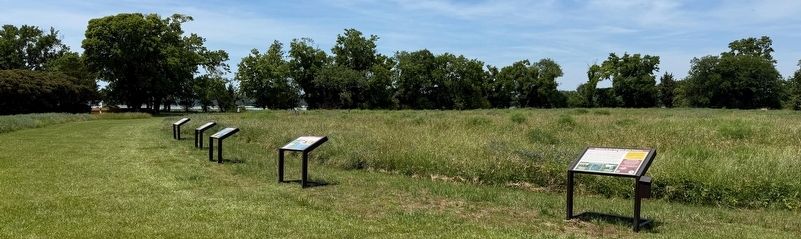
3. Several markers on display at Arlington Sites Preserve
Other nearby markers. At least 8 other markers are within 3 miles of this marker, measured as the crow flies: African Presence (here, next to this marker); European Settlement (a few steps from this marker); American Indians (a few steps from this marker); Welcome to the Arlington Sites Preserve (a few steps from this marker); The Custis Tombs (within shouting distance of this marker); Elijah Baker (approx. 2.1 miles away); a different marker also named Elijah Baker (approx. 2.1 miles away); Cape Charles Colored School (approx. 2.4 miles away). Touch for a list and map of all markers in Cape Charles.
Other markers no longer nearby. Mansion Site (was within shouting distance of this marker but has been replaced with another marker now near it); Bacon's Rebellion (was within shouting distance of this marker but has been replaced with another marker now near it); Indians (was within shouting distance of this marker but has been replaced with another marker now near it); Slavery on the Eastern Shore (was within shouting distance of this marker but has been replaced with another marker now near it); Arlington (was approx. 1.2 miles away but has been confirmed missing).
Credits. This page was last revised on June 7, 2026. It was originally submitted on June 7, 2026, by Devry Becker Jones of Washington, District of Columbia. This page has been viewed 11 times since then. Photos: 1, 2, 3. submitted on June 7, 2026, by Devry Becker Jones of Washington, District of Columbia.
