District de Hull in Gatineau in Outaouais, Québec — Central Canada (French-Canadian)
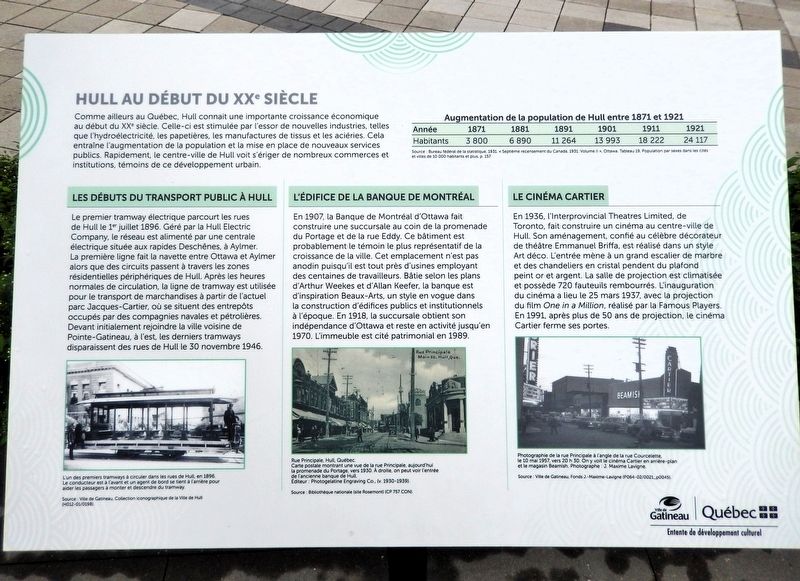
Hull au début du XXe siècle
Photographed by Cosmos Mariner, May 27, 2024
1. Hull au début du XXe siècle Marker

Les débuts du transport public à Hull
Le premier tramway électrique parcourt les rues de Hull le 1er juillet 1896. Géré par la Hull Electric Company, le réseau est alimenté par une centrale électrique située aux rapides Deschênes, à Aylmer. La première ligne fait la navette entre Ottawa et Aylmer alors que des circuits passent à travers les zones résidentielles périphériques de Hull. Après les heures normales de circulation, la ligne de tramway est utilisée pour le transport de marchandises à partir de l'actuel parc Jacques-Cartier, où se situent des entrepôts occupés par des compagnies navales et pétrolières. Devant initialement rejoindre la ville voisine
this page online
L’édifice de la banque de Montréal
En 1907, la Banque de Montréal d'Ottawa fait construire une succursale au coin de la promenade du Portage et de la rue Eddy. Ce bâtiment est probablement le témoin le plus représentatif de la croissance de la ville. Cet emplacement n'est pas anodin puisqu'il est tout près d'usines employant des centaines de travailleurs. Bâtie selon les plans d'Arthur Weekes et d'Allan Keefer, la banque est d'inspiration Beaux-Arts, un style en vogue dans la construction d'édifices publics et institutionnels à l'époque. En 1918, la succursale obtient son indépendance d'Ottawa et reste en activité jusqu'en 1970. L'immeuble est cité patrimonial en 1989.
Le cinéma Cartier
En 1936, l'Interprovincial Theatres Limited, de Toronto, fait construire un cinéma au centre-ville de Hull. Son aménagement, confié au célèbre décorateur de théâtre Emmanuel Briffa, est réalisé dans un style Art déco. L'entrée mène à un grand escalier de marbre et des chandeliers en cristal pendent du plafond peint or et argent. La salle de projection

Ville de Gatineau, Collection iconographique de la Ville de Hull
2. Marker detail: L'un des premiers tramways à circuler dans les rues de Hull, en 1896.
Le conducteur est à l'avant et un agent de bord se tient à l'arrière pour aider tes passagers à monter et descendre du tramway. • • • One of the first trams to run in the streets of Hull, in 1896. The driver is at the front and a conductor stands at the back to help passengers get on and off the tram.
Hull at the Beginning of the 20th Century
As elsewhere in Quebec, Hull experienced significant economic growth at the beginning of the 20th century. This was driven by the rise of new industries, such as hydroelectricity, paper mills, textile manufacturing, and steelworks. This led to an increase in population and the establishment of new public services. Quickly, downtown Hull saw the construction of numerous businesses and institutions, witnesses to this urban development.
The Beginnings of Public Transport in Hull
The first electric tram ran through the streets of Hull on July 1, 1896. Managed by the Hull Electric Company, the network was powered by a power plant located at the Deschênes Rapids in Aylmer. The first line shuttled between Ottawa and Aylmer while routes passed through Hull's suburban residential areas. After normal hours of operation, the tram

Courtesy Photogelatine Engraving Co., Bibliothèque nationale (site Rosemont)
3. Marker detail: Rue Principale, Hull, Québec, vers 1930.
Carte postale montrant une vue de la rue Principale, aujourd'hui la promenade du Portage, vers 1930. À droite, on peut voir l'entrée de l'ancienne banque de Hull. • • • Main Street, Hull, Quebec. Postcard showing a view of Main Street, today Portage Promenade, around 1930. On the right, you can see the entrance of the former Hull bank.
The Montreal Bank Building
In 1907, the Bank of Montreal in Ottawa built a branch at the corner of Portage Avenue and Eddy Street. This building is probably the most representative witness of the city's growth. Its location is not accidental, as it is very close to factories employing hundreds of workers. Built according to the plans of Arthur Weekes and Allan Keefer, the bank is inspired by Beaux-Arts, a style popular in the construction of public and institutional buildings at the time. In 1918, the branch gained independence from Ottawa and remained in operation until 1970. The building was designated a heritage property in 1989.
The Cartier Cinema
In 1936, Interprovincial Theatres Limited, from Toronto, built a cinema in downtown Hull. Its design, entrusted to the famous theater decorator Emmanuel Briffa, was created in an Art Deco style. The entrance

Courtesy Ville de Gatineau, Fonds J.-Maxime-Lavigne
4. Marker detail: Rue Principale à l'angle de ta rue Courcelette, le 10 mai 1957.
On y voit le cinéma Cartier en arrière-plan et te magasin Beamish. • • • Main Street at the corner of Courcelette Street, May 10, 1957. In the background, you can see the Cartier cinema and the Beamish store.
Erected by Ville de Gatineau, Québec, Entente de développement culturel.
Topics. This historical marker is listed in these topic lists: Architecture • Arts, Letters, Music • Industry & Commerce • Roads & Vehicles.
Location. 45° 25.525′ N, 75° 43′ W. Marker is in Gatineau, Québec, in Outaouais. It is in District de Hull. It is at the intersection of Rue Laval and Promenade du Portage, on the left when traveling north on Rue Laval. The marker is in the triangular plaza bordered by Promenade du Portage and Rue Laval. Touch for map. Marker is in this post office area: Gatineau QC J8X 2K1, Canada. Touch for directions.

Regionally, this marker is in the Ottawa Metropolitan Area

Photographed by Cosmos Mariner, May 27, 2024
5. Hull au début du XXe siècle Marker
Looking east across Rue Laval.
Other nearby markers. At least 8 other markers are within walking distance of this marker: Bienvenue à Wrightstown (about 150 meters away, measured in a direct line); Maison Aubry (about 150 meters away); Le métier et les combats des allumettières (about 150 meters away); Une enclave du passé au cœur de la ville (about 180 meters away); Ce bâtiment est un haut lieu du syndicalisme Québécois (about 180 meters away); Une histoire marquée par les flammes (about 180 meters away); Les débuts modestes de l'usine E. B. Eddy (about 210 meters away); Hull, une ville ouvrière dans l'âme (approx. 0.2 kilometers away). Touch for a list and map of all markers in Gatineau.

/
6. Marker detail: Augmentation de la population de Hull entre 1871 et 1921.
Increase in the population of Hull between 1871 and 1921.
Credits. This page was last revised on June 15, 2026. It was originally submitted on June 8, 2026, by Cosmos Mariner of Cape Canaveral, Florida. This page has been viewed 24 times since then. Photos: 1, 2, 3, 4, 5, 6. submitted on June 9, 2026, by Cosmos Mariner of Cape Canaveral, Florida.
