District de Hull in Gatineau in Outaouais, Québec — Central Canada (French-Canadian)
Le ruisseau de la Brasserie

Photographed by Cosmos Mariner, May 27, 2024
1. Le ruisseau de la Brasserie Marker

Le ruisseau a été baptisé en l'honneur de la brasserie de Philemon Wright construite sur ses rives au début du XIXe siècle. Pendant plus d'un siècle et demi, c'est un si d'une grande importance pour l'Outaouais. Plusieurs industries s'y installent et profitent de son potentiel hydraulique. On retrouve les entreprises de bois d'E. B. Eddy, Gilmour et Hughson, la cimenterie C. B. Wright, le fabricant de haches Washburn and Walters, l'Imperial Furniture, la S. E. Woods Sportswear, l'Ottawa Mica, la Hanson Hosiery Mills, la salaison Canada Packers, la Hull Electric et la compagnie Hull Match.
Le Théâtre de l'Île
En 1886, Hull construit sa première station municipale de pompage le long du ruisseau de La Brasserie. En 1902, un nouvel édifice de pierre le remplace. Il est équipé de pompes plus performantes et d'une turbine capable de produire de l'électricité. Dans les années 1970, l'ancien immeuble est transformé en théâtre municipal. Situé sur un site exceptionnel entouré d'eau et de verdure, le Théâtre de l'Île est un joyau unique du patrimoine bâti de
this page online
Le Château d'eau
Le site du Château d'eau fut d'abord occupé par une brasserie. L'usine Washburn œuf Walters Axe Co. s'y installe vers 1860 pour fabriquer des haches d'acier reconnues internationalement. Ces outils s'avèrent indispensables pour les bûcherons dans les chantiers. En 1902, la Ville achète la propriété pour construire un édifice en pierres produisant de l'eau potable et de l'électricité afin d'éclairer les rues. Le Château d'eau cesse ses opérations en 1971. Un écomusée a occupé les lieux entre 1996 et 2004. Le bâtiment abrite aujourd'hui la brasserie artisanale Les Brasseurs du Temps ainsi qu'un musée du patrimoine brassicole.
La Filature
En 1878, John D. Hanson fonde la Hanson's Woollen Mill pour transformer la laine en fils, en vêtements et en filtres spéciaux pour égoutter la pulpe. En 1951, H. F. Kenny achète l'entreprise qui se spécialise dans le tricot de bas. Le chiffre d'affaires et le nombre d'employés de cette manufacture en font la deuxième entreprise en importance de Hull, après l'E. B. Eddy. La Hanson Hosiery Mills, puis la Hanson-Mohawk, connaissent le succès grâce à l'ajout de nylon dans la fabrication

Photographed by Cosmos Mariner, May 27, 2024
2. Le ruisseau de la Brasserie Marker
Looking west from the Théâtre de l'Île parking lot across le ruisseau de la Brasserie (the Brewery Creek).
Le village d'Argentine, rues Hanson, Wright et Taylor
Ce paisible secteur résidentiel surnommé le « village d'Argentine » demeure le seul ensemble architectural du XIXe siècle épargné par le grand feu de 1900. On y retrouve plusieurs belles résidences bourgeoises, entourées de grands arbres, construites entre 1871 et 1915 par de riches familles industrielles de la ville. En 1991, le secteur devient le premier quartier patrimonial cité par l'ancienne Ville de Hull.
[légendes]
• Le Théâtre de l'île, 1, rue Wellington
• Le Château d'eau, 170, rue Montcalm
• La Hanson Mills, 82, rue Hanson
• Le Village d'Argentine
Brewery Creek
Brewery Creek, a witness to a rich industrial past
The creek was named in honor of Philemon Wright's brewery built on its banks at the beginning of the 19th century. For more than a century and a half, it has been a site of great

Photographed by Cosmos Mariner, May 27, 2024
3. Brewery Creek (looking north from the marker)
Island Theatre
In 1886, Hull built its first municipal pumping station along Brasserie Creek. In 1902, a new stone building replaced it. It was equipped with more efficient pumps and a turbine capable of generating electricity. In the 1970s, the old building was turned into a municipal theater. Located on an exceptional site surrounded by water and greenery, the Théâtre de l'Île is a unique gem of Gatineau's built heritage.
The Water Tower
The site of the Water Tower was first occupied by a brewery. The Washburn and Walters Axe Co. factory moved in around 1860 to make steel axes that were internationally recognized. These tools proved essential for lumberjacks on the job sites. In 1902, the city bought the property to build a stone

Photographed by Cosmos Mariner, May 27, 2024
4. Brewery Creek (looking south from the marker)
Island Theatre (Théâtre de l'Île) is in the middle of the creek.
The Spinning Mill
In 1878, John D. Hanson founded Hanson's Woollen Mill to turn wool into yarn, clothing, and special filters for draining pulp. In 1951, H. F. Kenny bought the company, which specialized in knitting socks. The revenue and number of employees made this factory the second-largest business in Hull, after E. B. Eddy. Hanson Hosiery Mills, later Hanson-Mohawk, became successful by adding nylon to wool sock production, which extended their lifespan and prevented shrinking. In 1975, the company moved to Fournier Boulevard but closed shortly after. In 2001, the old mill was renovated to host artists' workshops. The center is called La Filature.
The Argentine Village, Hanson, Wright and Taylor Streets
This peaceful residential area, nicknamed the "Argentine Village," remains the only 19th-century architectural ensemble spared by the great fire of
Photographed by Cosmos Mariner, May 27, 2024
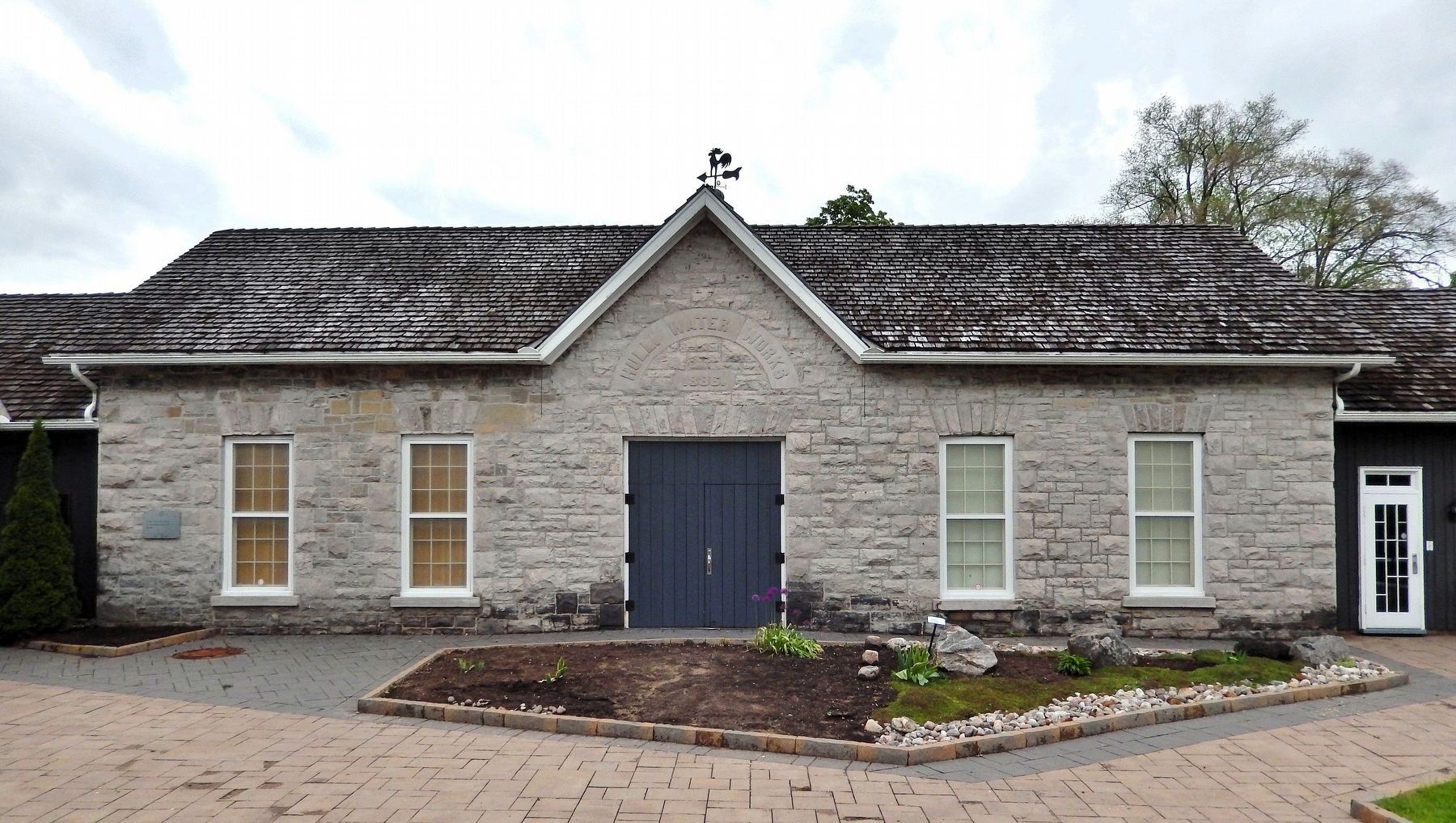
5. Island Theatre / Théâtre de l'Île
Formerly Hull Water Works (1886).
[captions]
• The Island Theatre, 1 Wellington Street
• The Water Tower, 170 Montcalm Street
• Hanson Mills, 82 Hanson Street
• The Argentine Village
Erected by Ville de Gatineau.
Topics. This historical marker is listed in these topic lists: Architecture • Industry & Commerce • Waterways & Vessels.
Location. 45° 25.558′ N, 75° 43.474′ W. Marker is in Gatineau, Québec, in Outaouais. It is in District de Hull. It can be reached from the intersection of Rue Montcalm and Rue Wellington, on the left when traveling north. The marker overlooks Brewery Creek from the west side of the Théâtre de l'Île parking lot. Touch for map. Marker is at or near this postal address: 1 Rue Wellington, Gatineau QC J8X 2L3, Canada. Touch for directions.

Regionally, this marker is in the Ottawa Metropolitan Area and in the Outaouais & Eastern Townships. It is also in Central Canada. Globally, it is in North America, the Great North Woods, the Western Hemisphere, and the Western World. Historically, it finds itself in what was once a British colony, the Viceroyalty of New France, the Haudenosaunee (Iroquois) Confederacy, and Rupert’s Land.
Other nearby markers. At least 8 other markers are within walking distance of this marker: Le village d'Argentine, dernier témoin d'une époque (within shouting distance of this marker); Place de la Francophonie (within shouting distance of this marker); La Rue Hanson : témoin d'une famille d'industriels (about 150 meters away, measured in a direct line); La Maison Wright-Scott : Un environnement pittoresque au cœur de la ville (about 150 meters away); Philemon Wright (approx. 0.2 kilometers away); L'édifice Jules-Léger / The Jules Léger Building (approx. 0.4 kilometers away); Les débuts modestes de l'usine E. B. Eddy (approx. 0.4 kilometers away); Le métier et les combats des allumettières (approx. half a kilometer away). Touch for a list and map of all markers in Gatineau.
Also see . . . Ruisseau de la Brasserie (Wikipedia).
Excerpt: A small creek that forms the northern and western shores of Île Hull. It circles the downtown of the Hull sector, of Gatineau, Quebec. In the 1980s the area was refurbished by the National Capital Commission. The former water works on a small island in the creek became the Théâtre de l'Île and the Montcalm Street Bridge was replaced by the ornate Tour Eiffel Bridge.(Submitted on June 12, 2026, by Cosmos Mariner of Cape Canaveral, Florida.)Not long after Wright's Town, Lower Canada was founded by Philemon Wright in 1800, a large brewery was built and began operations in 1813 on the banks of this creek. The Brewery was the second major brewery in Lower Canada, the first having been built by John Molson in Montreal — Molson was a friend and associate and Philemon was the first to have sold hops to John Molson in 1796. In 1822, the Wright Brewery became a rum distillery as well. By 1828, 2 distilleries and 1 Brewery were operating in the Township of Hull.
The creek has had more than one name in its history, being called Brewery Creek, Brigham Creek and Ruisseau de la Brasserie.
Credits. This page was last revised on June 15, 2026. It was originally submitted on June 8, 2026, by Cosmos Mariner of Cape Canaveral, Florida. This page has been viewed 24 times since then. Photos: 1, 2. submitted on June 11, 2026, by Cosmos Mariner of Cape Canaveral, Florida. 3, 4, 5. submitted on June 12, 2026, by Cosmos Mariner of Cape Canaveral, Florida.
