
District de Hull in Gatineau in Outaouais, Québec — Central Canada (French-Canadian)
La Rue Hanson : témoin d'une famille d'industriels

Photographed by Cosmos Mariner, May 27, 2024
1. La Rue Hanson : témoin d'une famille d'industriels Marker

Né en 1872, George E. Hanson est le fils de John D. Hanson, un cardeur de laine qui possède une manufacture sur la rue Montcalm. Vers 1910, George fait construire une magnifique demeure bourgeoise en bois au 19, rue Hanson, qui est recouverte de briques rouges deux ans plus tard. Présentant des lignes très classiques, sa façade possède un porche néoclassique et des fenêtres garnies de vitraux et de carreaux plombés. La famille Hanson habite la maison jusqu'en 1959. Le fils de George, John David, acquiert en 1938 la propriété voisine du 17, rue Hanson, construite en bois avant 1881, puis éventuellement recouverte de stuc.
L'église presbytérienne Cushman Memorial
L'église presbytérienne Cushman Memorial est érigée en 1924 au 20, rue Front (aujourd'hui la rue Hanson), afin de remplacer la Zion Presbyterian Church, une petite chapelle en bois datant de 1872. Sa construction est financée par Sturgis Salmon Cushman, vice-président de la E. B. Eddy Company. La majorité de ses membres habitent le quartier. De style néo-roman, l'église se distingue par sa volumétrie, ses fenêtres cintrées et ses vitraux. Le bâtiment abrite aujourd'hui une église évangélique.
L’Héritage de la communauté portugaise
Au milieu du XXe siècle, l'essor économique qui suit la crise économique des années 1930 favorise les possibilités d'emploi et la mise en place de structures d'accueil qui facilitent grandement l'intégration des nouveaux arrivants. À la suite d'une entente signée entre le Canada et le Portugal visant à recruter des travailleurs agricoles et manuels, un premier groupe d'immigrants portugais s'installe à Gatineau en 1953. L'immigration en provenance de ce pays continue à un rythme régulier jusqu'en 1990. À cette époque, la communauté portugaise représente 14 % de la population immigrante de la région.
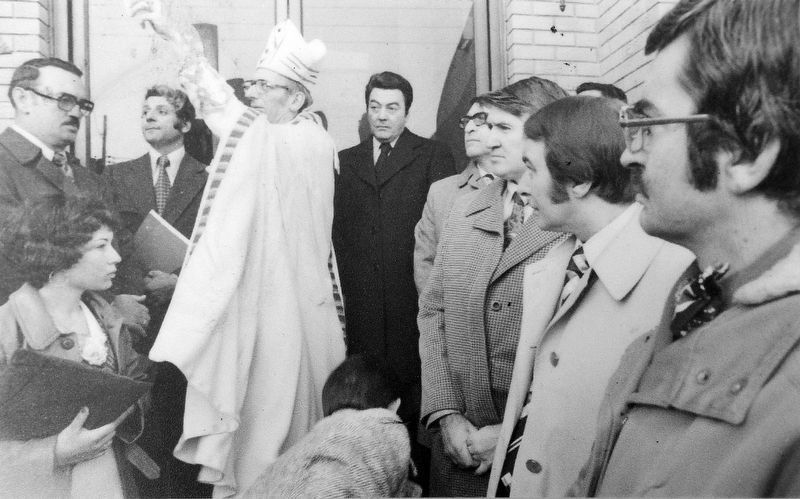
Situé au 42, rue Hanson, le Centre communautaire portugais est inauguré en 1974. Construit par des membres de la communauté, il est un lieu de rencontre et de diffusion de la culture portugaise. Abritant l'église Notre-Dame-de-Fatima, le centre permet également les rassemblements spirituels.
Hanson Street: Witness to a Family of Industrialists
Hanson Street, formerly Front Street, was renamed in 2002 in honor of George Edward Hanson (1872-1943), founder of the George E. Hanson Carding and Woolen Co. Built in 1905 on the vacant lot at 82 Hanson Street, this factory is now occupied by La Filature, a self-managed artists' center.
Born in 1872, George E. Hanson was the son of John D. Hanson, a wool carder who owned a factory on Montcalm Street. Around 1910, George had a magnificent wooden bourgeois house built at 19 Hanson Street, which was covered with red bricks two years later. Featuring very classical lines, its façade has a neoclassical porch and windows adorned with stained glass and leaded tiles. The Hanson family lived in the house until 1959. George's son, John David, acquired the neighboring property at 17 Hanson Street in 1938, which was built of wood before 1881 and eventually covered with stucco.
Cushman Memorial Presbyterian Church
The Cushman Memorial Presbyterian Church was built in 1924 at 20 Front Street (now Hanson Street), to replace the Zion Presbyterian Church, a small wooden chapel dating from 1872. Its construction was funded by Sturgis Salmon Cushman, vice-president of the E. B. Eddy Company. Most of its members live in the neighborhood. In the Neo-Romanesque style, the church stands out for its volume, arched windows, and stained glass. The building now houses an evangelical church.
The Legacy of the Portuguese Community
In the mid-20th century, the economic boom following the economic crisis of the 1930s promoted employment opportunities and the establishment of reception structures that greatly facilitated the integration of newcomers. Following an agreement signed between Canada and Portugal aimed at recruiting agricultural and manual workers, a first group of Portuguese immigrants settled in Gatineau in 1953. Immigration from this country continued at a steady pace until 1990. At that time, the Portuguese community represented 14% of the region's immigrant population.
Located at 42 Hanson Street, the Portuguese Community Centre was inaugurated in 1974. Built by members of the community, it is a meeting place and a hub for spreading Portuguese culture. Housing the Notre-Dame-de-Fatima Church, the center also allows for spiritual gatherings.
Erected by Ville
this page online
Topics. This historical marker is listed in these topic lists: Immigration • Industry & Commerce • Religion & Religious Structures • Settlements & Settlers.
Location. 45° 25.551′ N, 75° 43.589′ W. Marker is in Gatineau, Québec, in Outaouais. It is in District de Hull. It is on Rue Hanson just south of Rue Wright, on the right when traveling north. The marker is beside the sidewalk near the northwest corner of Église Évangélique Source de Vie. Touch for map. Marker is at or near this postal address: 20 Rue Hanson, Gatineau QC J8Y 3M3, Canada. Touch for directions.

Regionally, this marker is in the Ottawa Metropolitan Area and in the Outaouais & Eastern Townships. It is also in Central Canada. Globally, it is in North America, the Great North Woods, the Western Hemisphere, and the Western World. Historically, it finds itself in what was once a British colony, the Viceroyalty of New France, the Haudenosaunee (Iroquois) Confederacy, and Rupert’s Land.
Other nearby markers. At least 8 other markers

Archives nationales à Montréal, Fonds La Presse
2. Marker detail: Église presbytérienne Cushman Memorial, érigée en 1924.
Cushman Memorial Presbyterian Church, built in 1924.
Archives de l’Université d'Ottawa, Fonds Le Droit
3. Marker detail: Inauguration du Centre communautaire portugais, 1974.
Inauguration du Centre communautaire portugais « Les amis unis » sur ta rue Front (aujourd'hui ta rue Hanson) à Hull, en 1974. • • • Inauguration of the Portuguese Community Center “United Friends” on Front Street (today Hanson Street) in Hull, in 1974.

Photographed by Cosmos Mariner, May 27, 2024
4. Église Évangélique Source de Vie / Evangelical Church Source of Life
Looking east from Hanson Street. The marker is beside the sidewalk at the far left.
Credits. This page was last revised on June 15, 2026. It was originally submitted on June 8, 2026, by Cosmos Mariner of Cape Canaveral, Florida. This page has been viewed 14 times since then. Photos: 1, 2, 3, 4. submitted on June 10, 2026, by Cosmos Mariner of Cape Canaveral, Florida.
