Le Quartier-du-Musée : Un lieu résidentiel, commercial et professionnel


Les trois grandes phases de développement qui ont marqué la ville de Hull ont influencé le profil des propriétaires du Quartier-du-Musée. Les registres démontrent un tien entre les métiers exercés et les principaux secteurs économiques de la ville lors de ces phases. Entre 1860 et 1910, le quartier dénombre plusieurs propriétaires exerçant leurs activités dans les domaines de la construction, de la transformation du bois et du commerce, alors que boucheries, épiceries et quincailleries s'installent dans le quartier.
De 1910 à 1960, les grands chantiers cessent, ce qui entraîne la diminution du nombre de propriétaires issus du milieu de la construction et attire progressivement différents types de professionnels, des fonctionnaires et des gens de métiers spécialisés. Des avocats, des notaires, des médecins et des architectes acquièrent des résidences pour y vivre et y installent leurs bureaux en
this page online
Mesdames les propriétaires
À la fin du XIXe siècle et au début du XXe siècle, plusieurs femmes deviennent propriétaires dans le Quartier-du-Musée. Quelques-unes le sont devenues à la suite d'un legs ou du décès de leur époux, tandis que d'autres ont acquis leur propriété à titre personnel. Vendeuses, secrétaires ou institutrices, ces femmes avaient des profils variés. Certaines femmes d'affaires possédaient même plus d'une propriété, comme Adèle Leduc, épouse du notaire Nérée Tétreau, qui à elle seule en possédait huit. Certaines louaient leurs immeubles et pouvaient ainsi faire vivre leur famille. En tant que propriétaires, les femmes ont assurément contribué au développement socioéconomique

The Museum District: A residential, commercial, and professional area
In 1888, a fire almost completely destroyed the Museum District. Long known as the "Laurier neighborhood," the Museum District today takes its name from its proximity to the Canadian Museum of History.
The three major phases of development that marked the city of Hull influenced the profile of the property owners in the Museum District. The records show a link between the trades practiced and the main economic sectors of the city during these phases. Between 1860 and 1910, the neighborhood had many owners working in construction, wood processing, and commerce, while butcher shops, grocery stores, and hardware stores settled in the neighborhood.
From 1910 to 1960, large construction projects ceased, leading to a decrease in the number of owners from the construction sector and gradually attracting different types of professionals, civil servants, and skilled tradespeople. Lawyers, notaries, doctors, and architects acquired residences to live in and set up their offices in annexes, as evidenced by several
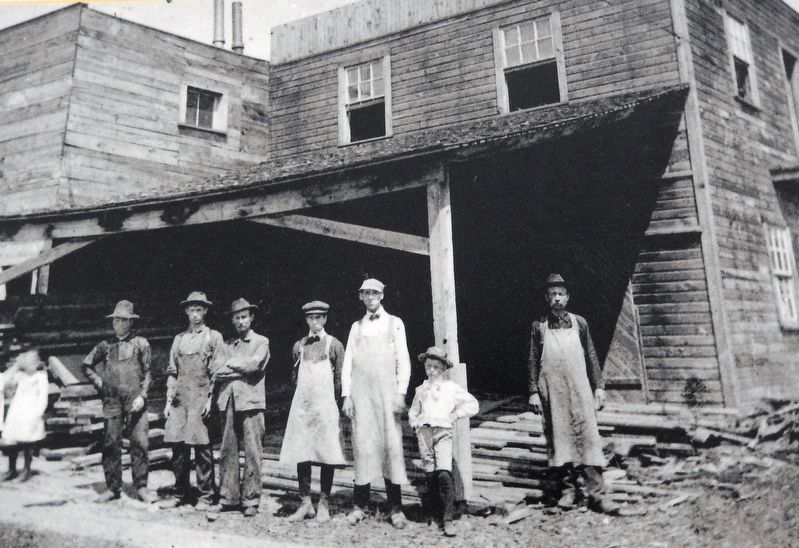
Lady Property Owners
At the end of the 19th century and the beginning of the 20th century, several women became property owners in the Museum District. Some became owners through an inheritance or the death of their husbands, while others purchased their property personally. Sellers, secretaries, or teachers, these women had varied backgrounds. Some businesswomen even owned more than one property, like Adèle Leduc, the wife of notary Nérée Tétreau, who alone owned eight. Some rented out their buildings, providing for their families. As property owners, these women undoubtedly contributed to the socioeconomic development of Hull in the first half of the 20th century.
Erected by Ville de Gatineau, Québec, Entente de développement culturel.
Topics.

Location. 45° 25.854′ N, 75° 42.711′ W. Marker is in Gatineau, Québec, in Outaouais. It is in District de Hull. It is on Rue Champlain just south of Rue Élisabeth-Bruyère, on the right when traveling north. Touch for map. Marker is at or near this postal address: 174 Rue Champlain, Gatineau QC J8X 3R2, Canada. Touch for directions.

Regionally, this marker is in the Ottawa Metropolitan Area and in the Outaouais & Eastern Townships. It is also in Central Canada. Globally, it is in North America, the Great North Woods, the Western Hemisphere, and the Western World. Historically, it finds itself in what was once a British colony, the Viceroyalty of New France, the Haudenosaunee (Iroquois) Confederacy, and Rupert’s Land.
Other nearby markers. At least 8 other markers are within walking distance of this marker: Mère Élisabeth Bruyère : une femme inspirante (about 90 meters away, measured in a direct line); École Normale St-Joseph (about 90 meters away); Le Quartier-du-Musée : Des habitants qui ont marqué l'histoire de Hull

Also see . . . Le Quartier du Musée (University of Ottawa Press).
(par Michelle Guitard) Excerpt: Le Quartier du Musée est le lieu d’origine identitaire des francophones de l’Outaouais. Première paroisse catholique française de Hull avec ses bâtiments institutionnels, résidentiels et commerciaux, le Quartier du Musée regroupe un ensemble de références socioéconomiques et historiques, plus particulièrement pour la société catholique et canadienne-française de la région. Un des rares témoins de la Ville de Hull d’avant 1900, son patrimoine bâti ancien reflète l’adaptation des divers courants architecturaux de la région de la capitale nationale du Canada : 53 des bâtiments de ce quartier datent d’avant 1910, alors que(Submitted on June 10, 2026, by Cosmos Mariner of Cape Canaveral, Florida.)44 précèdent l'incendie de 1900.Photographed by Cosmos Mariner, May 27, 20246. Le quartier-du-musée — Museum District — architectureLes brèves histoires des propriétaires et occupants révèlent l’évolution de l’histoire sociale, économique et culturelle de l’Outaouais. Les activités socioéconomiques des habitants, propriétaires et locataires permettent de mieux connaître les nombreuses personnalités qui ont joué un rôle de grande importance dans l’histoire de la ville et de la région.
[English translation] The Museum District is the original identity hub for Francophones in the Outaouais. As the first French Catholic parish of Hull with its institutional, residential, and commercial buildings, the Museum District brings together a mix of socio-economic and historical references, particularly for the Catholic and French-Canadian community in the region. One of the rare remnants of Hull before 1900, its old built heritage reflects the adaptation of various architectural styles in Canada’s National Capital Region: 53 of the buildings in this district date back to before 1910, while 44 predate the fire of 1900.
The brief histories of the owners and occupants reveal the evolution of the social, economic, and cultural history of the Outaouais.
The socioeconomic activities of residents, owners, and tenants help us get to know the many personalities who played an important role in the history of the city and the region.Photographed by Cosmos Mariner, May 27, 20247. Le quartier-du-musée — Museum District — architecture


Credits. This page was last revised on June 15, 2026. It was originally submitted on June 8, 2026, by Cosmos Mariner of Cape Canaveral, Florida. This page has been viewed 12 times since then. Photos: 1, 2, 3, 4, 5, 6, 7. submitted on June 10, 2026, by Cosmos Mariner of Cape Canaveral, Florida.
