
Mitte in Halle (Saale) in Halle, Saxony-Anhalt, Germany — Central Europe
Irgendwo hier stand mal eine Kirche ...
Die Stadt der fünf Türme
⎯⎯⎯
Somewhere Around Here Once Stood a Church ...
The City of Five Towers

Photographed by James Hulse, March 10, 2026
1. Irgendwo hier stand mal eine Kirche ... / Somewhere Around Here Once Stood a Church ... Marker

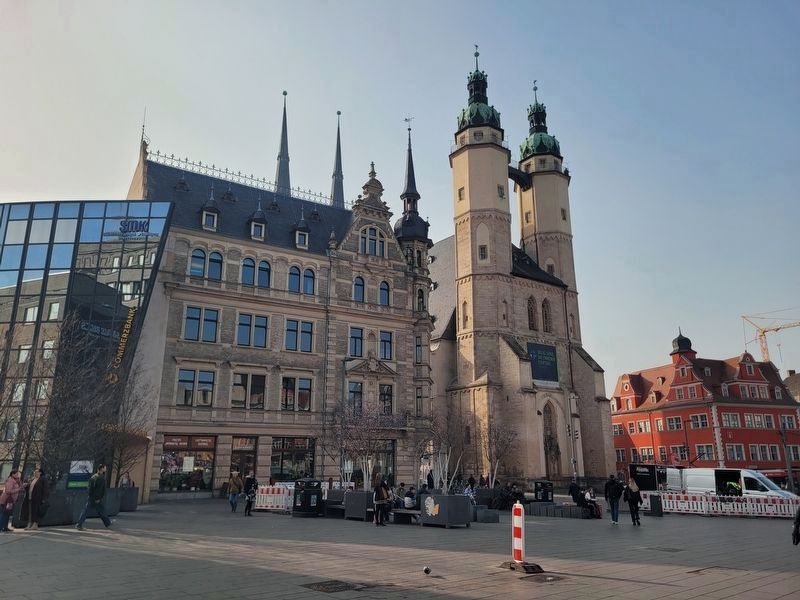
Die Kirche Unser Lieben Frauen auf dem Markt von Halle, kurz auch Marienkirche oder Marktkirche genannt, ist über 450 Jahre alt. Sie zählt in Mitteldeutschland zu den bedeutendsten Kirchenbauten aus der Zeit des Übergangs von der Spätgotik zur Renaissance. Ihre Türme bilden zusammen mit dem Roten Turm, einem freistehenden Glockenturm aus dem 15. Jahrhundert, das Wahrzeichen der Stadt - die fünf Türme.
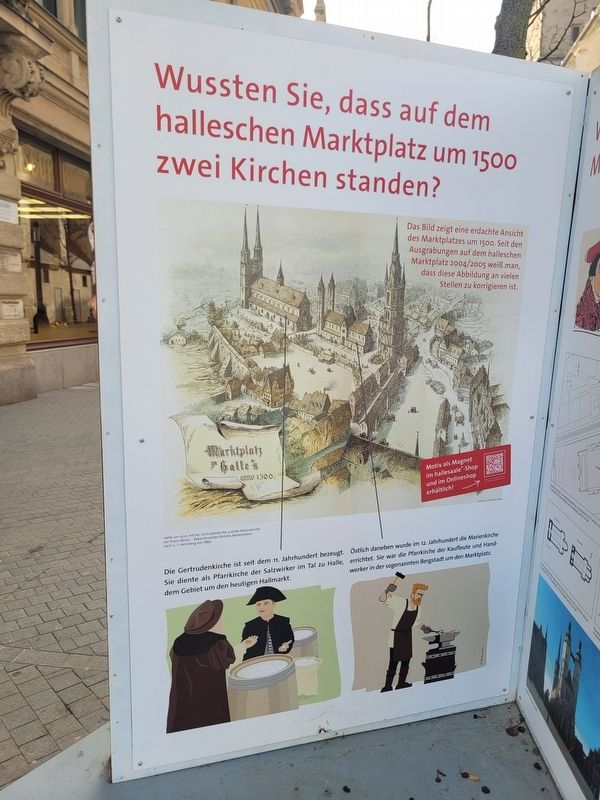
Wussten Sie, dass auf dem halleschen Marktplatz um 1500 zwei Kirchen standen?
Das Bild zeigt eine erdachte Ansicht des Marktplatzes um 1500. Seit den Ausgrabungen auf dem halleschen Marktplatz 2004/2005 weiß man, dass diese Abbildung an vielen Stellen zu korrigieren ist.
Die Gertrudenkirche ist seit dem 11. Jahrhundert bezeugt. Sie diente als Pfarrkirche der Salzwirker im Tal zu Halle, dem Gebiet um den heutigen Hallmarkt.
Östlich daneben wurde im 12. Jahrhundert die Marienkirche errichtet. Sie war die Pfarrkirche der Kaufleute und Handwerker in der sogenannten Bergstadt um den Marktplatz.
Halle um 1500, mit der Gertrudenkirche und der Marienkirche vor ihrem Abriss – Rekonstruiertes
this page online
Wieso hat die hallesche Marktkirche vier Türme?
Die heutige Marktkirche wurde von 1529 bis 1554 zwischen den Turmpaaren der Vorgängerkirchen St. Gertruden und St. Marien errichtet. Die Entscheidung für den Bau einer größeren und prächtigeren Kirche fiel unter dem Einfluss eines mächtigen geistlichen Fürsten: Kardinal Albrecht von Brandenburg. Als Erzbischof von Mainz und Magdeburg wollte er Halle zu seiner Residenzstadt ausbauen und die Ausbreitung der Wittenberger Reformation aufhalten. Ratgeber des Erzbischofs, Mitglieder des städtischen Rats und Kirchenvorsteher kamen 1529 zusammen und beschlossen, die beiden Kirchen bis auf die jeweiligen Türme abzureißen und die vier Türme durch eine einzige Kirchenhalle miteinander zu verbinden.
Nach dem Abriss der alten Kirchenschiffe blieben von der Gertrudenkirche nur die „Blauen Türme“ aus der Zeit um 1400 übrig, die zu Beginn des 16. Jahrhunderts gerade neue Turmspitzen bekommen hatten. Von der Marienkirche stammen die „Hausmannstürme“ mit ihren spätromanischen Untergeschossen. Zwischen 1551 und 1554 wurden sie mit neuen Aufbauten versehen und durch eine Brücke miteinander verbunden, damit ein Turmwächter, damals Hausmann genannt, die Bewohner der Stadt vor Bränden und anderen Gefahren warnen konnte.
Tipp: Die Turm-Tour
Okay,
Photographed by James Hulse, March 10, 2026
2. Irgendwo hier stand mal eine Kirche ... / Somewhere Around Here Once Stood a Church ... Marker
Schauen Sie genau! Können Sie die Spuren von St. Marien entdecken?
Grundrisse der hoch- und spätmittelalterlichen Kirchenbauten von St. Marien aus dem 12. bis frühen 16. Jh. Landesamt für Denkmalpflege und Archäologie Sachsen-Anhalt.
Grundrissrekonstruktion beider Kirchen nach R. Hünicken und H. Schuster 1933/34. Landesamt für Denkmalpflege und Archäologie Sachsen-Anhalt.
Phasenzeichnungen beider Kirchen: Romanik I und II sowie Gotik. © Landesamt für Denkmalpflege und Archäologie Sachsen-Anhalt.
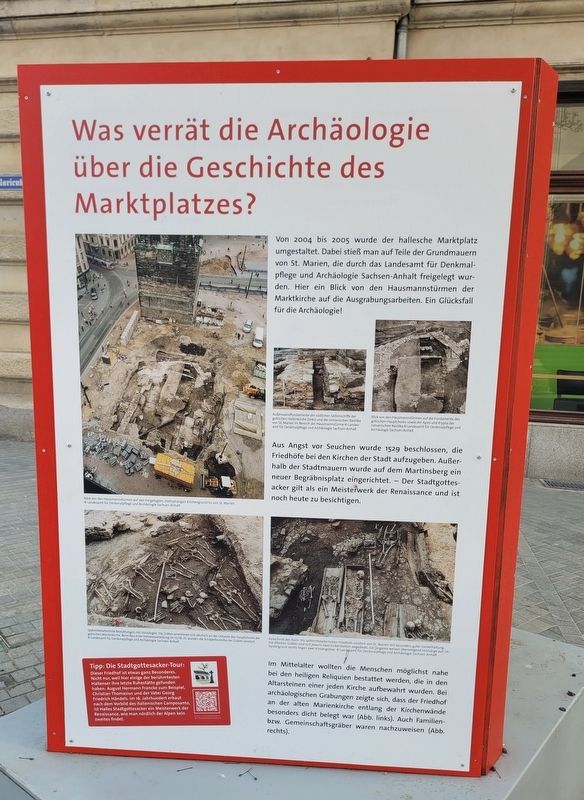
Was verrät die Archäologie über die Geschichte des Marktplatzes?
Von 2004 bis 2005 wurde der hallesche Marktplatz umgestaltet. Dabei stieß man auf Teile der Grundmauern von St. Marien, die durch das Landesamt für Denkmalpflege und Archäologie Sachsen-Anhalt freigelegt wurden. Hier ein Blick von den Hausmannstürmen der Marktkirche auf die Ausgrabungsarbeiten. Ein Glücksfall für die Archäologie!
Aus Angst vor Seuchen wurde 1529 beschlossen, die Friedhöfe bei den Kirchen der Stadt aufzugeben. Außerhalb der Stadtmauern wurde auf dem Martinsberg ein neuer Begräbnisplatz

Photographed by James Hulse, March 10, 2026
3. Irgendwo hier stand mal eine Kirche ... / Somewhere Around Here Once Stood a Church ... Marker
Im Mittelalter wollten die Menschen möglichst nahe bei den heiligen Reliquien bestattet werden, die in den Altarsteinen einer jeden Kirche aufbewahrt wurden. Bei archäologischen Grabungen zeigte sich, dass der Friedhof an der alten Marienkirche entlang der Kirchenwände besonders dicht belegt war (Abb. links). Auch Familien- bzw. Gemeinschaftsgräber waren nachzuweisen (Abb. rechts).
Tipp: Die Stadtgottesacker-Tour
Dieser Friedhof ist etwas ganz Besonderes. Nicht nur, weil hier einige der berühmtesten Hallenser ihre letzte Ruhestätte gefunden haben: August Hermann Francke zum Beispiel, Christian Thomasius und der Vater Georg Friedrich Händels. Im 16. Jahrhundert erbaut nach dem Vorbild des italienischen Camposanto, ist Halles Stadtgottesacker ein Meisterwerk der Renaissance, wie man nördlich der Alpen kein zweites findet.
Außenwandfundamente der südlichen Seitenschiffe der gotischen Hallenkirche (links) und der romanischen Basilika von St. Marien im Bereich der Hausmannstürme. © Landesamt für Denkmalpflege und Archäologie Sachsen-Anhalt.
Blick von den Hausmannstürmen auf die Fundamente des gotischen Hauptchores sowie der Apsis und Krypta der romanischen Basilika. Landesamt für Denkmalpflege und Archäologie Sachsen-Anhalt.
Blick
Photographed by James Hulse, March 10, 2026
4. Irgendwo hier stand mal eine Kirche ... / Somewhere Around Here Once Stood a Church ... Marker
Spätmittelalterliche Bestattungen mit Holzsärgen. Die Gräber orientieren sich deutlich an der Ostseite des Hauptchores der gotischen Marienkirche. Beim Bau einer Holzwasserleitung im 17./18. Jh. wurden die Schädelbereiche der Gräber zerstört. Landesamt für Denkmalpflege und Archäologie Sachsen-Anhalt.
Ausschnitt des hoch- bis spätmittelalterlichen Friedhofs nördlich von St. Marien mit besonders guter Holzerhaltung. Die ältesten Gräber sind mit jeweils zwei Eichenbohlen abgedeckt, die jüngeren weisen überwiegend Holzsärge auf. Im Vordergrund rechts liegen zwei Kindergräber. Landesamt für Denkmalpflege und Archäologie Sachsen-Anhalt.
The Church of Our Lady on the market square of Halle, also known simply as St. Mary's Church or the Market Church, is more than 450 years old. It is one of the most significant church buildings in Central Germany from the transitional period between the Late Gothic and Renaissance eras. Its towers, together with the Red Tower, a freestanding bell tower dating from the 15th century, form the symbol of the city—the Five Towers.
Did you know that around 1500 there were two churches on Halle's market square?
The

Photographed by James Hulse, March 10, 2026
5. Irgendwo hier stand mal eine Kirche ... / Somewhere Around Here Once Stood a Church ... Marker
The view of the marker with the Red Tower in the background.
St. Gertrude's Church is documented as early as the 11th century. It served as the parish church of the salt workers of the Valley at Halle, the area around today's Hallmarkt.
To the east, St. Mary's Church was built in the 12th century. It served as the parish church of the merchants and craftsmen of the so-called Hill Town surrounding the market square.
Halle around 1500, showing the Church of St. Gertrude and St. Mary's Church before their demolition – reconstructed image of the market square based on G. F. Hertzberg (1889).
Why Does Halle's Market Church Have Four Towers?
Today's Market Church was built between 1529 and 1554 between the pairs of towers belonging to its predecessor churches, St. Gertrude's and St. Mary's. The decision to construct a larger and more magnificent church was made under the influence of a powerful prince of the Church: Cardinal Albrecht of Brandenburg. As Archbishop of Mainz and Magdeburg, he sought to develop Halle into his residence city and to halt the spread of the Reformation from Wittenberg. Advisors to the archbishop, members of the city council, and church
Photographed by James Hulse, March 10, 2026
6. Irgendwo hier stand mal eine Kirche ... / Somewhere Around Here Once Stood a Church ... Marker
The view of the two east towers from the Marktplatz.
After the demolition of the old church naves, only the "Blue Towers" of St. Gertrude's Church, dating from around 1400, remained. At the beginning of the 16th century, these towers had just received new spires. From St. Mary's Church came the "Hausmann Towers," whose lower stories date from the Late Romanesque period. Between 1551 and 1554, they were fitted with new upper sections and connected by a bridge so that a tower watchman, then known as a Hausmann, could warn the city's inhabitants of fires and other dangers.
Tip: The Tower Tour
The climb of 220 steps up the Hausmann Towers of the Market Church is certainly a challenge. But at the top, fascinating stories about the daily life of the tower watchman's family await visitors. And we cannot praise the view highly enough!
Look Closely! Can you discover the traces of St. Mary's Church?
Floor plans of the High and Late Medieval church buildings of St. Mary's Church from the 12th to the early 16th century. State Office for Heritage Management and Archaeology of Saxony-Anhalt.
Floor plan reconstruction of both churches based on R. Hünicken and H. Schuster, 1933/34. State Office for Heritage Management and Archaeology of

Photographed by James Hulse, March 10, 2026
7. Irgendwo hier stand mal eine Kirche ... / Somewhere Around Here Once Stood a Church ... Marker
The view of the 5 Towers of Halle from the Marktplatz.
Phase drawings of both churches: Romanesque I and II, as well as Gothic. © State Office for Heritage Management and Archaeology of Saxony-Anhalt.
What Does Archaeology Reveal About the History of the Market Square?
From 2004 to 2005, Halle's market square was redesigned. During the work, portions of the foundation walls of St. Mary's Church were discovered and excavated by the State Office for Heritage Management and Archaeology of Saxony-Anhalt. Shown here is a view from the Hausmann Towers of the Market Church overlooking the archaeological excavations. A fortunate opportunity for archaeology!
Out of fear of epidemics, it was decided in 1529 to abandon the cemeteries located beside the city's churches. A new burial ground was established on Martinsberg outside the city walls. The City God's Acre (Stadtgottesacker) is considered a masterpiece of Renaissance architecture and can still be visited today.
In the Middle Ages, people wished to be buried as close as possible to the holy relics preserved within the altar stones of each church. Archaeological excavations revealed that the cemetery surrounding the old St. Mary's Church was especially densely occupied along the church walls (fig. left). Family and communal graves were also identified (fig. right).
Tip: The Stadtgottesacker Tour
This cemetery is something truly special. Not only because some of Halle's most famous citizens found their final resting place here—among them August Hermann Francke, Christian Thomasius, and the father of George Frideric Handel. Built in the 16th century after the model of the Italian Camposanto, Halle's Stadtgottesacker is a masterpiece of Renaissance architecture, unmatched anywhere north of the Alps.
Exterior wall foundations of the southern side aisles of the Gothic hall church (left) and of the Romanesque basilica of St. Mary's Church in the area of the Hausmann Towers. © State Office for Heritage Management and Archaeology of Saxony-Anhalt.
View from the Hausmann Towers of the foundations of the Gothic main choir, as well as the apse and crypt of the Romanesque basilica. State Office for Heritage Management and Archaeology of Saxony-Anhalt.
View from the Hausmann Towers of the excavated, multi-phase ground plan of St. Mary's Church. State Office for Heritage Management and Archaeology of Saxony-Anhalt.
Late medieval burials with wooden coffins. The graves are clearly oriented toward the eastern side of the main choir of the Gothic St. Mary's Church. During the construction of a wooden water pipeline in the 17th/18th century, the skull areas of the graves were destroyed. State Office for Heritage Management and Archaeology of Saxony-Anhalt.
Section of the High and Late Medieval cemetery north of St. Mary's Church, showing exceptionally well-preserved wood remains. The oldest graves are covered with two oak planks each, while the more recent burials predominantly contain wooden coffins. In the foreground on the right are two children's graves. State Office for Heritage Management and Archaeology of Saxony-Anhalt.
Topics. This historical marker is listed in these topic lists: Anthropology & Archaeology • Architecture • Religion & Religious Structures. A significant historical year for this entry is 1500.
Location. 51° 28.95′ N, 11° 58.125′ E. Marker is in Halle (Saale), Sachsen-Anhalt (Saxony-Anhalt), in Halle. It is in Mitte. It is at the intersection of An der Marienkirche and Marktplatz, on the left when traveling east on An der Marienkirche. The marker is located at the southeast corner of the church building. Touch for map. Marker is at or near this postal address: An d Marienkirche 2, Halle (Saale) ST 06108, Germany. Touch for directions.

Regionally, it is in Europe, the European Union, Atlantic Europe, Central Europe, the Schengen Area, Western Europe, and the Western World. Historically, it finds itself in what was once the Roman Empire and specifically also the Holy Roman Empire.
Other nearby markers. At least 8 other markers are within walking distance of this marker: Marktkirche Unser Lieben Frauen / Market Church of Our Lady (within shouting distance of this marker); Marktplatz 13 (within shouting distance of this marker); Marktkirche bei Nacht / Market Church at Night (within shouting distance of this marker); Marktplatz Nr. 13 (within shouting distance of this marker); Marktplatz 2 (about 120 meters away, measured in a direct line); Hochzeits- und Waagehaus / Wedding and Weigh House (about 150 meters away); Rosa Wenzymer (about 210 meters away); Siegfried Wenzymer (about 210 meters away). Touch for a list and map of all markers in Halle (Saale).
Credits. This page was last revised on June 11, 2026. It was originally submitted on June 9, 2026, by James Hulse of Medina, Texas. This page has been viewed 5 times since then. Photos: 1, 2, 3, 4, 5, 6, 7. submitted on June 11, 2026, by James Hulse of Medina, Texas.
