Huisduinen in Den Helder, North Holland, Netherlands — Northwestern Europe
Monument ‘De Walvis’
⎯⎯⎯
Huisduinen Whaling Memorial

Photographed by Andrew Ruppenstein, June 2, 2026
1. Huisduinen Whaling Memorial Marker

In 1964 stopte de nederlandse walvisvaart.
Huisduiner Pieter Zeeman (1906-1994) was de laatste kapitein van de walvisvaarder Willem Barendsz.
Ontwerp en uitvoering: Peter Jonas.
Mede mogelijk gemaakt door: Het Waddenfonds.
(English translation:)
For centuries, the people of Huisduinen engaged in whaling.
Dutch whaling operations ceased in 1964.
Pieter Zeeman (1906–1994), a native of Huisduinen, was the last captain of the whaling ship Willem Barendsz.
Design and execution: Peter Jonas.
Made possible with the support of: The Wadden Fund.
Topics. This historical marker and memorial is listed in these topic lists: Industry & Commerce • Waterways & Vessels. A significant historical year for this entry is 1964.
Location. 52° 57.196′ N, 4° 43.552′ E. Marker is in Huisduinen, Noord-Holland (North Holland), in Den Helder. It is at the intersection of Badhuisstraat and H.W. Mesdagstraat, on the right when traveling west on Badhuisstraat. Touch for map. Marker is at or near this postal address: Badhuisstraat 31, Huisduinen, Noord-Holland 1789 AH, Netherlands.
this page online

Regionally, it is in Europe, the European Union, Atlantic Europe, the Benelux Low Countries, the Schengen Area, Western Europe, and the Western World. Historically, it finds itself in what was once the Holy Roman Empire.
Other nearby markers. At least 8 other markers are within walking distance of this marker: Slag bij Kijkduin (21 augustus 1673) / Battle of Texel (August 21, 1673) (within shouting distance of this marker); Nooit meer zoals het was / Never the same again! / Es wird nie wieder wie es war (about 90 meters away, measured in a direct line); De Atlantikwall / Der Atlantikwall / The Atlantikwall (about 90 meters away); Fort Kijkduin (about 90 meters away); Vuurtoren de Lange Jaap / Lange Jaap Lighthouse (approx. 0.3 kilometers away); Monument Joodse Begraafplaats / Jewish Cemetery Memorial (approx. 0.8 kilometers away); Waddenzee-graftekens / Waddenzee Gravestones (approx. 0.8 kilometers away); Bijzonder oude graftekens / Exceptionally Old Grave Markers (approx. 0.8 kilometers away). Touch for a list and map of all markers in Huisduinen.
Also see . . . Walvisvaarders (Canon van Nederland, in Dutch).
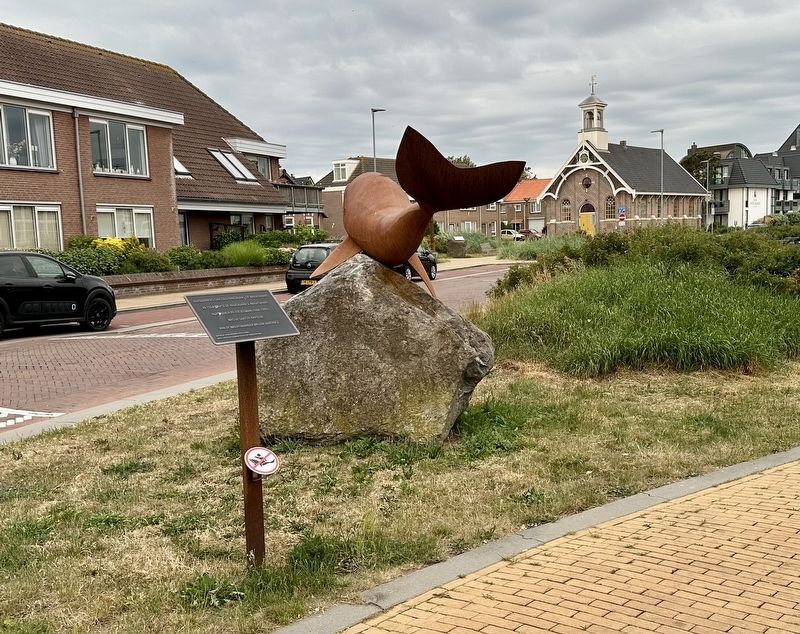
Photographed by Andrew Ruppenstein, June 2, 2026
2. Monument ‘De Walvis’ / Huisduinen Whaling Memorial - wide view
The inhabitants of Texel, Wieringen, Petten, Callantsoog, Den Helder, and Huisduinen relied largely on the sea for their livelihood. During the seventeenth and eighteenth centuries, more than half of the working population of Huisduinen and Den Helder found employment in the whaling industry, serving as sailors, blubber cutters, harpooners, mates, or commanders (captains). In the eighteenth century, Texel and Huisduinen were home to dozens of commanders; some had more than a hundred whale catches to their name. Commanders were paid per catch, and successful ones could amass considerable wealth. At the industry's peak around 1720, some 250 Dutch whaling ships set sail for the polar regions annually. The vessels were largely owned by shipowners from Amsterdam, the Zaan region, and Waterland.(Submitted on June 12, 2026.)
After 1800, catch numbers declined, although ships continued to depart for whaling or sealing expeditions each year. By the mid-nineteenth century, the Greenland right whale had been virtually wiped out. After the Second World War, there was a brief resurgence in Dutch whaling driven by a severe shortage of fats—needed,among other things, for margarine production. A number of men from the 'Noordkop' region once again served on the whaling ships Willem Barendsz I and II, operated by the Amsterdam shipping company Vincke & Co. The intrepid whalers of that era could not have foreseen that their quarry would one day merit global protection.Photographed by Andrew Ruppenstein, June 2, 20263. Monument ‘De Walvis’ / Huisduinen Whaling Memorial

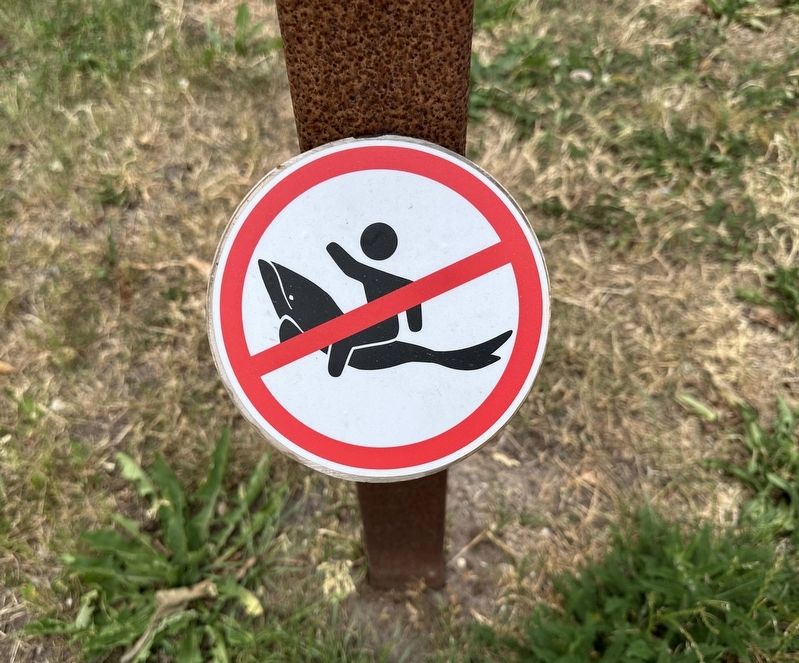
Photographed by Andrew Ruppenstein, June 2, 2026
4. No riding the whale!

Photographed by Andrew Ruppenstein, June 2, 2026
5. Monument ‘De Walvis’ / Huisduinen Whaling Memorial
Credits. This page was last revised on June 12, 2026. It was originally submitted on June 12, 2026, by Andrew Ruppenstein of Lamorinda, California. This page has been viewed 4 times since then. Photos: 1, 2, 3, 4, 5. submitted on June 12, 2026, by Andrew Ruppenstein of Lamorinda, California.
