
Fox Point in Providence in Providence County, Rhode Island — The American Northeast (New England)
Roger Williams Landing 1636
Providence Harbor Walk at Fox Point & India Point
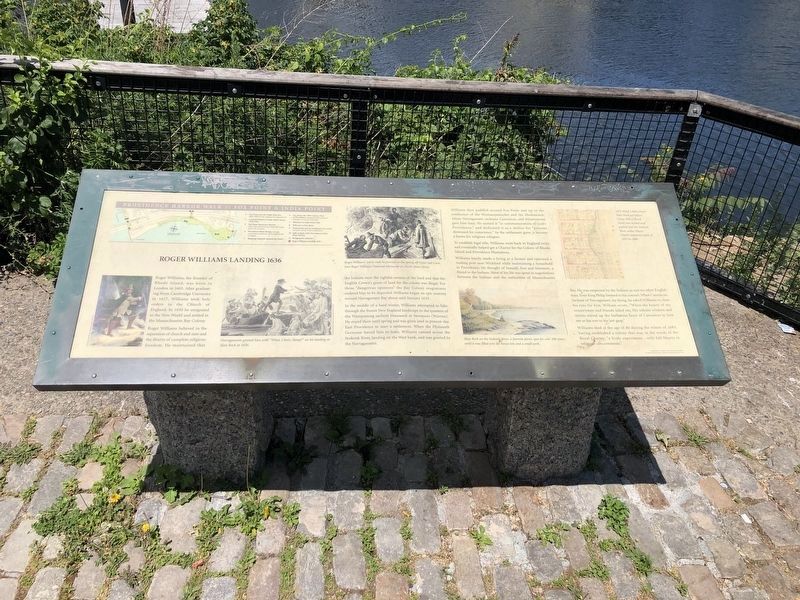
Roger Williams, the founder of Rhode Island, was born in London in 1603. After graduating from Cambridge University in 1627, Williams took holy orders in the church of England. In 1630 he emigrated to the New World and settled in the Massachusetts Bay Colony.
Roger Williams believed in the separation of church and state and liberty of complete religious freedom. He maintained that the Indians were the rightful owners of the land and that the English Crown's grant of land for the colony was illegal. For these "dangerous opinions" the Bay Colony magistrates ordered him to be deported. Williams began an epic journey toward Narragansett Bay about mid-January 1635.
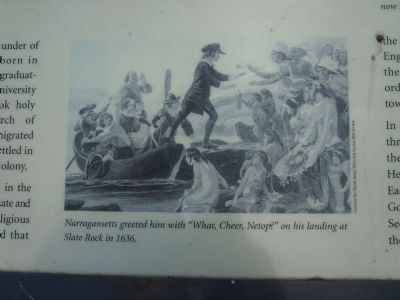
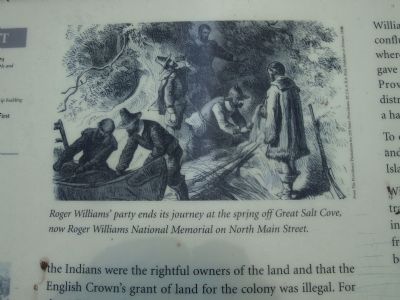
In the middle of a hard winter, Williams attempted to hike through the frozen New England landscape to the quarters of the Wampanoag sachem Massasoit at Swomans (Warren). He stayed there until spring and was given land in present-day East Providence to start a settlement. When the Plymouth Governor forced him the leave, Williams canoed across the Seekonk River, landing on the West Bank, and was greeted by the Narragansetts.
Williams then paddled around Fox Point and up to the confluence of the Woonasquatucket and the Moshassuck, where Narragansett sachems Canonicus and Miantonomi gave him land. He named it "in commemoration of God's Providence,"
this page online
To establish legal title, Williams went back to England twice and eventually helped get a Charter for the Colony of Rhode Island and Providence Plantations.
Williams barely made a living as a farmer and operated a trading post near Wickford while maintaining a household in Providence. He thought of himself, first and foremost, a friend to the Indians. Most of his life was spent in negotiations between the Indians and the authorities of Massachusetts Bay. He was respected by the Indians as was no other English man. Even King Philip listened to his council. When Canonicus, Sachem of Narragansett, lay dying, he asked Williams to close his eyes for him. Williams wrote, "When the hearts of my countrymen and friends failed me, His infinite wisdom and merits stirred up the barbarous heart of Canonicus to love me as his son to his last gasp."
Williams died at the age of 80 during the winter of 1683, having established a colony that was, in the words of the Royal Charter, "a lively experiment... with full liberty in religious concernments." (Marker Number 12.)
Topics. This historical marker is listed in these topic lists: Colonial Era • Religion & Religious Structures
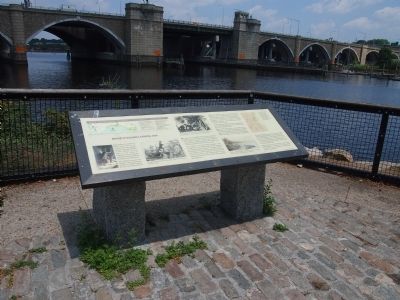
Photographed by Bryan Simmons, July 2012
2. Roger Williams Landing 1636 Marker
Location. 41° 49.072′ N, 71° 23.285′ W. Marker is in Providence, Rhode Island, in Providence County. It is in Fox Point. It can be reached from India Street, on the right when traveling east. Marker is located in India Point Park. Touch for map. Marker is at or near this postal address: 250 India St, Providence RI 02903, United States of America. Touch for directions.

Regionally, this marker is on Rhode Island’s Narragansett Bay. It is also in the American Northeast and in New England. Globally, it is in the North Atlantic Region, North America, the Western Hemisphere, the Western World, and the Anglosphere. Historically, it finds itself in what was once one of the original Thirteen Colonies.
Other nearby markers. At least 8 other markers are within walking distance of this marker: Bridging the Seekonk (within shouting distance of this marker); West Bank / East Bank / Washington Bridges (about 500 feet away, measured in a direct line); Head of Narragansett Bay / Crossing the Seekonk River (about 500 feet away); Tockwotton and the Indiamen / Sails to Rails 1835: Providence's First Train Station (about 700 feet away); Washington Bridge (approx. ¼ mile away); Four Cannon Fort (approx. ¼ mile away); Veterans Memorial Parkway (approx. 0.3 miles away); McDowell-Slade Memorial Bridge (approx. 0.3 miles away). Touch for a list and map of all markers in Providence.
Related markers. Click here for a list of markers that are related to this marker. To better understand the relationship, study each marker in the order shown.
Photographed by Bryan Simmons, July 2012
3. Roger Williams Landing 1636 Marker
Photographed by Bryan Simmons, July 2012
4. Roger Williams Landing 1636 Marker
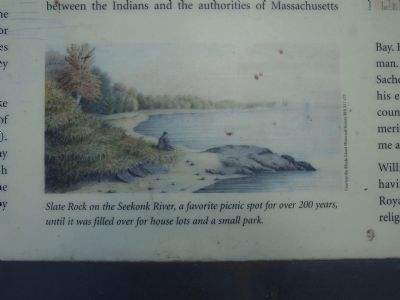
Photographed by Bryan Simmons, July 2012
5. Roger Williams Landing 1636 Marker
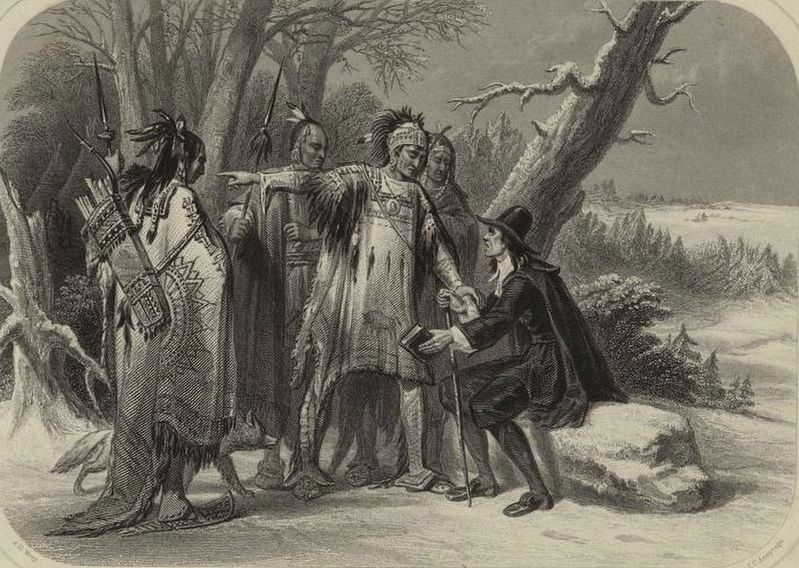
Engraving by James Charles Armytage at the New York Public Library, 1856
6. Roger Williams, founder of Rhode Island, meeting with the Narragansett Indians
Credits. This page was last revised on June 14, 2026. It was originally submitted on July 16, 2012, by Bryan Simmons of Attleboro, Massachusetts. This page has been viewed 2,790 times since then and 36 times this year. Last updated on June 12, 2026, by G.W.Bartlett of Hingham, Massachusetts. Photos: 1. submitted on June 21, 2020, by Devry Becker Jones of Washington, District of Columbia. 2, 3, 4, 5. submitted on July 16, 2012, by Bryan Simmons of Attleboro, Massachusetts. 6. submitted on October 8, 2016, by J. J. Prats of Powell, Ohio. • Devry Becker Jones was the editor who published this page.
