Great Bend in Barton County, Kansas — The American Midwest (Upper Plains)
Santa Fe Trail
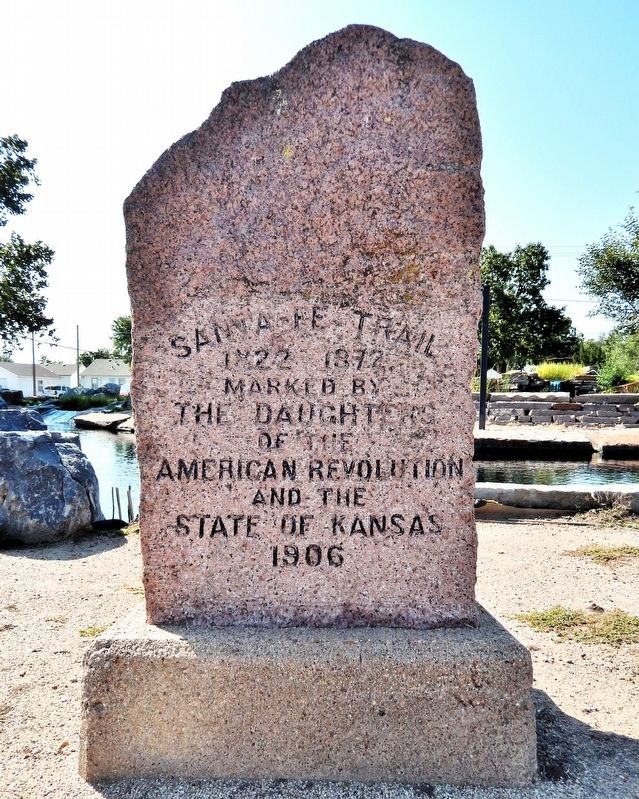
Photographed by Cosmos Mariner, September 8, 2024
1. Santa Fe Trail Marker
1822-1872
Erected 1906 by Daughters of the American Revolution and the State of Kansas.
Topics and series. This historical marker is listed in these topic lists: Industry & Commerce • Roads & Vehicles • Settlements & Settlers. In addition, it is included in the Daughters of the American Revolution (DAR), and the Santa Fe Trail series lists. A significant historical year for this entry is 1822.
Location. 38° 21.676′ N, 98° 45.371′ W. Marker is in Great Bend, Kansas, in Barton County. It is on 10th Street (U.S. 56) just west of Frey Street, on the left when traveling west. The marker is on the north side of Santa Fe Trail Park. Touch for map. Marker is at or near this postal address: 1405 10th Street, Great Bend KS 67530, United States of America. Touch for directions.

Regionally, this marker is in Central Kansas. It is also in the American Midwest, in the Corn Belt, on the prairies, on the Southern Plains, and on the Santa Fe Trail Corridor. Globally, it is in North America, the Western Hemisphere, the Western World, and the Anglosphere. Historically, it finds itself in what was once
this page online
Other nearby markers. At least 8 other markers are within walking distance of this marker: A different marker also named Santa Fe Trail (a few steps from this marker); Lt. Zebulon Pike, 1806 (within shouting distance of this marker); Prey and Play (approx. ¼ mile away); Post Rock & Black Gold (approx. ¼ mile away); Wild West Superhighway (approx. half a mile away); Veterans of Foreign Wars Memorial (approx. half a mile away); Streetscape (approx. 0.6 miles away); Jack Kilby (approx. 0.6 miles away). Touch for a list and map of all markers in Great Bend.
Also see . . .
1. Santa Fe Trail Markers - Kansas State Society Daughters of the American Revolution.
Excerpt: In 1902, Kansas Daughters began their dream of service to Kansas history by kicking off a campaign to place markers along the Santa Fe Trail in the state. They secured red granite boulders of varying size for the markers, at a cost of about $16 per boulder.(Submitted on June 13, 2026, by Cosmos Mariner of Cape Canaveral, Florida.)
2. Marking the Santa Fe Trail.
The story of the marking of the Santa Fe Trail by the Daughters(Submitted on June 13, 2026, by Cosmos Mariner of Cape Canaveral, Florida.)of the American Revolution in Kansas.Photographed by Cosmos Mariner, September 8, 20242. Santa Fe Trail MarkerLooking south from US Highway 56 across Santa Fe Trail Park.

3. The Santa Fe National Historic Trail (National Park Service).
Excerpt: From 1821 until 1846, the Santa Fe Trail was a two-way international commercial highway used by both Mexican and American traders. Then, in 1846, the Mexican-American War began, and a few months later, America’s Army of the West followed the Santa Fe Trail westward to successfully invade Mexico. After the Treaty of Guadalupe Hidalgo ended the war in 1848, the Santa Fe Trail became a national road connecting the more settled parts of the United States to the new southwest territories. Commercial freighting along the trail boomed to unheard-of levels, including considerable military freight hauling to supply the southwestern forts. The trail was also used by stagecoach lines, thousands of gold seekers heading to the California and Colorado gold fields, adventurers, missionaries, wealthy New Mexican families and emigrants.(Submitted on June 13, 2026, by Cosmos Mariner of Cape Canaveral, Florida.)
4. Santa Fe Trail Association.
Excerpt: In 1821, the Santa Fe Trail became America's first great international commercial highway, and for nearly sixty years thereafter was one of the nation's great routes of adventure and western expansion.(Submitted on June 13, 2026, by Cosmos Mariner of Cape Canaveral, Florida.)
Credits. This page was last revised on June 13, 2026. It was originally submitted on June 12, 2026, by Cosmos Mariner of Cape Canaveral, Florida. This page has been viewed 15 times since then. Photos: 1, 2. submitted on June 12, 2026, by Cosmos Mariner of Cape Canaveral, Florida.
