Indische Buurt in Amsterdam, North Holland, Netherlands — Northwestern Europe
Wielerbaan Zeeburg
⎯⎯⎯
Zeeburg Velodrome
| — | Geschiednis van de Indische Buurt | — |
Photographed by Andrew Ruppenstein, June 5, 2026
1. Wielerbaan Zeeburg / Zeeburg Velodrome Marker

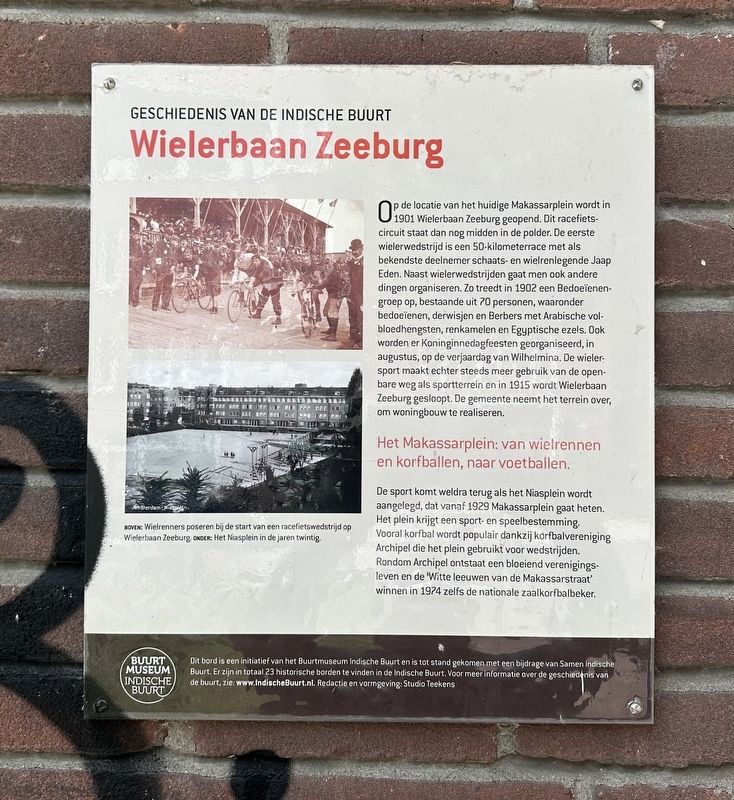
Op de locatie van het huidige Makassarplein wordt in 1901 Wielerbaan Zeeburg geopend. Dit racefiets-circuit staat dan nog midden in de polder. De eerste wielerwedstrijd is een 50-kilometerrace met als bekendste deelnemer schaats- en wielrenlegende Jaap Eden. Naast wielerwedstrijden gaat men ook andere dingen organiseren. Zo treedt in 1902 een Bedoeïenengroep op, bestaande uit 70 personen, waaronder bedoeïenen, derwisjen en Berbers met Arabische volbloedhengsten, renkamelen en Egyptische ezels. Ook worden er Koninginnedagfeesten georganiseerd, in augustus, op de verjaardag van Wilhelmina. De wielersport maakt echter steeds meer gebruik van de openbare weg als sportterrein en in 1915 wordt Wielerbaan Zeeburg gesloopt. De gemeente neemt het terrein over, om woningbouw te realiseren.
Het Makassarplein: van wielrennen en korfballen, naar voetballen.
De sport komt weldra terug als het Niasplein wordt aangelegd, dat vanaf 1929 Makassarplein gaat heten. Het plein krijgt een sport- en speelbestemming. Vooral korfbal wordt populair dankzij korfbalvereniging Archipel die het plein gebruikt voor wedstrijden. Rondom Archipel ontstaat een bloeiend verenigingsleven en de 'Witte leeuwen van de Makassarstraat' winnen in 1974 zelfs de nationale zaalkorfbalbeker.
Zeeburg Velodrome
The
this page online
Makassarplein: from cycling and korfball to football.
Sports returned to the area with the construction of Niasplein—renamed Makassarplein in 1929—which was designated for sports and recreation. Korfball, in particular, became popular thanks to the Archipel club, which used the square for its matches. A thriving club culture grew around Archipel, and the "White Lions of Makassarstraat" even won the national indoor korfball cup in 1974.
Erected by Buurt Museum Indische Buurt.
Topics. This historical marker is
Photographed by Andrew Ruppenstein, June 5, 2026
2. Wielerbaan Zeeburg / Zeeburg Velodrome Marker - wide view
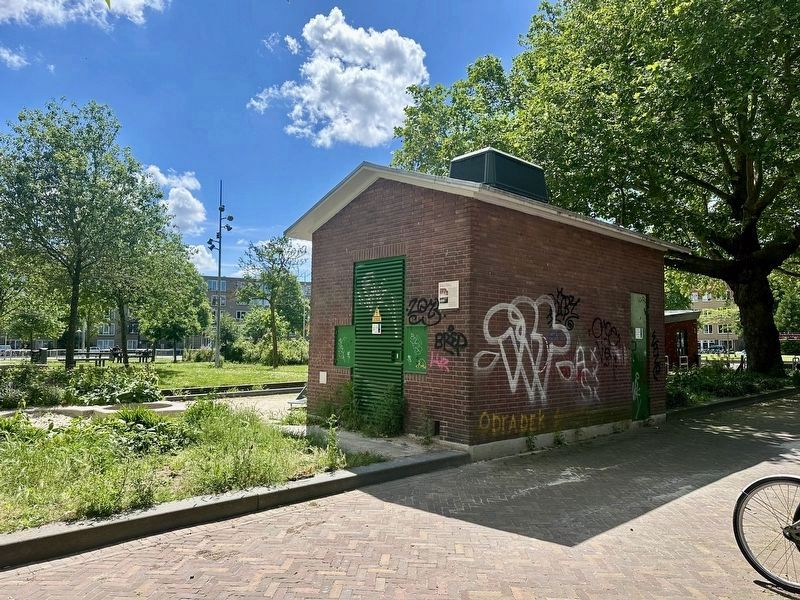
The marker can be seen here mounted to the exterior of some sort of utility structure. It can easily be seen from the street, but it is easy to miss as it isn’t in a location where one would expect such.
Location. 52° 21.895′ N, 4° 56.513′ E. Marker is in Amsterdam, Noord-Holland (North Holland). It is in Indische Buurt. It is on Gorontalostraat near Niasstraat, on the right when traveling south. Touch for map. Marker is at or near this postal address: Niasstraat 16Z, Amsterdam, Noord-Holland 1094 BK, Netherlands. Touch for directions.

Regionally, it is in Europe, the European Union, Atlantic Europe, the Benelux Low Countries, the Schengen Area, Western Europe, and the Western World. Historically, it finds itself in what was once the Holy Roman Empire.
Other nearby markers. At least 8 other markers are within walking distance of this marker: Het Badhuis / The Bathhouse (about 210 meters away, measured in a direct line); Het Zeeburgerdorp (approx. 0.4 kilometers away); De 3de Ambachtsschool / The Third Vocational School (approx. 0.4 kilometers away); Laplace (approx. one kilometer away); Archimedes (approx. one kilometer away); Isaac Newton (approx. 1.1 kilometers away); Copernicus (approx. 1.1 kilometers away); Kepler (approx. 1.1 kilometers away). Touch for a list and map of all markers in Amsterdam.
Regarding Wielerbaan Zeeburg / Zeeburg Velodrome. The sport Korfball, mentioned on the marker, is, according to Wikipedia:
a ball sport with similarities to netball, basketball, and ringball. The objective is to throw a ball into a netless basket that is mounted on a 3.5 m (11.5-foot) pole. Each team is composed of four female players and four male players. The sport was created in the Netherlands in 1902 by schoolteacher Nico Broekhuysen, and has since spread globally.
Credits. This page was last revised on June 13, 2026. It was originally submitted on June 13, 2026, by Andrew Ruppenstein of Lamorinda, California. This page has been viewed 11 times since then. Photos: 1, 2. submitted on June 13, 2026, by Andrew Ruppenstein of Lamorinda, California.
