District de Hull in Gatineau in Outaouais, Québec — Central Canada (French-Canadian)
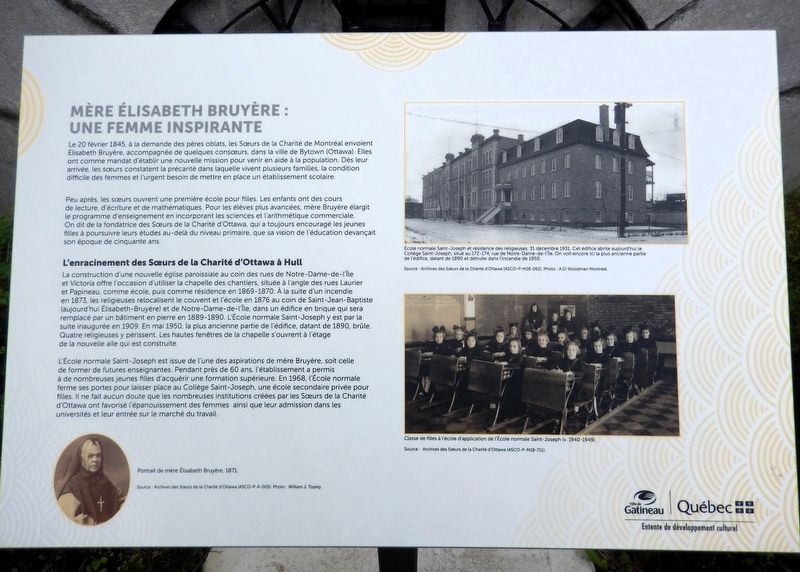
Mère Élisabeth Bruyère : une femme inspirante
Photographed by Cosmos Mariner, May 28, 2024
1. Mère Élisabeth Bruyère : une femme inspirante Marker

Peu après, les sœurs ouvrent une première école pour filles. Les enfants ont des cours de lecture, d'écriture et de mathématiques. Pour les élèves plus avancées, mère Bruyère élargit le programme d'enseignement en incorporant les sciences et l'arithmétique commerciale. On dit de la fondatrice des Sœurs de la Charité d'Ottawa, qui a toujours encouragé les jeunes filles à poursuivre leurs études au-delà du niveau primaire, que sa vision de l'éducation devançait son époque de cinquante ans.
L'enracinement des Sœurs de la Charité d'Ottawa à Hull
La construction d'une nouvelle église paroissiale au coin des rues de Notre-Dame-de-l'Île et Victoria offre l'occasion
this page online
L'École normale Saint-Joseph est issue de l'une des aspirations de mère Bruyère, soit celle de former de futures enseignantes. Pendant près de 60 ans, l'établissement a permis à de nombreuses jeunes filles d'acquérir une formation supérieure. En 1968, l'École normale ferme ses portes pour laisser place au Collège Saint-Joseph, une école secondaire privée pour filles. Il ne fait aucun doute que les nombreuses institutions créées par les Sœurs de la Charité d'Ottawa ont favorisé
Archives des Sœurs de la Charité d'Ottawa
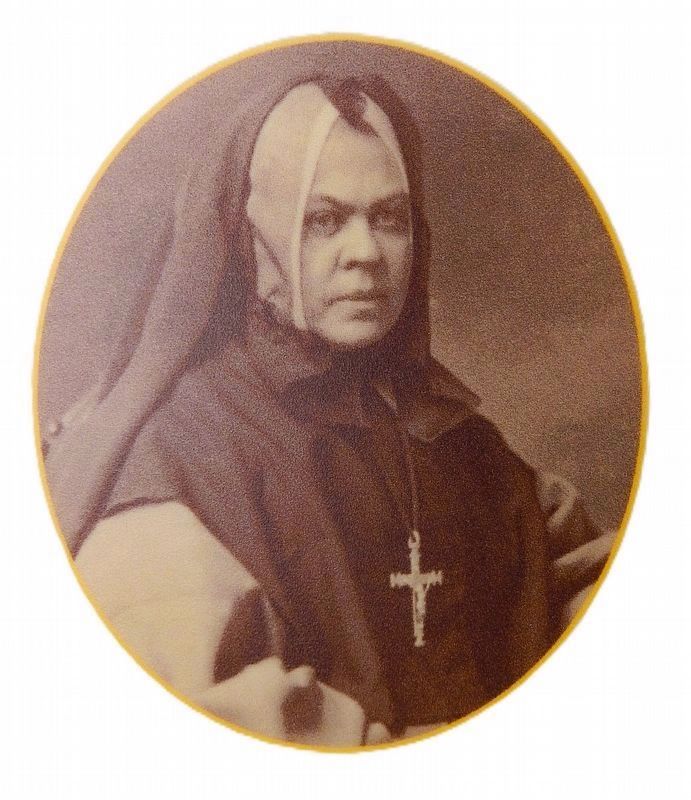
2. Marker detail: Mère Élisabeth Bruyère, 1871
Mother Élisabeth Bruyère: an inspiring woman
On February 20, 1845, at the request of the Oblate Fathers, the Sisters of Charity of Montreal sent Élisabeth Bruyère, accompanied by a few fellow sisters, to the town of Bytown (Ottawa). Their mission was to set up a new initiative to help the local population. As soon as they arrived, the sisters noticed the precarious living conditions of many families, the tough situation faced by women, and the urgent need to establish a school.
Soon after, the sisters opened their first school for girls. The children had lessons in reading, writing, and math. For the more advanced students, Mother Bruyère expanded the curriculum to include science and business arithmetic. People say that the founder of the Sisters of Charity of Ottawa, who always encouraged young girls to continue their studies beyond the primary level, had an educational vision that was fifty years ahead of her time.
The Establishment of the Sisters of Charity of Ottawa in Hull
The construction of a new
A.D. Woodman, Archives des Sœurs de la Charité d'Ottawa
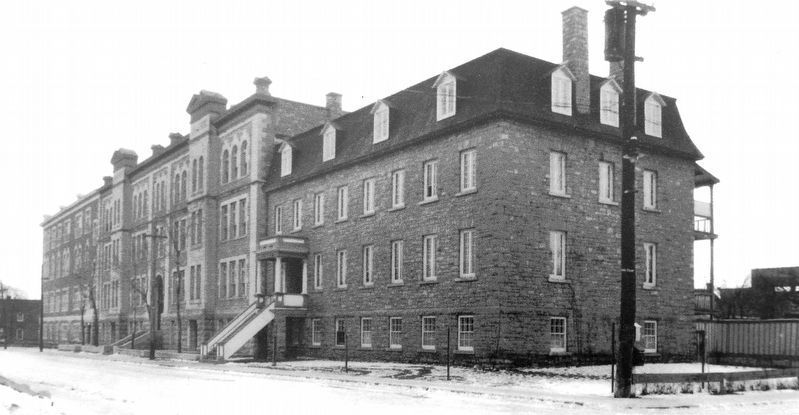
3. Marker detail: École normale Saint-Joseph et résidence des religieuses, 31 décembre 1931.
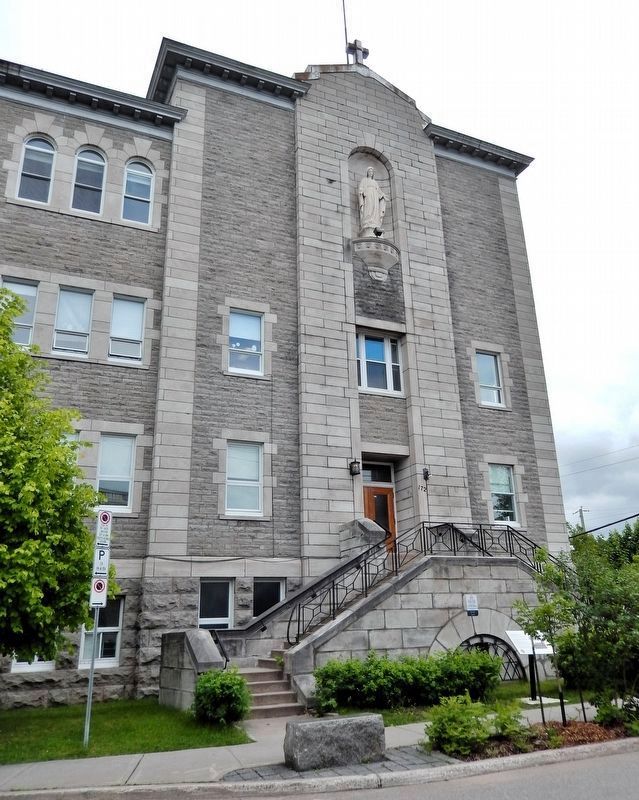
Cet édifice abrite aujourd'hui le Collège Saint-Joseph. On voit encore ici la plus ancienne partie de l'édifice, datant de 1890 et détruite dans l'incendie de 1950. • • • Saint-Joseph Normal School and the nuns' residence, December 31, 1931. Today, this building houses the Saint-Joseph College. You can still see the oldest part of the building here, dating back to 1890 and destroyed in the 1950 fire.
Saint Joseph Normal School came from one of Mother Bruyère's aspirations, which was to train future teachers. For nearly 60 years, the school allowed many young girls to receive higher education. In 1968, the Normal School closed its doors to make way for Collège Saint-Joseph, a private secondary school for girls. There’s no doubt that the many institutions created by the Sisters of Charity of Ottawa helped
Archives des Sœurs de la Charité d'Ottawa
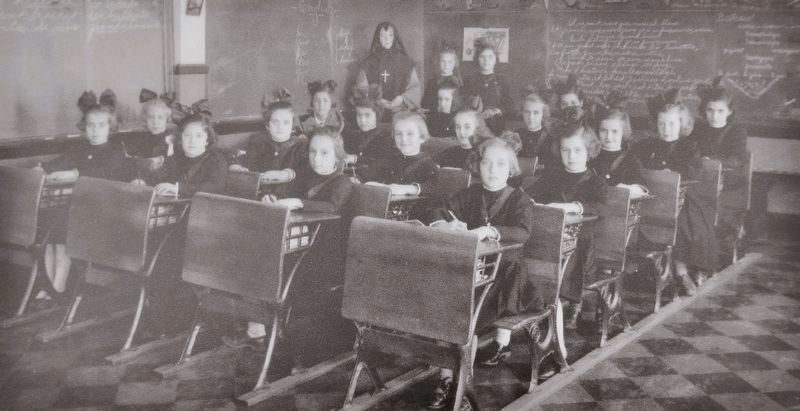
4. Marker detail: Classe de filles à l’école d’application de l’École normale Saint-Joseph, 1940-1949
Girls' class at the Saint-Joseph Normal School Training School, c. 1940-1949.
Erected by Ville de Gatineau, Québec, Entente de développement culturel.
Topics. This historical marker is listed in these topic lists: Charity & Public Work • Education • Religion & Religious Structures • Women. A significant historical date for this entry is February 20, 1845.
Location. 45° 25.867′ N, 75° 42.65′ W. Marker is in Gatineau, Québec, in Outaouais. It is in District de Hull. It is at the intersection of Rue Notre-Dame-de-l'île and Rue Élisabeth-Bruyère, on the left when traveling south on Rue Notre-Dame-de-l'île. The marker is near the southwest corner of Collège Saint-Joseph de Hull. Touch for map. Marker is at or near this postal address: 174 Rue Notre-Dame-de-l'île, Gatineau QC J8X 3T3, Canada. Touch for directions.

Regionally, this marker is in the Ottawa Metropolitan Area and in the Outaouais & Eastern Townships. It is also in Central Canada. Globally, it is in North America, the Great North Woods, the Western Hemisphere, and the Western World. Historically, it finds itself in what was once a British colony, the Viceroyalty of New France,
Photographed by Cosmos Mariner, May 28, 2024
5. Mère Élisabeth Bruyère Marker
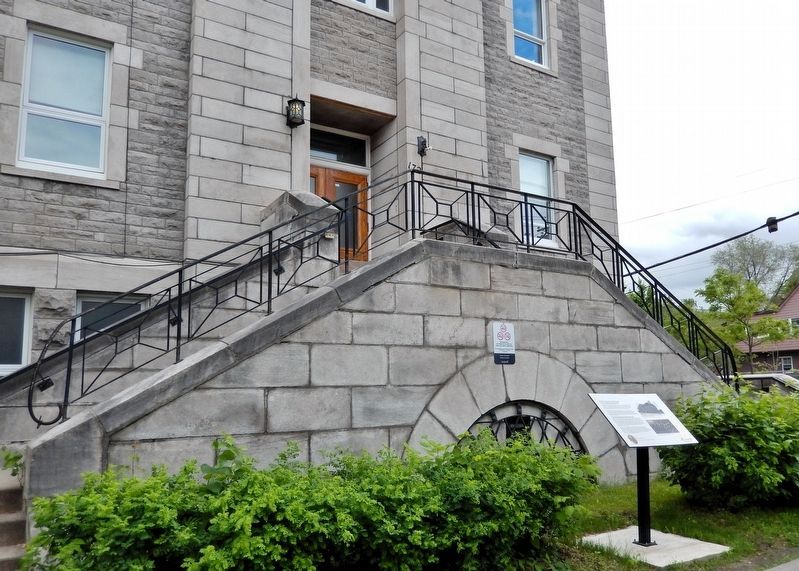
The marker is beside the sidewalk at the Collège Saint-Joseph de Hull southwest entrance.
Other nearby markers. At least 8 other markers are within walking distance of this marker: École Normale St-Joseph (a few steps from this marker); Le Quartier-du-Musée : Un lieu résidentiel, commercial et professionnel (about 90 meters away, measured in a direct line); Deux cents ans d'essor / 200 Years in the Making (about 120 meters away); Le Quartier-du-Musée : Des habitants qui ont marqué l'histoire de Hull (about 150 meters away); Le Parlement du Canada / Canada's Parliament (approx. 0.3 kilometers away); La Tour de Lessivage / The Digester Tower (approx. 0.3 kilometers away); Tessouat (approx. 0.4 kilometers away); Une histoire marquée par les flammes (approx. 0.6 kilometers away). Touch for a list and map of all markers in Gatineau.
Related markers. Click here for a list of markers that are related to this marker. Mère Élisabeth Bruyère
Also see . . . Élisabeth Bruyère (1818-1876) (Wikipedia).
Excerpt: In 1839, she joined the Sisters of Charity of the Hôpital Général of Montreal, also known as the Grey Nuns. In 1845, she was asked to set(Submitted on June 14, 2026, by Cosmos Mariner of Cape Canaveral, Florida.)up a community of the Sisters of Charity at Bytown. With three other Grey Nuns, she established Roman Catholic schools, hospitals and orphanages there. In 1854, the community in Bytown became independent of Montreal. Although the Sisters of Charity cared for people of every religious denomination during the typhus outbreak in 1847, a Protestant General Hospital, later the Ottawa Civic Hospital, was opened in 1850. The Sisters of Charity were also responsible from 1870 to 2001 of the school which became today the Collège Saint-Joseph de Hull in Gatineau, the city's girl school and one of two private secondary institutions.Photographed by Cosmos Mariner, May 28, 20246. Collège Saint-Joseph de Hull
(southwest corner)
Credits. This page was last revised on June 15, 2026. It was originally submitted on June 14, 2026, by Cosmos Mariner of Cape Canaveral, Florida. This page has been viewed 12 times since then. Photos: 1, 2, 3, 4, 5, 6. submitted on June 14, 2026, by Cosmos Mariner of Cape Canaveral, Florida.
