East End in Melbourne, Victoria, Australia — Oceania
The Palace 1840 - 1919
Part I
Photographed by Dean Barton-Ancliffe, June 3, 2026
1. The Palace Marker
- The Age, 8 April 1912
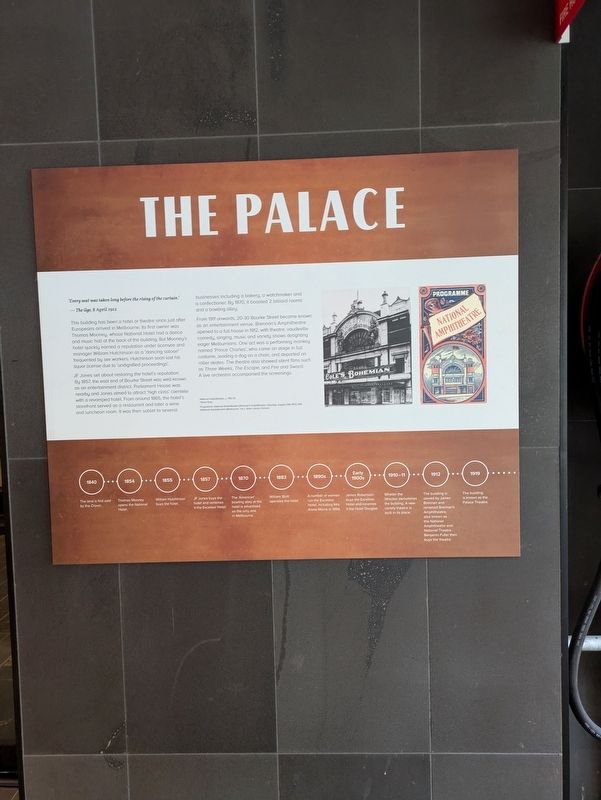
This building has been a hotel or theatre since just after Europeans arrived in Melbourne. Its first owner was Thomas Mooney, whose National Hotel had a dance and music hall at the back of the building. But Mooney's hotel quickly earned a reputation under licensee and manager William Hutchinson as a 'dancing saloon' frequented by sex workers. Hutchinson soon lost his liquor license due to 'undignified proceedings'.
JF Jones set about restoring the hotel's reputation. By 1857, the east end of Bourke Street was well-known as an entertainment district. Parliament House was nearby and Jones aimed to attract 'high class' clientele with a revamped hotel. From around 1865, the hotel's storefront served as a restaurant and later a wine and luncheon room. It was then subject to several businesses including a bakery, a watchmaker and a confectioner. By 1870, it boasted 2 billiard rooms and a bowling alley.
From 1911 onwards, 20-30 Bourke Street became known as an entertainment venue. Brennan's Amphitheatre opened to a full house in 1912,
this page online
1840 The land is first sold by the Crown.
1854 Thomas Mooney opens the National Hotel.
1855 William Hutchinson buys the hotel.
1857 JF Jones buys the hotel and renames it the Excelsior Hotel.
1883 William Stutt operates the hotel.
1890s A number of women run the Excelsior Hotel, including Mrs Annie Morris in 1894.
Early 1900s James Robertson buys the Excelsior Hotel and renames it the Hotel Douglas.
1910-11 Whelan the Wrecker demolishes the building. A new variety theatre is built in its place.
1912 The building is owned by James Brennan and renamed Brennan's Amphitheatre, also known as the National Amphitheatre and National Theatre. Benjamin Fuller then buys the theatre.
1919 The building is known as the Palace Theatre
Topics. This historical
Photographed by Dean Barton-Ancliffe, June 3, 2026
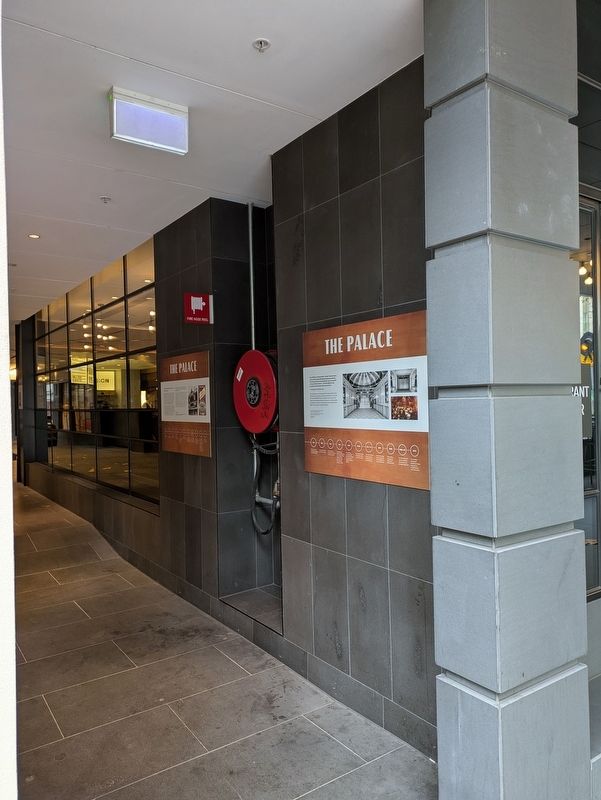
2. The Two Palace Markers in the Courtyard
Location. 37° 48.689′ S, 144° 58.33′ E. Marker is in Melbourne, Victoria. It is in East End. It is on Bourke Street 0.1 kilometers west of Spring Street, on the left when traveling east. Touch for map. Marker is at or near this postal address: 20 Bourke Street, Melbourne VIC 3000, Australia. Touch for directions.

Regionally, it is in Oceania, in Australasia, in the Pacific Ocean, in South Pacific, on the Pacific Rim, in the Western World, and in the Anglosphere. Historically, it finds itself in what was once a British colony.
Other nearby markers. At least 8 other markers are within walking distance of this marker: 32-38 Bourke Street (here, next to this marker); The Palace 1934 - 2007 (a few steps from this marker); Bourke Street c1900. (within shouting distance of this marker); The Salvation Army Temple (within shouting distance of this marker); The Windsor Hotel (about 90 meters away, measured in a direct line); Victorian Houses of Parliament (about 120 meters away); Scotch College (about 150 meters away); Adam Lindsay Gordon 1932 (about 150 meters away). Touch for a list and map of all markers in Melbourne.
Also see . . . Palace Theatre, Melbourne. Wikipedia
The Palace Theatre (also known as The Palace) was an entertainment venue located in Melbourne, Australia. First built for live theatre in 1912, it was also used as a cinema and for live music. It was demolished except for its facade in 2020 after much community opposition, to be replaced by a Le Méridien hotel.(Submitted on June 15, 2026, by Dean Barton-Ancliffe of Rowville, Victoria.)
The Palace site had a rich history of entertainment uses through many many different incarnations over the decades 1912-2010s. Although altered many times, its superabundance of contributions to Melbourne's theatrical heritage made it worthy of preservation, arguments which unfortunately did not prevent its destruction.
Credits. This page was last revised on June 15, 2026. It was originally submitted on June 15, 2026, by Dean Barton-Ancliffe of Rowville, Victoria. This page has been viewed 8 times since then. Photos: 1, 2. submitted on June 15, 2026, by Dean Barton-Ancliffe of Rowville, Victoria. • Andrew Ruppenstein was the editor who published this page.
