Ballyvoloon in Cobh in County Cork, Munster, Ireland — Irish South-West ((Éire) North Atlantic Ocean)
Lusitania Peace Memorial

Photographed by Ian Lefkowitz, May 15, 2026
1. Lusitania Peace Memorial Marker

Following the Lusitania incident and as a mark of respect, the Irish American Sculptor Jerome Connor was commissioned by the New York Memorial Committee to sculpt a memorial to this tragedy to be installed in Cobh, County Cork. Cobh was chosen as it was known as
‘the gateway between the new and old worlds’
and it is where many of the Lusitania victims are buried. Jerome Connor had previously worked on a Lusitania memorial to Elbert and Alice Hubbard in East Aurora, New York. Both had died on the Lusitania along with the father of William H. Vanderbilt, head of the New York Memorial Committee.
In 1952 the base was installed and the Bronze Fishermen were placed on top of it in. Sadly Jerome died before the memorial could be finished and it remained unfinished for many years.
But in 1965, thanks to the involvement and inspiration of Cork sculptor Domhall O’Murchaha and the campaigning by an American citizen Thomas J. Fox – Sean Lemass, Taoiseach of Ireland, ordered the Arts Council to oversee the completion of the monument in accordance with Jerome Connor’s design.
What you see today was completed in 1970. Although Jerome
this page online
It was always the intention that the names of the victims would be inscribed on the memorial. Today, thanks to technological advances, all 1,196 names can be viewed by visiting – www.corkcoco.ie/heritage or by accessing the QR Code provided.
[Gaeilge:]
As Gaeilge
Is scéal thar a bheith tragóideach é scéal an Lusitania a bhain aitheantas idirnáisiúnta amach ag an am. Ar an 7ú Bealtaine 1915 scaoil fomhuireán de chuid na Gearmáine toirpéad leis an Lusitania. Bhuail sé a sprioc agus chuaigh an Lusitania go tóin poill amach ón Seancheann dá bharr. Meastar gurbh é seo an eachtra, thar aon rud eile, a tharraing Meiriceá isteach sa Chéad Chogadh Domhanda.
Ar an dea-uair tarrtháileadh 700 paisinéir, ach ar an drochuair cailleadh 1,198. Tugadh na marthanóirí agus roinnt mhaith díobh siúd a cailleadh go dtí An Cóbh agus tugadh dídean dóibh sna hospidéil agus i bhfoirgnimh áitiúla.
Tá cuid des na príomhshulomhanna (m.sh. na háiteanna
Photographed by Ian Lefkowitz, May 15, 2026
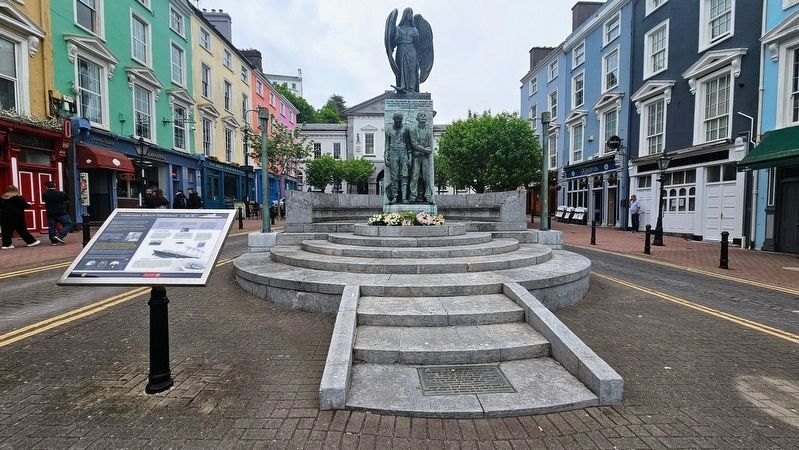
2. Lusitania Peace Memorial
The marker is located next to the memorial, located in Cobh's Casement Square.
The Lusitania Tragedy
The Lusitania, a Cunard passenger liner, was travelling between the United States of America and Liverpool, England when on the 07th May 1915, it was torpedoed and sunk by a German U-boat (U–20) off the Old Head of Kinsale. Some say the event is synonymous with World War One.
The sinking was a tragedy of overwhelming proportion. Although 764 passengers and crew survived, tragically, 1,196 passengers lost their lives. Both the survivors and many of those who lost their lives were ferried by boats to Cobh and accommodated in local buildings and hospitals.
Most of the key sites (e.g. landing sites, bollards) are still standing today and in nearby Cobh Museum, located on High Road, as well as in the Cobh Heritage Centre, artefacts relating to the Lusitania are on display. The Clonmel (Old Church) Cemetery, one mile north of the town, also contains interred therein, the souls of 168 victims who tragically died in this event.
Remembrance
The Lusitania Peace Memorial is a protected structure which provides a major focus of remembrance in the town of Cobh, a town which has perhaps more links to the Irish Diaspora than any other city in Ireland and indeed the town from which the last passengers for the Titanic embarked in 1912. Cobh was significant as a major emigration port for those who left Ireland for the United States and the Lusitania Peace Memorial serves as a solemn reminder of the town’s vast and varied maritime heritage. There is a wealth of Heritage sites in the Town of Cobh including Cobh Museum, Cobh Heritage Centre, the Titanic Experience, and from the edge of the square adjacent to this monument, a Historic Town Walking Trail begins.
Erected by Cork County Council Heritage Unit.
Topics. This historical marker and memorial is listed in these topic lists: Disasters • War, World I • Waterways & Vessels. A significant historical date for this entry is May 7, 1915.
Location. 51° 51.018′ N, 8° 17.709′ W. Marker is in Cobh, Munster, in County Cork. It is in Ballyvoloon. It is on Casement Square near Westbourne Place, on the left when traveling north. Touch for map. Marker is at or near this postal address: 3 Casement Square, Cobh, Munster, Ireland. Touch for directions.

Regionally, it is on the Atlantic Ocean, in the North Atlantic Region, on the Atlantic Arc, in Europe, on the Island of Ireland, on the Celtic Fringe, in the European Union, in Atlantic Europe, on one of the British Isles, in the Western World, and in the Anglosphere.
Other nearby markers. At least 8 other markers are within walking distance of this marker: S.S. Lusitania (here, next to this marker); John Hennessy (a few steps from this marker); RMS Mauretania (a few steps from this marker); a different marker also named Lusitania Peace Memorial (a few steps from this marker); Sonia O’Sullivan (within shouting distance of this marker); James Connolly (within shouting distance of this marker); Rob Roy Hotel (within shouting distance of this marker); White Star Line Office (within shouting distance of this marker). Touch for a list and map of all markers in Cobh.
Also see . . . Lusitania Victims (The Lusitania Resource). The link in the historical sign no longer works. However, in keeping with the stated goal of the monument, the full list of names is available at this link. (Submitted on June 16, 2026, by Ian Lefkowitz of New York, New York.)
Credits. This page was last revised on July 10, 2026. It was originally submitted on June 16, 2026, by Ian Lefkowitz of New York, New York. This page has been viewed 17 times since then. Photos: 1, 2. submitted on June 16, 2026, by Ian Lefkowitz of New York, New York. • Andrew Ruppenstein was the editor who published this page.
