Near Bainbridge in Decatur County, Georgia — The American South (South Atlantic)
Fort Scott
←
Photographed by David Seibert, May 16, 2012
1. Fort Scott Marker
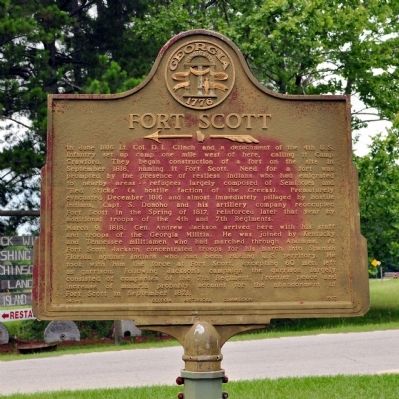
In June 1816 Lt. Col. D. L. Clinch and a detachment of the 4th U.S. Infantry set up camp one mile west of here, calling it Camp Crawford. They began construction of a fort on the site in September 1816, naming it Fort Scott. Need for a fort was prompted by the presence of restless Indians who had emigrated to nearby areas -- refugees largely composed of Seminoles and “Red Sticks” (a hostile faction of the Creeks). Prematurely evacuated December 1816 and almost immediately pillaged by hostile Indians, Capt. S. Donoho and his artillery company reoccupied Fort Scott in the Spring of 1817, reinforced later that year by additional troops of the 4th and 7th Regiments.
March 9, 1818, Gen. Andrew Jackson arrived here with his staff and troops of the Georgia Militia. He was joined by Kentucky and Tennessee militiamen, who had marched through Alabama. At Fort Scott Jackson concentrated troops for his march into Spanish Florida against Indians who had been raiding U.S. territory. He took with him the force at Fort Scott, excepting 60 men left as garrison. Following Jackson’s campaign the garrison largely consisted of companies
this page online
Erected 1962 by Georgia Historical Commission. (Marker Number 043-5.)
Topics and series. This historical marker is listed in this topic list: Wars, US Indian. In addition, it is included in the Georgia Historical Society series list. A significant historical month for this entry is March 1890.
Location. 30° 46.148′ N, 84° 44.065′ W. Marker is near Bainbridge, Georgia, in Decatur County. It is on Hutchinson Ferry Road (Georgia Route 97 Spur) near Wingate Road, on the left when traveling north. The marker is at the Jack Wingate Fishing Lodge. Touch for map. Marker is in this post office area: Bainbridge GA 39819, United States of America. Touch for directions.

Regionally, this marker is on the Coastal Plain. It is also in the American South and specifically in the Deep South. Globally, it is in North America, the Western Hemisphere, the Western World, and the Anglosphere. Historically, it finds itself in what was once the territory of the Mississippian Culture, one of the original Thirteen Colonies,
Photographed by David Seibert, May 16, 2012
2. Fort Scott Marker
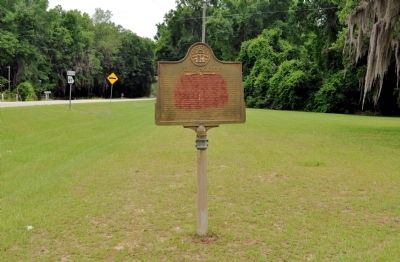
Looking south, with Hutchinson Ferry Road (GA 97 Spur) on the left.
Other nearby markers. At least 8 other markers are within 8 miles of this marker, measured as the crow flies: Camp Recovery (approx. 1.1 miles away); Camp Recovery Monument (approx. 1.1 miles away); Joshua Davis House (approx. 5.6 miles away in Florida); Ira Sanborn (approx. 5.6 miles away); Apalachicola Arsenal (approx. 7.3 miles away in Florida); Charles James Munnerlyn / “Refuge” (approx. 7.4 miles away); Village of Fowltown (approx. 7.4 miles away); a different marker also named Apalachicola Arsenal (approx. 7.6 miles away in Florida). Touch for a list and map of all markers in Bainbridge.
Regarding Fort Scott. The site of Fort Scott is now under the waters of Lake Seminole, created by damming the Chattahoochee River. A cannon, erected as a monument to mark the site of Fort Scott, has been moved to J. D. Chason Park in Bainbridge.
Photographed by David Seibert, May 16, 2012
3. Fort Scott Marker
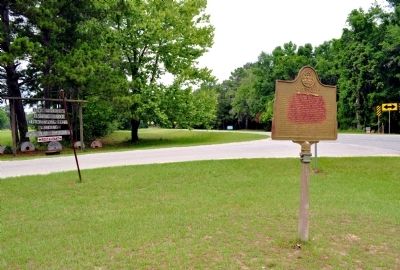
Looking north, with Hutchinson Ferry Road (GA Highway 97 Spur) on the right, and Wingate Road, leading to the Jack Wingate Fishing Lodge, in the foreground.
Photographed by David Seibert, May 16, 2012
4. Fort Scott Marker
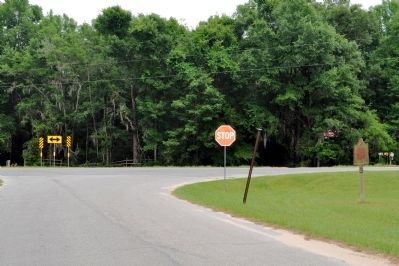
Looking east on Wingate Road at the intersection with Hutchinson Ferry Road (GA Highway 97 Spur).
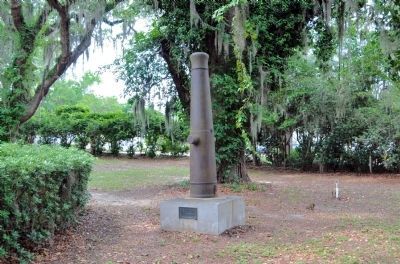
Photographed by David Seibert, May 16, 2012
5. Fort Scott Monument
This 32 pound cannon was one of three obtained from Fort Clinch, Florida, to mark the site of Fort Scott. (The other two marked Fort Hughes and Camp Recovery.) When the creation of the Jim Woodruff Reservoir inundated the site of Fort Scott, the cannon was moved to the J.D. Chason Memorial Park in Bainbridge, the site of Fort Hughes.
Credits. This page was last revised on June 17, 2026. It was originally submitted on May 20, 2012, by David Seibert of Sandy Springs, Georgia. This page has been viewed 1,785 times since then and 118 times this year. Last updated on June 17, 2026, by James L.Whitman of Eufaula, Alabama. Photos: 1, 2, 3, 4. submitted on May 20, 2012, by David Seibert of Sandy Springs, Georgia. 5. submitted on June 1, 2012, by David Seibert of Sandy Springs, Georgia. • Devry Becker Jones was the editor who published this page.
