Jefferson Township near Jeffersonville in Fayette County, Ohio — The American Midwest (Great Lakes)
Ohio Native Plants
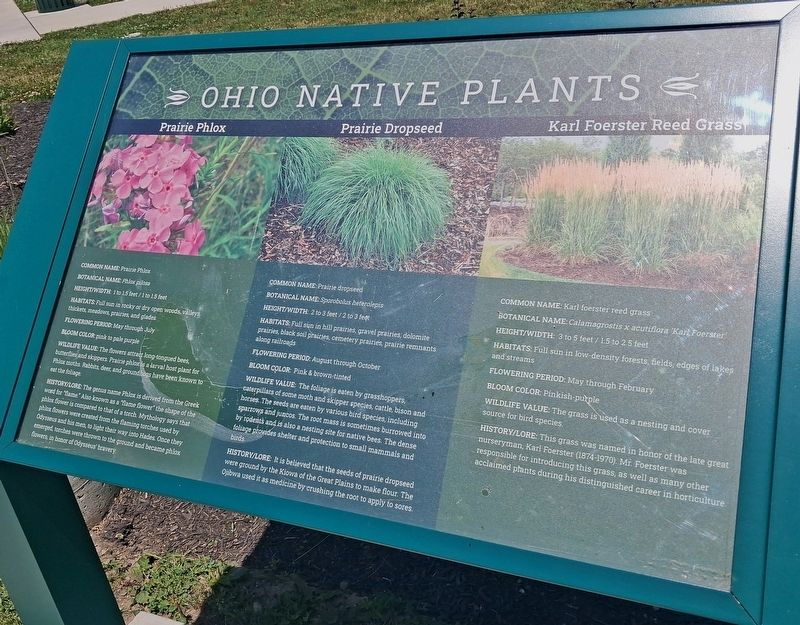
Photographed by William Fischer, Jr., June 13, 2026
1. Ohio Native Plants Marker
Prairie Phlox
COMMON NAME:Prairie Phlox
BOTANICAL NAME: Phlox pilosa
HEIGHT/WIDTH: 1 to 1.5 feet / 1 to 1.5 feet
HABITATS: Full sun in rocky or dry open woods, valleys
thickets, meadows, prairies, and glades
FLOWERING PERIOD: May through July
BLOOM COLOR: pink to pale purple
WILDLIFE VALUE: The flowers attract long-tongued bees,
butterflies and skippers. Prairie phlox a larval host plant for
Phlox moths. Rabbits, deer, and grounhogs have been known to
eat the foliage.
HISTORY/LORE: The genus name Phlox is derived from the Greek
word for "flame." Also known as a "flame flower" the shape of the
phlox flower is compared to that of a torch. Mythology says that
phlox flowers were created from the flaming torches used by
Odysseus and his men, to light their way into Hades. Once they
emerged, torches were thrown to the ground and became phlox
flowers in honor of Odysseus' bravery.
Prairie Dropseed
COMMON NAME:Prairie dropseed
BOTANICAL NAME: Sporobolus betelep
HEIGHT/WIDTH: 2 to 3 feet / 2 to 3 feet
HABITATS: Full sun hill prairies, gravel prairies, dolomite
prairies, black sol prairies, cemetery prairies,
this page online
along railroads
FLOWERING PERIOD: August through October
BLOOM COLOR: Pink & brown tinted
WILDLIFE VALUE: The foliage is eaten by grasshoppers,
caterpillars of some moth and skipper species, cattle, bison and
horses. The seeds are eaten by various bird species, including
sparrows and juncos. The root mass is sometimes burrowed into
by rodents and is also a nesting site for native bees. The dense
foliage provides shelter and protection to small mammals and birds.
HISTORY/LORE: It is believed that the seeds of prairie dropseed
were ground by the Kiowa of the Great Plains to make flour. The
Ojibwa used it as medicine by crushing the root to apply to sores.
Karl Foerster Reed Grass
COMMON NAME:Karl [F]oerster reed grass
BOTANICAL NAME: Calamagrostis x acutiflora Karl Foerster
HEIGHT/WIDTH: 3 to 5 feet / 1.5 to 2.5 feet
HABITATS: Full sun in low-density forests, fields, edges of lakes and streams
FLOWERING PERIOD: May through February
BLOOM COLOR: Pinkish-purple
WILDLIFE VALUE: The grass is used as a nesting and cover
source for bird species.
HISTORY/LORE: This grass was named in honor of the late
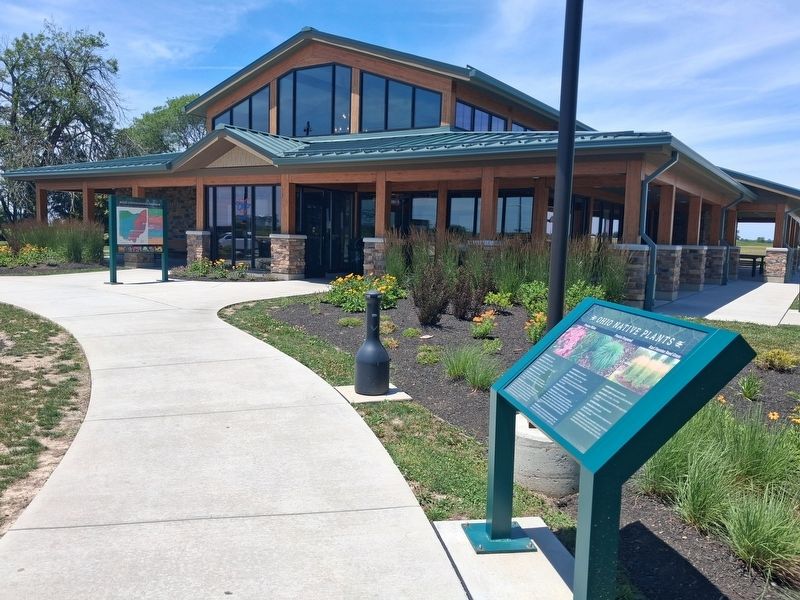
Photographed by William Fischer, Jr., June 13, 2026
2. Ohio Native Plants Marker
nurseryman, Karl Foerster (1874-1970) Mr. Foerster was responsible
for introducing this grass, as well as many other acclaimed plants
during his distinguished career in horticulture
Erected 2025 by Ohio Department of Transportation.
Topics. This historical marker is listed in these topic lists: Arts, Letters, Music • Horticulture & Forestry • Indigenous Peoples and Communities.
Location. 39° 38.209′ N, 83° 34.439′ W. Marker is near Jeffersonville, Ohio, in Fayette County. It is in Jefferson Township. It is on Interstate 71 at milepost 68, on the right when traveling south. Marker is on the Fayette County (Garmhausen) Southbound Rest Area grounds. Touch for map. Marker is in this post office area: Jeffersonville OH 43128, United States of America. Touch for directions.

Regionally, this marker is in Southern Ohio Hill Country. It is also in the American Midwest and in the Corn Belt. Globally, it is in North America, the Western Hemisphere, the Western World, and the Anglosphere. Historically, it finds itself in what was once the Haudenosaunee (Iroquois) Confederacy, the territory of the Mississippian Culture, and the Northwest Territory.
Other nearby markers. At least 8 other markers are within 2 miles of this marker, measured as the crow flies: Garmhausen Roadside Rest Area (a few steps from this marker); a different marker also named Ohio Native Plants (a few steps from this marker); Ohio's Physiographic Regions (a few steps from this marker); a different marker also named Ohio Native Plants (within shouting distance of this marker); a different marker also named Ohio Native Plants (within shouting distance of this marker); Ohio Buckeye Tree (within shouting distance of this marker); a different marker also named Ohio Native Plants (within shouting distance of this marker); Veterans Memorial (approx. 1.3 miles away). Touch for a list and map of all markers in Jeffersonville.
Credits. This page was last revised on June 17, 2026. It was originally submitted on June 17, 2026, by William Fischer, Jr. of Reynoldsburg, Ohio. This page has been viewed 8 times since then. Photos: 1, 2. submitted on June 17, 2026, by William Fischer, Jr. of Reynoldsburg, Ohio.
