De Cocksdorp in Texel, North Holland, Netherlands — Northwestern Europe
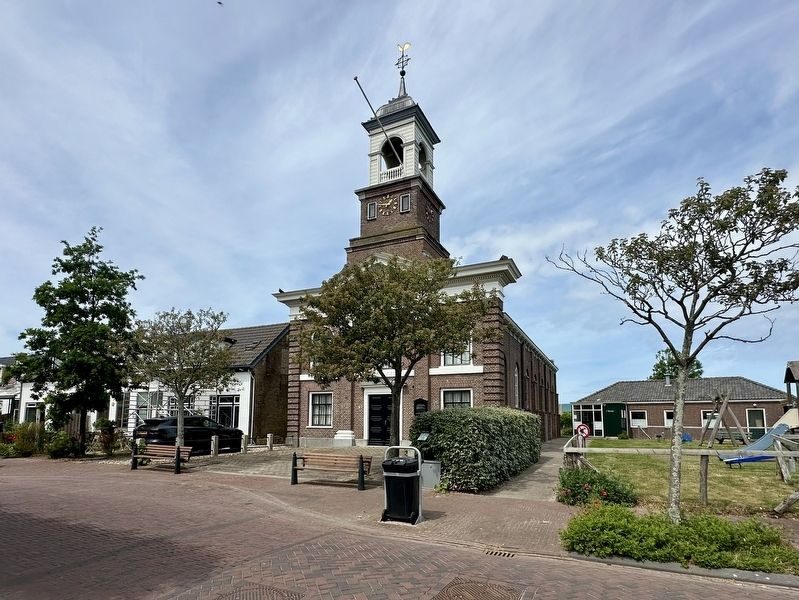
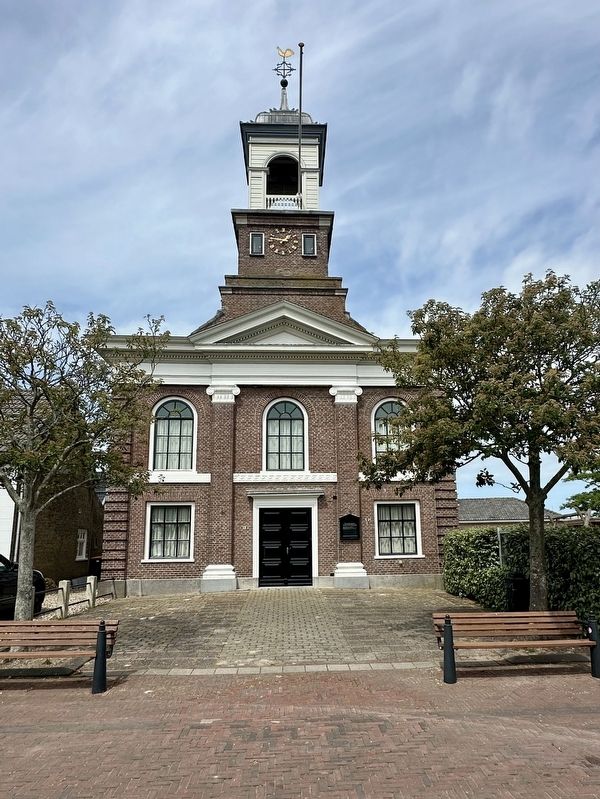
De Waddenkerk
⎯⎯⎯
The Wadden Church

Photographed by Andrew Ruppenstein, June 1, 2026
1. De Waddenkerk / The Wadden Church Marker
Note that: 1) The small text in the upper left is repeated on all 12+ similar markers in Decocksdorp, as it is, effectively, the origin story of the area, and 2) the URL provided on the marker seemingly does not work.

Bij de inschrijving voor de bouw van de Nederlandsch Hervormde Kerk voor het dorp in de polder Eierland kreeg de plaatselijke timmerman van der Kloot in september 1839 de opdracht. In de kerk is de geschiedenis vanaf de bouw tot de laatste restauratie die in 2012 werd afgerond, te lezen.
De polder Eierland is in 1835 ontstaan na bedijking van het Buitenveld, een kwelder oostelijk gelegen van de Zanddijk.
Deze stuifdijk werd ca. 1630 met gebruik van gevlochten matten van rijshout aangelegd tussen de duinen van de Koog en het voormalig eilandje Eyerland.
Deze zanddijk en de polder boven de Ruigendijk bepaalden de vorm van Texel.
The Wadden Church
In September 1839, the local carpenter Van der Kloot was awarded the contract to build the Dutch Reformed Church for the village in the Eierland polder. Inside the church, one can read about its history, spanning from its construction to the final restoration completed in 2012.
The Eierland polder was created in 1835 following the diking of the Buitenveld, a salt marsh located east of the Zanddijk.
This drift-sand dike was constructed around 1630—using woven brushwood mats—between the dunes of De Koog and the former small island of Eyerland.
This sand dike and the polder situated above the Ruigendijk determined the shape of Texel.
Topics.
this page online
Location. 53° 9.464′ N, 4° 52.521′ E. Marker is in De Cocksdorp, Noord-Holland (North Holland), in Texel. It is on Kikkertstraat. Touch for map. Marker is at or near this postal address: Kikkertstraat 85, De Cocksdorp, Noord-Holland 1795 AC, Netherlands. Touch for directions.

Regionally, this marker is on the German Wadden Sea. Globally, it is in Europe, the European Union, Atlantic Europe, the Benelux Low Countries, the Schengen Area, Western Europe, and the Western World. Historically, it finds itself in what was once the Holy Roman Empire.
Other nearby markers. At least 8 other markers are within walking distance of this marker: De Cocksdorp openbare lagere school / De Cocksdorp Public Primary School (within shouting distance of this marker); Stengweg (about 90 meters away, measured in a direct line); Gemaal Eijerland / Eijerland Pumping Station (about 90 meters away); De Cocksdorp - Kikkertstraat 59, Polderhuis (about 120 meters away); De Posthoorn / The Post Horn
Photographed by Andrew Ruppenstein, June 1, 2026
2. De Waddenkerk / The Wadden Church and marker
The marker is visible here in front of the bushes and behind the garbage can.
Also see . . . De Waddenkerk in De Cocksdorp (Waddenkerk, in Dutch). Excerpt (in translation):
The Eierland polder was drained in 1835. Construction of a Reformed church began four years later. Local carpenter Van der Kloot was awarded the contract for the building in September 1839. Initially named Nieuwdorp, the village soon became known as De Cocksdorp. It was named after De Cock, a cloth merchant from Antwerp who had initiated the reclamation of Eierland and overseen the development of the new polder's infrastructure. In 1840, the land allocation deed designated a site for the churchyard; it is located in the tree-lined area along Molenlaan. The church was inaugurated on June 6, 1841. A sum of 8,000 guilders (3,700 euros) was made available for the new building, which was constructed in a neoclassical style. In 1840, the pulpit—along with the accompanying church(Submitted on June 18, 2026.)council seats and baptismal enclosure—was acquired from the English Church in The Hague, which had closed in 1822. A local carpenter there had originally purchased the items for 83 guilders. This acquisition secured fine woodcarving for a mere 200 guilders. The first minister was appointed in 1841. By 1843, the church proved too small and was extended; that same year, it also received its first clock and tower. Unfortunately, during the Georgian Uprising (often referred to as the Russian Uprising) in May 1945, the church roof and some of the church council pews were damaged by shellfire. Restoration of the church and its interior took place after the war...Photographed by Andrew Ruppenstein, June 1, 20263. De Waddenkerk / The Wadden Church
Credits. This page was last revised on June 18, 2026. It was originally submitted on June 18, 2026, by Andrew Ruppenstein of Lamorinda, California. This page has been viewed 7 times since then. Photos: 1, 2, 3. submitted on June 18, 2026, by Andrew Ruppenstein of Lamorinda, California.
