Dungarvan in County Waterford, Munster, Ireland — Irish South-West ((Éire) North Atlantic Ocean)
Dungarvan Town
Photographed by Ian Lefkowitz, May 16, 2026
1. Dungarvan Town Marker
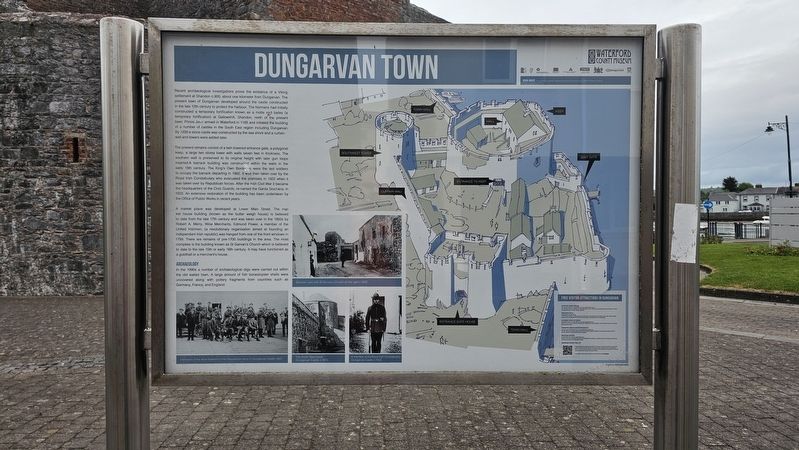
Recent archaeological investigations prove the existence of a Viking settlement at Shandon c.900, about one kilometer from Dungarvan. The present town of Dungarvan developed around the castle constructed in the late 12th century to protect the harbour. The Normans had initially constructed a temporary fortification known as a motte and bailey (a temporary fortification) at Gallowshill, Shandon, north of the present town. Prince John arrived in Waterford in 1185 and initiated the building of a number of castles in the South East region including Dungarvan. By 1209 a stone castle was constructed by the sea shore and a curtain-wall and towers were added later.
The present remains consist of a twin towered entrance gate, a polygonal keep, a large two storey tower with walls seven feet in thickness. The southern wall is preserved to its original height with later gun loops inserted. A barrack building was constructed within the walls in the early 18th century. The King’s Own Borderers were the last soldiers to occupy the barrack departing in 1882. It was then taken over by the Royal Irish Constabulary who evacuated the premises
this page online
A market place was developed at Lower Main Street. The market house building (known as the butter weigh house) is believed to date from the late 17th century and was taken over in the 1860s by Robert A. Merry, Wine Merchants. Edmund Power, a member of the United Irishmen, (a revolutionary organisation aimed at founding an independent Irish republic) was hanged from one of the front windows in 1799. There are remains of pre-1700 buildings in the area. The most complete is the building known as St Garvan’s Church which is believed to date to the late 15th or early 16th century. It may have functioned as a guildhall or a merchant’s house.
Archaeology
In the 1990s a number of archaeological digs were carried out within the old walled town. A large amount of fish bones/oyster shells were uncovered along with pottery fragments from countries such as Germany, France, and England.
(Captions)
Barrack Lane with St Garvan’s Church on the right c.1903.
Members of the West Waterford Irish Republican army in Dungarvan Castle 1922.
The South West tower, Dungarvan Castle, c.1890.
A member of the Royal Irish Constabulary, Dungarvan Castle c.1900.
Erected by Waterford
Photographed by Ian Lefkowitz, May 16, 2026
2. Dungarvan Town Marker
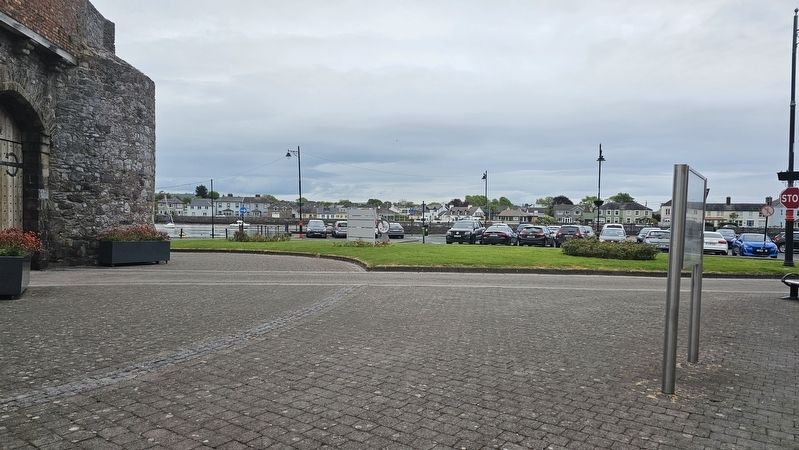
The marker is located in front of the entrance to Dungarvan Castle.
Topics. This historical marker is listed in these topic lists: Anthropology & Archaeology • Forts and Castles • Industry & Commerce. A significant historical year for this entry is 1209.
Location. 52° 5.343′ N, 7° 36.962′ W. Marker is in Dungarvan, Munster, in County Waterford. It is on Castle Street west of Davitts Quay, on the left when traveling east. Touch for map. Marker is at or near this postal address: 4 Castle Street, Dungarvan, Munster, Ireland. Touch for directions.

Regionally, this marker is in the Ancient East. Globally, it is on the Atlantic Ocean, in the North Atlantic Region, in Europe, on the Island of Ireland, on the Celtic Fringe, in the European Union, in Atlantic Europe, on one of the British Isles, in the Western World, and in the Anglosphere.
Other nearby markers. At least 8 other markers are within walking distance of this marker: St. Garvan’s Church (a few steps from this marker); In Memory of Waterford Men and Women Who Died In World War I (within shouting distance of this marker); James FX O’Brien (about 90 meters away, measured in a direct line); Cuan Dhún Garbhán / Dungarvan Harbour
Photographed by Ian Lefkowitz, May 16, 2026
3. Dungarvan Castle
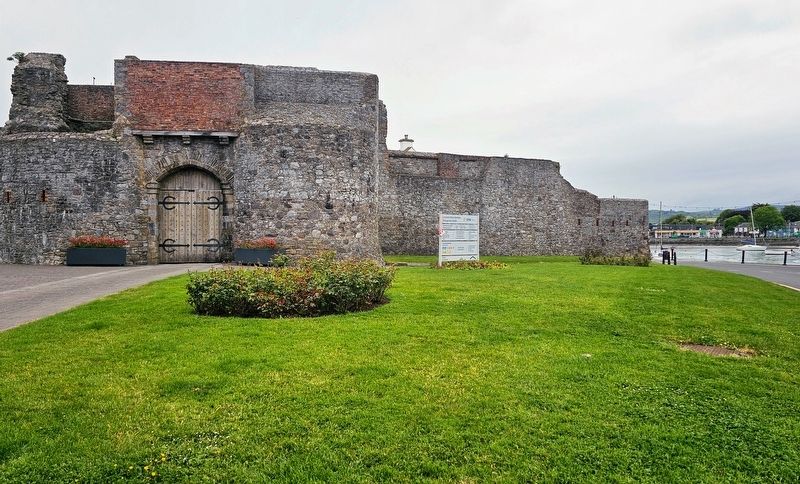
The medieval castle that Dungarvan Town was built around.
Credits. This page was last revised on June 18, 2026. It was originally submitted on June 18, 2026, by Ian Lefkowitz of New York, New York. This page has been viewed 13 times since then. Photos: 1, 2, 3. submitted on June 18, 2026, by Ian Lefkowitz of New York, New York. • Andrew Ruppenstein was the editor who published this page.
