
Getchell Township in Valley City in Barnes County, North Dakota — The American Midwest (Upper Plains)
A Taste of North Dakota
⎯⎯⎯
A Thoroughly Modern Farm
Photographed by Cosmos Mariner, August 27, 2022
1. A Taste of North Dakota / A Thoroughly Modern Farm Marker
A Taste of North Dakota
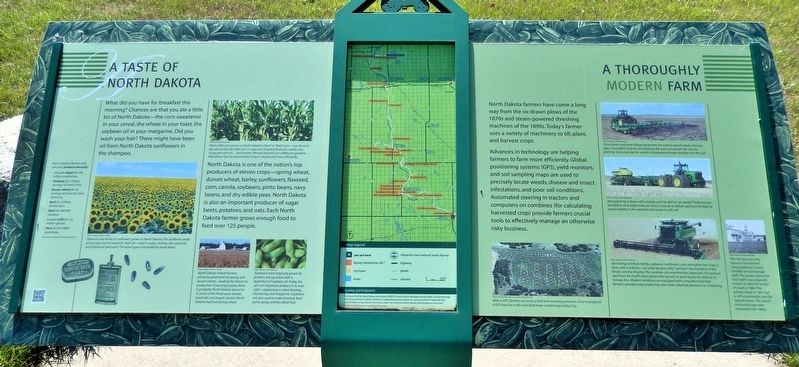
What did you have for breakfast this morning? Chances are that you ate a little bit of North Dakota — the corn sweetener in your cereal, the wheat in your toast, the soybean oil in your margarine. Did you wash your hair? There might have been oil from North Dakota sunflowers in the shampoo.
There are two kinds of sunflowers grown in North Dakota. The sunflower seeds of one type are harvested for their oil — used in soaps, cooking oils, salad oils, and industrial lubricants. The other type is harvested for snack foods.
Most of the corn grown in North Dakota is “dent” or “field” corn — not the kind you eat on the cob. Field corn is made into livestock feed, corn starch, corn syrup, and corn oil... and alcohol. Ethanol alcohol is an additive to gasoline that allows fuel (in automobiles) to burn cleaner and more efficiently.
North Dakota is one of the nation's top producers of eleven crops — spring wheat, durum wheat, barley, sunflowers, flaxseed, corn, canola, soybeans, pinto beans, navy beans, and dry edible peas. North Dakota is also an important producer of sugar beets, potatoes, and oats. Each North
this page online
North Dakota wheat farmers primarily grow hard red spring and durum wheat — leading the Nation in production. If you enjoy pasta, there is probably North Dakota durum in it. Some of the finest yeast breads, hard rolls, and bagels contain North Dakota hard red spring wheat.
Soybeans were originally grown for protein-rich soy meal, with a byproduct of soybean oil. Today, the oil is an important product in its own right — appearing in salad dressing, shortening, and margarine. Soybeans are also used to make livestock feed, paint, epoxy, and bio-diesel fuel.
North Dakota farmers and ranchers produce annually:
• Enough wheat for 108 billion sandwiches.
• Potatoes for 2 billion servings of French fries.
• Durum wheat for 93 servings of pasta for every American.
• Beef for 2 billion hamburgers.
• Wool for 640,000 sweaters.
• Enough milk for 1.6 million glasses.
• Pork for 65 million porkchops.
A Thoroughly Modern Farm
North Dakota farmers have come a long way from the ox-drawn plows of the 1870s and steam-powered threshing machines of the 1890s. Today's farmer uses a variety of machinery

Photo by Galyle Hansen, courtesy of Paul Metcalf
2. Marker detail: Corn Field Maze
With a GPS, farmers can work a field with amazing precision. A fun example of a GPS exercise is this corn field maze created near Valley City.
Advances in technology are helping farmers to farm more efficiently. Global positioning systems (GPS), yield monitors, and soil sampling maps are used to precisely locate weeds, disease and insect infestations, and poor soil conditions. Automated steering in tractors and computers on combines (for calculating harvested crop) provide farmers crucial tools to effectively manage an otherwise risky business.
Chisel plows and other tillage equipment are used to uproot weeds, mix last year's crop debris into the soil, break up the soil, and smooth the way for planting. Some can also be used to incorporate nitrogen fertilizer into the soil.
Most planting is done with a tractor and “air drill” or “air seeder.” Pulled across the field at six to eight miles per hour, it uses air to deliver seed and fertilizer to precise depths in the seed bed and covers it with soil.
Harvesting of wheat, barley, soybeans, sunflowers, corn, and other row crops is done with combines — so called because they combine the functions of the binder and the thresher. The combine cuts and threshes (separates the grain or seed from the chaff), then delivers the harvest to grain trucks for delivery to storage bins. Modern combines are equipped with computers that help farmers calculate crop production and make informed decisions on marketing.

Courtesy of Duane Borchert
3. Marker detail: Getchell Congregational Church & Township Hall
This site was once the home to the Getchell Congregational Church (middle) and parsonage (left). The present township hall (right) was originally known as Getchell School #1, built in 1880.
This site was once the home to the Getchell Congregational Church and parsonage. The present township hall was originally known as Getchell School #1, built in 1880. The school closed in 1951 but is still occasionally used for special events. The church and parsonage were removed in the 1960s.
Topics. This historical marker is listed in these topic lists: Agriculture • Education • Religion & Religious Structures • Settlements & Settlers.
Location. 47° 2.22′ N, 98° 0.163′ W. Marker is in Valley City, North Dakota, in Barnes County. It is in Getchell Township. It is at the intersection of 118th Avenue Southeast (County Road 21) and 26th Street Southeast, on the left when traveling north on 118th Avenue Southeast. Touch for map. Marker is at or near this postal address: 2603 118th Avenue Southeast, Valley City ND 58072, United States of America. Touch for directions.

Regionally, this marker is in North Dakota’s Red River Valley. It is also in the American Lewis & Clark Corridor, on the prairies, and on the Northern Plains. Globally, it is in North America,
Photographed by Cosmos Mariner, August 27, 2022
4. A Taste of North Dakota / A Thoroughly Modern Farm Marker
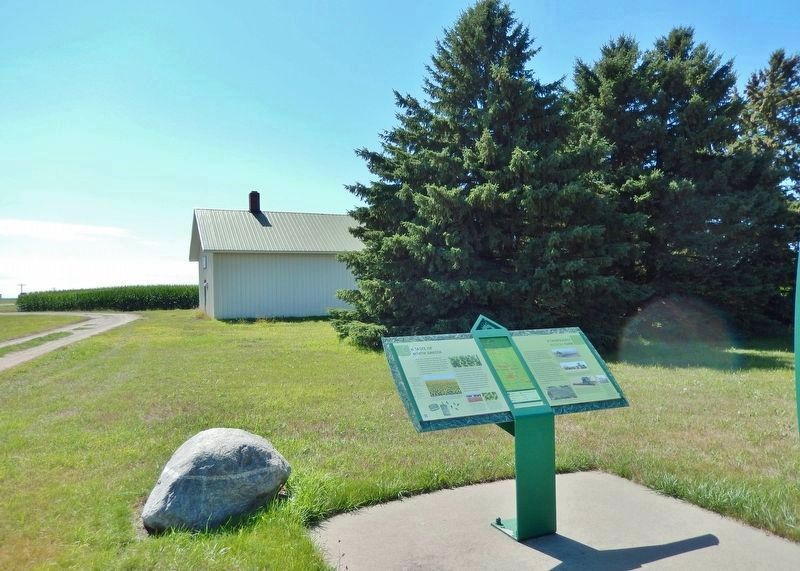
Looking south; Getchell Township Hall (originally known as Getchell School #1) is in the background.
Other nearby markers. At least 8 other markers are within 8 miles of this marker, measured as the crow flies: Bridge to Faith (approx. 5.4 miles away); High Above the Sheyenne (approx. 7 miles away); Northern Pacific High Line Bridge No. 64 (approx. 7 miles away); First Boy Scout Encampment in North Dakota (approx. 7 miles away); Our Sheyenne River (approx. 7½ miles away); Worldwide Daffodil Project (approx. 7.6 miles away); Votes For Women (approx. 7.7 miles away); Caboose (approx. 7.8 miles away). Touch for a list and map of all markers in Valley City.

Photographed by Cosmos Mariner, August 27, 2022
5. Getchell Township Hall 1883-1983
Originally known as Getchell School #1, built in 1880.
From the State Historical Society of North Dakota NDCRS Architectural Site Form recorded Kathy Wilner on 1/13/2017:
A one room prairie school sitting on a concrete foundation. The gable roof is covered with metal sheeting and the soffits are closed with metal as well. There is a red brick chimney near the east end of the roof. The building measures 40 feet east to west and 24½ feet north to south. This building is entirely covered with vertical metal siding. There is a newer entry door at the southwest corner, as well as newer entry door on the east side. In conversation with a township board member I learned that the windows were left in place when the siding was put on in the 1980's. The windows are double hung and might have some glass left. There is a foyer inside the entry door and small rooms to either side were coat rooms. The flooring is tongue and groove hard wood. The walls are covered with wall board and wainscot finishes the lower one-third of the wall. There is blackboard on the west wall. An oil burner sits inside the south part of the school room and is still used today.
From the State Historical Society of North Dakota NDCRS Architectural Site Form recorded Kathy Wilner on 1/13/2017:
A one room prairie school sitting on a concrete foundation. The gable roof is covered with metal sheeting and the soffits are closed with metal as well. There is a red brick chimney near the east end of the roof. The building measures 40 feet east to west and 24½ feet north to south. This building is entirely covered with vertical metal siding. There is a newer entry door at the southwest corner, as well as newer entry door on the east side. In conversation with a township board member I learned that the windows were left in place when the siding was put on in the 1980's. The windows are double hung and might have some glass left. There is a foyer inside the entry door and small rooms to either side were coat rooms. The flooring is tongue and groove hard wood. The walls are covered with wall board and wainscot finishes the lower one-third of the wall. There is blackboard on the west wall. An oil burner sits inside the south part of the school room and is still used today.
Credits. This page was last revised on June 19, 2026. It was originally submitted on June 18, 2026, by Cosmos Mariner of Cape Canaveral, Florida. This page has been viewed 15 times since then. Photos: 1, 2, 3, 4, 5. submitted on June 19, 2026, by Cosmos Mariner of Cape Canaveral, Florida.
