Soho in City of Westminster in Greater London, England, United Kingdom — Northwestern Europe (the British Isles)
Soho Square
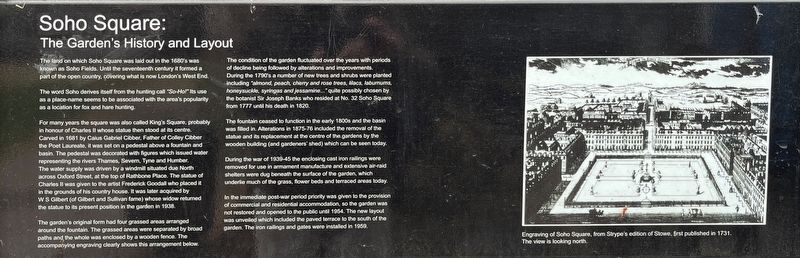
The Garden's History and Layout
Photographed by Ray Gurganus, April 5, 2026
1. Soho Square Marker
The word Soho derives itself from the hunting call "So-Hol" its use as a place-name seems to be associated with the area's popularity as a location for fox and hare hunting.
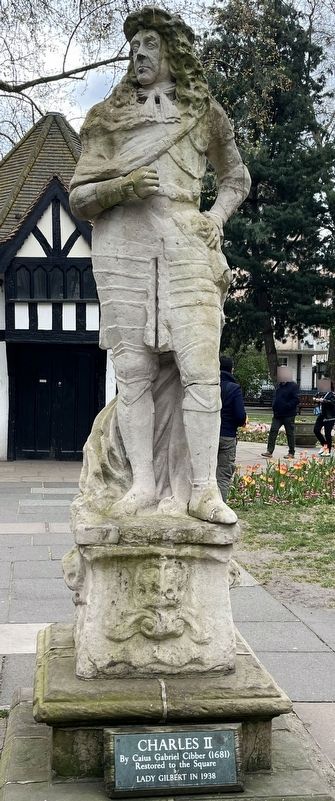
For many years the square was also called King's Square, probably in honour of Charles II whose statue then stood at its centre. Carved in 1681 by Caius Gabriel Cibber, Father of Colley Cibber the Poet Laureate, it was set on a pedestal above a fountain and basin. The pedestal was decorated with figures which issued water representing the rivers Thames, Severn, Tyne and Humber. The water supply was driven by a windmill situated due North across Oxford Street, at the top of Rathbone Place. The statue of Charles II was given to the artist Frederick Goodall who placed it in the grounds of his country house. It was later acquired by W.S. Gilbert (of Gilbert and Sullivan fame) whose widow returned the statue to its present position in the garden in 1938.
The
this page online
The condition of the garden fluctuated over the years with periods of decline being followed by alterations and improvements. During the 1700's a number of new trees and shrubs were planted including "almond, peach, cherry and rose trees, lilacs, laburnums, honeysuckle, syringas, and jessamine..." possibly chosen by the botanist Joseph Banks who resided at No. 32 Soho Square from 1777 until his death in 1820.
The fountain ceased to function in the early 1800s and the basin was filed in Alterations in 1875-76 included the removal of the statue and its replacement at the centre of the gardens by the wooden building (and gardeners' shed) which can be seen today.
During the war of 1939-45 the enclosing cast iron railings were removed for use in armament manufacture and extensive air-raid shelters were dug beneath the surface of the garden, which underlie much of the grass, flower beds and terraced
Photographed by Ray Gurganus, April 5, 2026
2. Charles II Statue
In the immediate post-war period priority was given to the provision of commercial and residential accommodation, so the garden was not restored and opened to the public until 1954. The new layout was unveiled which included the paved terrace to the south of the garden. The iron railings and gates were installed in 1950.
Topics. This historical marker is listed in this topic list: Parks & Recreational Areas.
Location. 51° 30.931′ N, 0° 7.94′ W. Marker is in City of Westminster, England, in Greater London. It is in Soho. It is on Soho Square. Touch for map. Marker is at or near this postal address: 106 Soho Square, City of Westminster, England W1D 3QH, United Kingdom. Touch for directions.

Regionally, this marker is in the Greater South East. Globally, it is on the Atlantic Ocean, in the North Atlantic Region, in Europe, in Atlantic Europe, on one of the British Isles, in the Western World, and in the Anglosphere. Historically, it finds itself in what was once the Roman Empire.
Other nearby markers. At least 8 other markers are within walking distance of this marker: Mary Seacole (within shouting distance of this marker); a different marker also named Soho Square (within shouting distance of this marker); William Hazlitt (about 120 meters away, measured in a direct line); The Flying Horse (about 150 meters away); Josiah Wedgwood (about 150 meters away); Karl Marx (about 150 meters away); Denmark Place Fire Memorial (about 180 meters away); William Nicholson (about 180 meters away). Touch for a list and map of all markers in City of Westminster.
Credits. This page was last revised on June 24, 2026. It was originally submitted on June 19, 2026, by Ray Gurganus of Washington, District of Columbia. This page has been viewed 140 times since then. Photos: 1, 2. submitted on June 19, 2026, by Ray Gurganus of Washington, District of Columbia. • Andrew Ruppenstein was the editor who published this page.
