Folkestone in Kent, England, United Kingdom — Northwestern Europe (the British Isles)
Saint Eanswythe, The Nunnery, and the Bayle Pond
| — | Folkestone Town Trail | — |
Photographed by Ray Gurganus, April 3, 2026
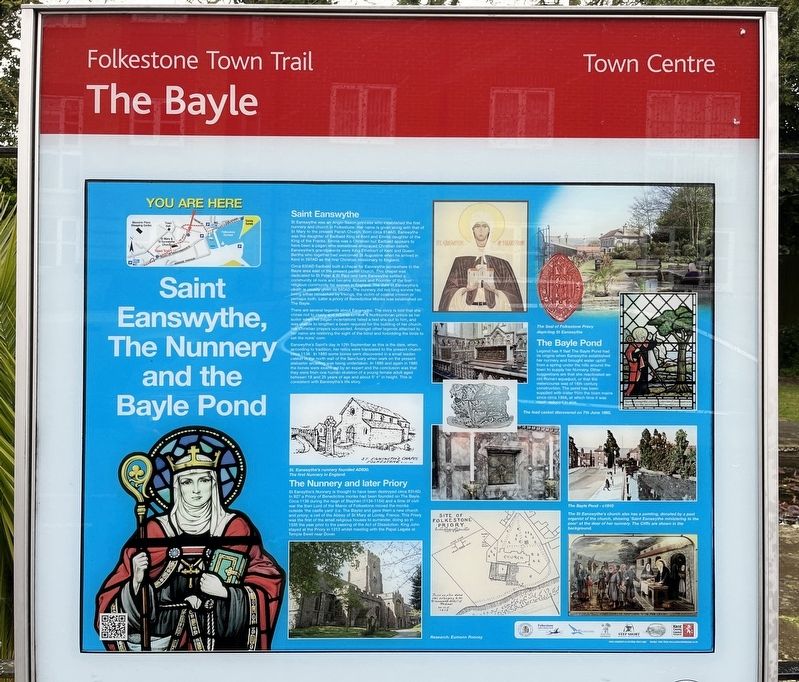
1. Saint Eanswythe, The Nunnery, and the Bayle Pond Marker
Saint Eanswythe
St Eanswythe was an Anglo-Saxon princess who established the first nunnery and church in Folkestone. Her name is given along with that of St Mary to the present Parish Church. Born circa 614AD, Eanswythe was the daughter of Eadbald King of Kent and Emma daughter of the King of the Franks. Emma was a Christian but Eadbald appears to have been a pagan who sometimes embraced Christian beliefs. Eanswythe's grandparents were King Ethelbert of Kent and Queen Bertha who together had welcomed St Augustine when he arrived in Kent in 597AD as the first Christian missionary to England.
Circa 630AD Eadbald built a chapel for Eanswythe somewhere in the Bayle area east of the present parish church. This chapel was dedicated to St Peter & St Paul and here Eanswythe settled a community of nuns and became Abbess and Founder of the first religious community for women in England. The date of Eanswythe's death is usually given as 640AD. Tho nunnery did not long survive her, being either ransacked by Vikings, the victim of coastal erosion or perhaps both. Later a priory of Benedictine Monks was established on The Bayle.
There
this page online
Eanswythe's Saint's day is 12th September as this is the date, when, according to tradition, her relics were translated to the present church circa 1138. In 1885 some bones were discovered in a small leaden casket in the north wall of the Sanctuary when work on the present alabaster arcading was being undertaken. In 1885 and again in 1980 the bones were examined by an expert and the conclusion was that they were from one human skeleton of a young female adult aged between 18 and 25 years of age and about 5' 4" in height. This is consistent with Eanswythe's life story.
The Nunnery and later Priory
St Eansythe's Nunnery is thought to have been destroyed circa 831AD. In 927 a Priory of Benedictine monks
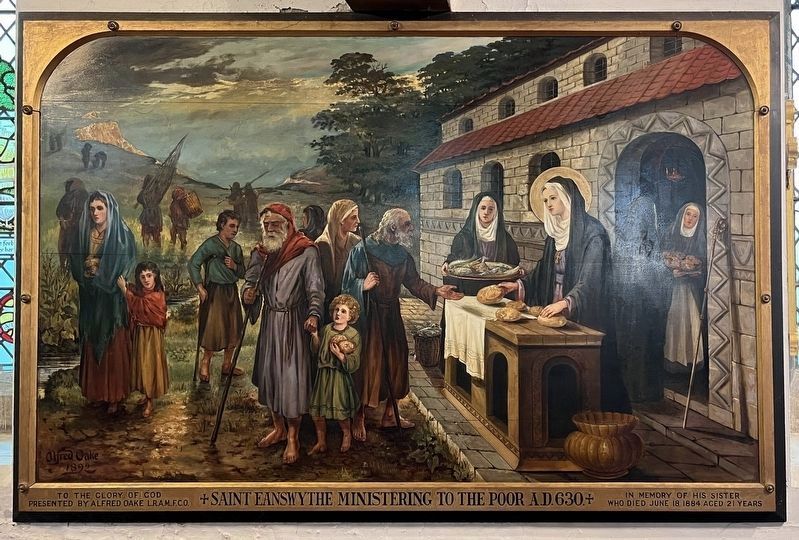
2. St Eanswythe Ministering to the Poor
The St Eanswythe's church also has a painting, donated by a past organist of the church, showing 'Saint Eanswythe ministering to the poor' at the door of her nunnery. The Cliffs are shown in the background. [Shown on the marker, but photographed from the original in the church]
The Bayle Pond
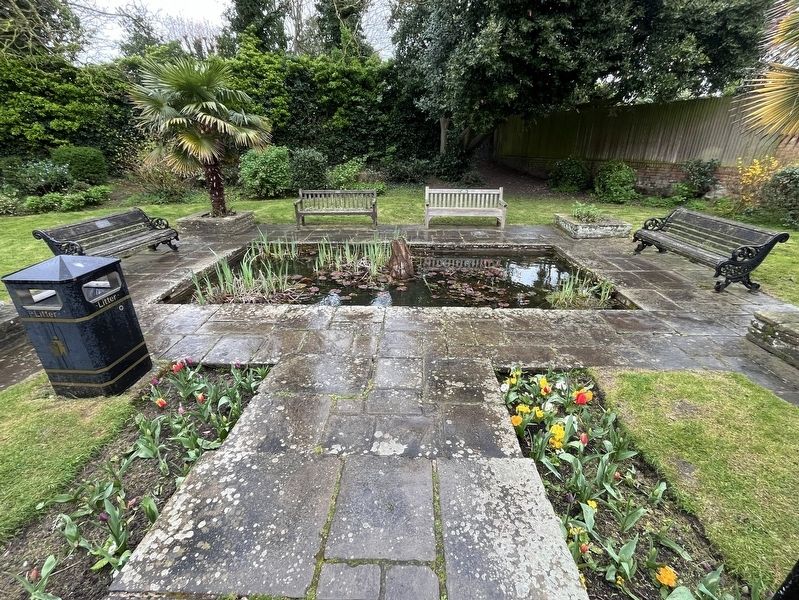
Legend has it that The Bayle Pond had its origins when Eanswythe established her nunnery and brought water uphill from a spring under the hills around the town to supply her Nunnery. Other suggestions are that she reactivated an old Roman aqueduct, or that the watercourse was of 16th century construction. The pond has been supplied with water from the town mains since circa 1954, at which time it was much reduced in sizes.
Topics. This historical marker is listed in these topic lists: Religion & Religious Structures • Women. A significant historical year for this entry is 614 CE.
Location. 51° 4.778′ N,
Photographed by Ray Gurganus, April 3, 2026
3. The Bayle Pond

Regionally, this marker is in the Greater South East. Globally, it is on the Atlantic Ocean, in the North Atlantic Region, in Europe, in Atlantic Europe, on one of the British Isles, in the Western World, and in the Anglosphere. Historically, it finds itself in what was once the Roman Empire.
Other nearby markers. At least 8 other markers are within 3 kilometers of this marker, measured as the crow flies: The Bayle Pond (within shouting distance of this marker); Dixwell (within shouting distance of this marker); The British Lion (within shouting distance of this marker); The Priory (about 90 meters away, measured in a direct line); Basement, 8 The Old High Street (about 90 meters away); The Town Cross (about 120 meters away); Battle of Britain Memorial (approx. 2.6 kilometers away); Lord Dowding (approx. 2.7 kilometers away). Touch for a list and map
Photographed by Editions L.L., 1905
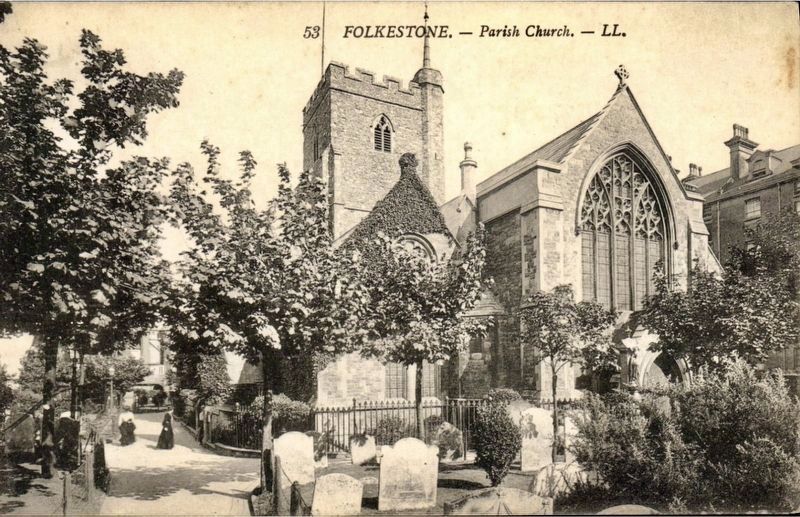
4. St Mary and St Eanswythe Church
The church is roughly 100+ meters to the south of the marker site.
More about this marker. The marker is located by the entrance to the park that contains the Bayle Pond.
Credits. This page was last revised on June 20, 2026. It was originally submitted on June 19, 2026, by Ray Gurganus of Washington, District of Columbia. This page has been viewed 12 times since then. Photos: 1, 2, 3. submitted on June 19, 2026, by Ray Gurganus of Washington, District of Columbia. 4. submitted on June 20, 2026, by Andrew Ruppenstein of Lamorinda, California. • Andrew Ruppenstein was the editor who published this page.
