Falling Waters in Berkeley County, West Virginia — The American South (Appalachia)
Federals Cross the Potomac
"They took this as a harbinger of success"
| — | The Battle of Hoke's Run (July 2, 1861) | — |
Photographed by Mike McKeown, June 20, 2026
1. Federals Cross the Potomac Marker
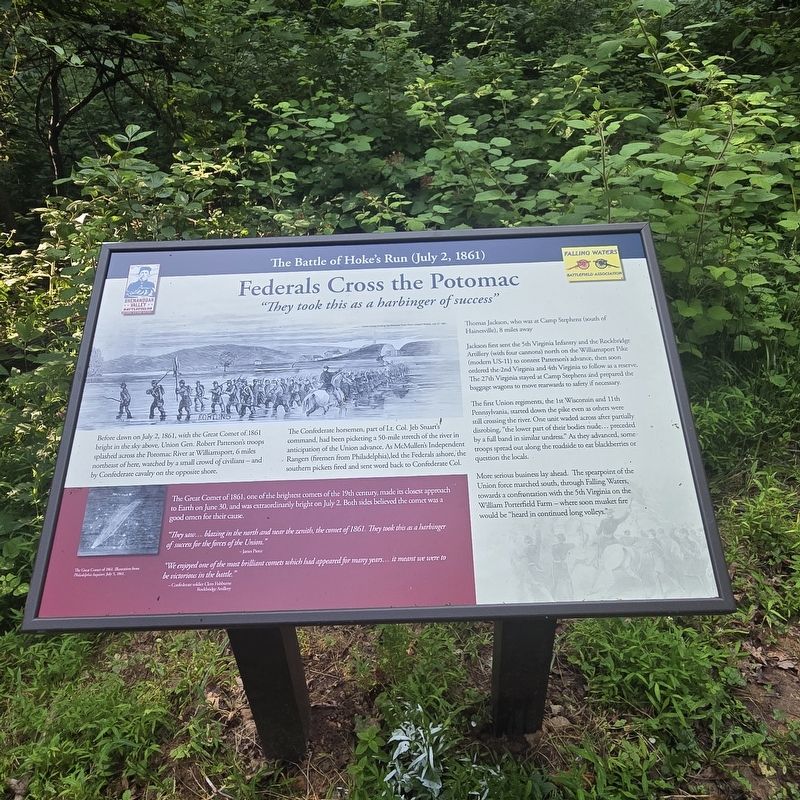
The Confederate horsemen, part of Lt. Col. Jeb Stuart's command, had been picketing a 50-mile stretch of the river in anticipation of the Union advance. As McMullen's Independent Rangers (firemen from Philadelphia) led the Federals ashore, the southern pickets fired and sent word back to Confederate Col. Thomas Jackson, who was at Camp Stephens (south of Hainesville), 8 miles a away
Jackson first sent the 5th Virginia Infantry and the Rockbridge Artillery (with four cannons) north on the Williamsport Pike (modern US-11) to contest Patterson's advance, then soon ordered the 2nd Virginia and 4th Virginia to follow as a reserve. The 27th Virginia stayed at Camp Stephens and prepared the baggage wagons to move rearwards to safety if necessary.
The first Union regiments, the 1st Wisconsin and 11th Pennsylvania, started down the pike even
this page online
More serious business lay ahead. The spearpoint of the Union force marched south, through Falling Waters, towards a confrontation with the 5th Virginia on the William Porterfield Farm—where soon musket fire would be "heard in continued long volleys."
The Great Comet of 1861, one of the brightest comets of the 19th century, made its closest approach to Earth on June 30, and was extraordinarily bright on July 2. Both sides believed the comet was a good omen for their cause.
"They saw... blazing in the north and near the zenith, the comet of 1861. They took this as a harbinger of success for the forces of the Union." -James Pierce(captions)
"We enjoyed one of the most brilliant comets which had appeared for many years... it meant we were to be victorious in the battle. -Confederate soldier Clem Fishburne Rockbridge Artillery
Union troops fording the Potomac River From Harpers Weekly, July 27, 1861.
The Great Comet of 1861. Illustration from Philadelphia Inquirer, July 5, 1861.
Erected 2026
Photographed by Mike McKeown, June 20, 2026
2. Federals Cross the Potomac Marker
Topics. This historical marker is listed in this topic list: War, US Civil. A significant historical date for this entry is July 2, 1861.
Location. 39° 32.857′ N, 77° 55.161′ W. Marker is in Falling Waters, West Virginia, in Berkeley County. It can be reached from Saint Andrews Drive 0.2 miles south of Hammonds Mill Road (West Virginia Route 901), on the left when traveling south. Along the hiking trail at the Springs Mills Community Park/Falling Waters battlefield park. Touch for map. Marker is in this post office area: Falling Waters WV 25419, United States of America. Touch for directions.

Regionally, this marker is in the Eastern Panhandle. It is also in the American South, specifically in the Upper South, in Appalachia, and specifically in Northern Appalachia. Globally, it is in North America, the Western Hemisphere, the Western World, and the Anglosphere. Historically, it finds itself in what was once the territory of the Mississippian Culture and also the Antebellum South.
Other nearby markers. At least 8 other markers are within walking distance of this marker: Protecting History and Nature (a few steps from this marker); Action at Stumpy's Hollow (within shouting distance of this marker); The Manassas Campaign (within shouting distance of this marker); Advance to Battle (within shouting distance of this marker); The Fighting Grows (within shouting distance of this marker); Skirmishers Pull Back (within shouting distance of this marker); Confederate Artillery (about 300 feet away, measured in a direct line); Stumpy's Hollow (about 600 feet away). Touch for a list and map of all markers in Falling Waters.
Also see . . .
1. Battle of Hoke's Run (Wikipedia). (Submitted on June 20, 2026, by Mike McKeown of Baltimore, Maryland.)
2. Shenandoah Battlefields Foundation. (Submitted on June 20, 2026, by Mike McKeown of Baltimore, Maryland.)
Credits. This page was last revised on June 21, 2026. It was originally submitted on June 20, 2026, by Mike McKeown of Baltimore, Maryland. This page has been viewed 32 times since then. Photos: 1, 2. submitted on June 20, 2026, by Mike McKeown of Baltimore, Maryland. • Bernard Fisher was the editor who published this page.
