Falling Waters in Berkeley County, West Virginia — The American South (Appalachia)
Skirmishers Pull Back
"Let him alone and make their escape"
| — | The Battle of Hoke's Run (July 2, 1861) | — |
Photographed by Mike McKeown, June 20, 2026
1. Skirmishers Pull Back Marker
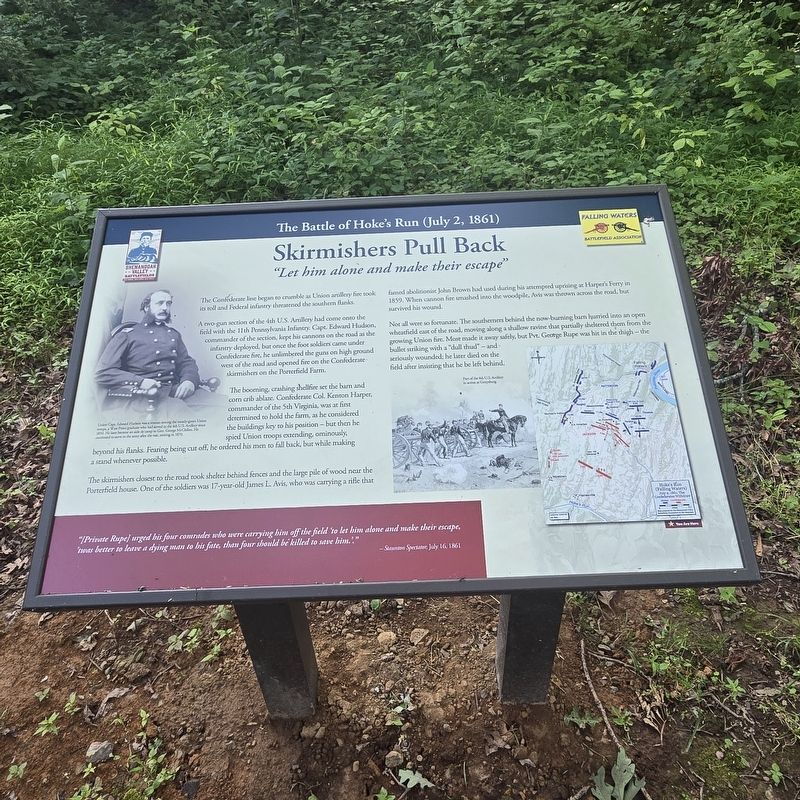
A two-gun section of the 4th U.S. Artillery had come onto the field with the 11th Pennsylvania Infantry. Capt. Edward Hudson, commander of the section, kept his cannons on the road as the infantry deployed, but once the foot soldiers came under Confederate fire, he unlimbered the guns on high ground west of the road and opened fire on the Confederate skirmishers on the Porterfield Farm.
The booming, crashing shellfire set the barn and corn crib ablaze. Confederate Col. Kenton Harper, commander of the 5th Virginia, was at first determined to hold the farm, as he considered the buildings key to his position - but then he spied Union troops extending, ominously, beyond his flanks. Fearing being cut off, he ordered his men to fall back, but while making a stand whenever possible.
The skirmishers closest to the road took shelter behind fences and the large pile of wood near the Porterfield house. One of the soldiers was 17-year-old James L. Avis, who was carrying a rifle that famed abolitionist
this page online
Not all were so fortunate. The southerners behind the now-burning barn hurried into an open wheatfield east of the road, moving along a shallow ravine that partially sheltered them from the growing Union fire. Most made it away safely, but Pvt. George Rupe was hit in the thigh—the bullet striking with a "dull thud"—and seriously wounded; he later died on the field after insisting that he be left behind.
"[Private Rupe] urged his four comrades who were carrying him off the field to let him alone and make their escape, 'twas better to leave a dying man to his fate, than four should be killed to save him.'." -Staunton Spectator, July 16, 1861(captions)
Union Capt. Edward Hudson was a veteran among the mostly-green Union troops, a West Point grade who had served in the 4th US Artillery since 1850. He later became an aide de camp to Gen. George McClellan. He continued to serve in the army after the war, retiring in 1870.
Part of the 4th U.S. Artillery in action at Gettysburg.
Erected 2026
Photographed by Mike McKeown, June 20, 2026
2. Skirmishers Pull Back Marker
Topics. This historical marker is listed in this topic list: War, US Civil. A significant historical date for this entry is July 2, 1861.
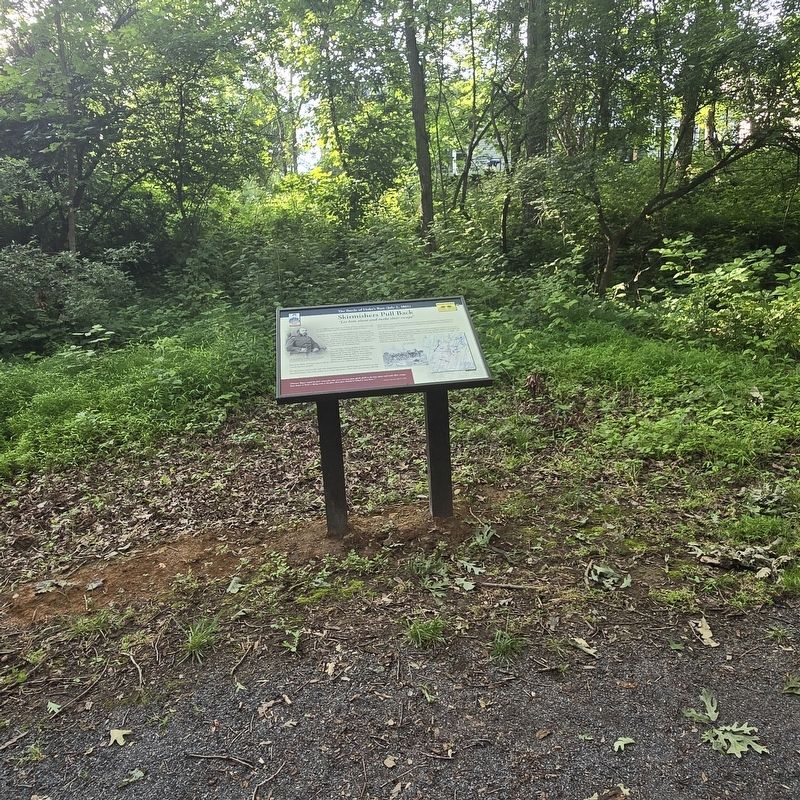
Location. 39° 32.836′ N, 77° 55.123′ W. Marker is in Falling Waters, West Virginia, in Berkeley County. It can be reached from Saint Andrews Drive 0.2 miles south of Hammonds Mill Road, on the left when traveling south. Along the hiking trail at the Springs Mills Community Park/Falling Waters battlefield park. Touch for map. Marker is in this post office area: Falling Waters WV 25419, United States of America. Touch for directions.

Regionally, this marker is in the Eastern Panhandle. It is also in the American South, specifically in the Upper South, in Appalachia, and specifically in Northern Appalachia. Globally, it is in North America, the Western Hemisphere, the Western World, and the Anglosphere. Historically, it finds itself in what was once the territory of the Mississippian Culture and also the Antebellum South.
Other nearby markers. At least 8 other markers are within walking distance of this marker: Advance to Battle (within shouting distance of this marker); Action at Stumpy's Hollow (within shouting distance of this marker); The Fighting Grows (within shouting distance of this marker); Federals Cross the Potomac (within shouting distance of this marker); Protecting History and Nature (within shouting distance of this marker); The Manassas Campaign (about 400 feet away, measured in a direct line); Confederate Artillery (about 400 feet away); Stumpy’s Hollow (about 600 feet away). Touch for a list and map of all markers in Falling Waters.
Credits. This page was last revised on July 8, 2026. It was originally submitted on June 20, 2026, by Mike McKeown of Baltimore, Maryland. This page has been viewed 33 times since then. Photos: 1, 2. submitted on June 20, 2026, by Mike McKeown of Baltimore, Maryland. • Bernard Fisher was the editor who published this page.
