Riverside in Riverside County, California — The American West (Pacific Coastal)
Harada House
1884
| — | Cultural Heritage Board Landmark | — |
Photographed by Craig Baker, 2017
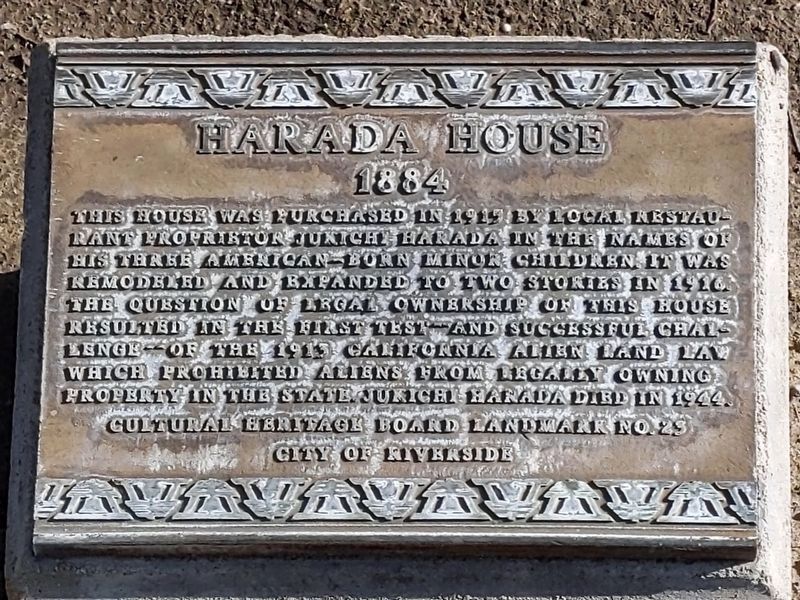
1. Harada House Marker
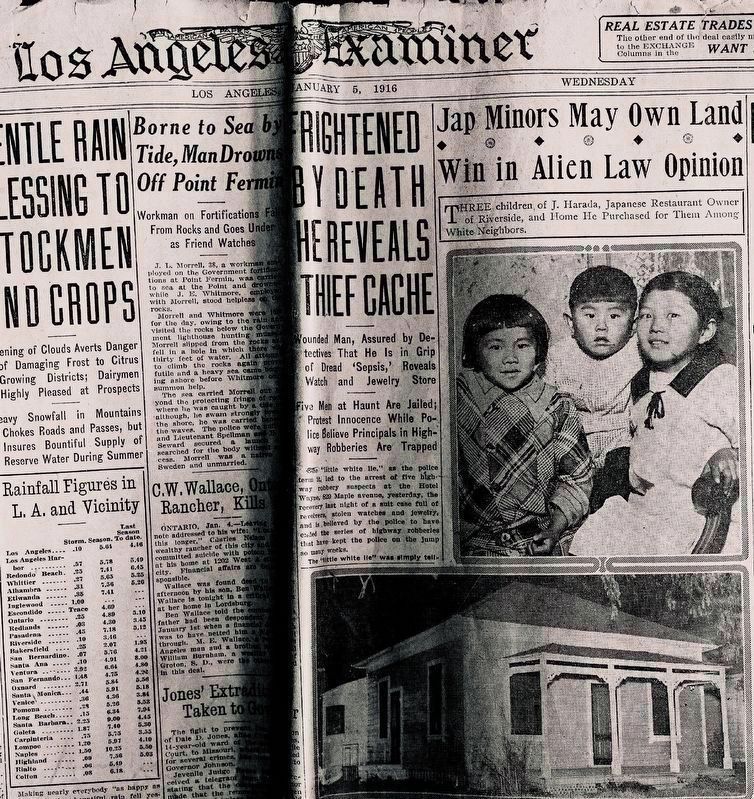
This house was purchased in 1915 by local restaurant proprietor Jukichi Harada in the names of his three American-born minor children. It was remodeled and expanded to two stories in 1916. The question of legal ownership of this house resulted in the first test -- and successful challenge -- of the 1913 California Alien Land Law which prohibited aliens from legally owning property in the state. Jukichi Harada died in 1944.
Erected 1977 by City of Riverside. (Marker Number 23.)
Topics and series. This historical marker is listed in these topic lists: Asian Americans • Civil Rights • War, World II. In addition, it is included in the California Historical Landmarks, and the National Historic Landmarks series lists. A significant historical year for this entry is 1915.
Location. 33° 59.109′ N, 117° 22.15′ W. Marker is in Riverside, California, in Riverside County. It is on Lemon Street north of 4th Street, on the right when traveling north. Touch for map. Marker is at or near this postal address: 3356 Lemon St, Riverside CA 92501, United States of America. Touch for directions.

Regionally, this marker is in
this page online
Other nearby markers. At least 8 other markers are within walking distance of this marker: Mitchell House (approx. 0.2 miles away); First Church of Christ Scientist (approx. 0.2 miles away); William Collier House (approx. ¼ mile away); Meet Me at the Cheech (approx. ¼ mile away); John J. Hewitt House (approx. ¼ mile away); Style and Grace of a Golden Era (approx. ¼ mile away); Riverside Municipal Auditorium (approx. ¼ mile away); Universalist-Unitarian Church (approx. ¼ mile away). Touch for a list and map of all markers in Riverside.
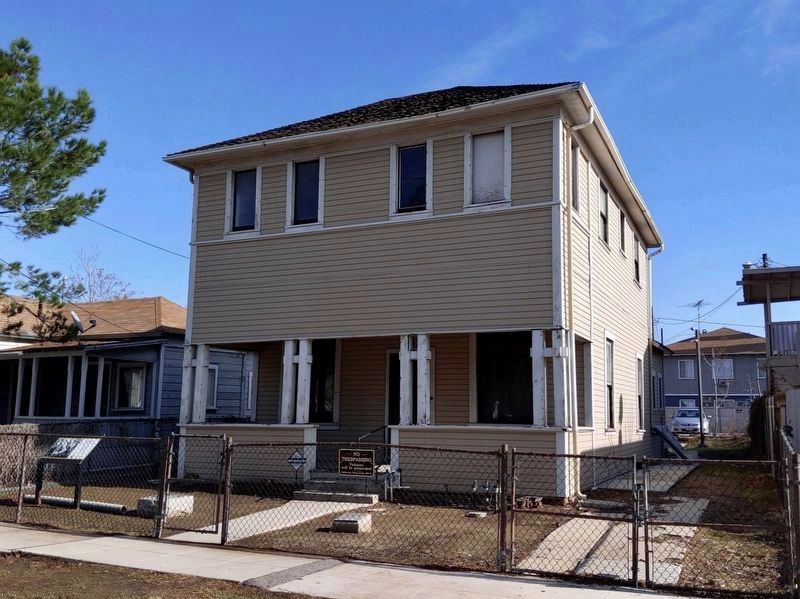
Regarding Harada House. Jukichi Harada emigrated from Japan during the early 1900’s. He purchased this house in 1915 and placed ownership in the hands of his three minor children, who were natural-born United States citizens. This was because
Photographed by Craig Baker, 2017
2. Harada House and Marker
Also see . . .
1. Landmarks of the City of Riverside (#23). (Submitted on June 6, 2026, by Volt Craft of Riverside, California.)
2. National Park Service: Harada House.
Photographed by Craig Baker, 2017
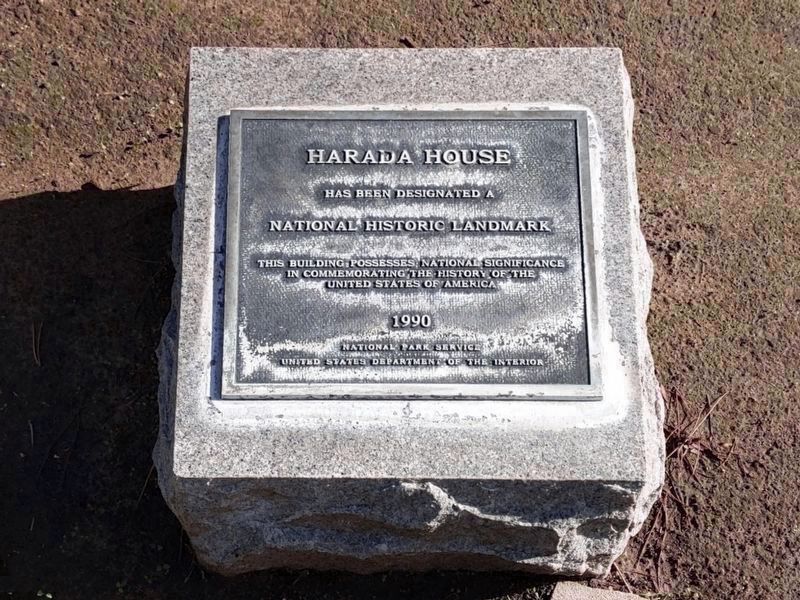
3. National Historic Landmark
courtesy Riverside Metropolitan Museum
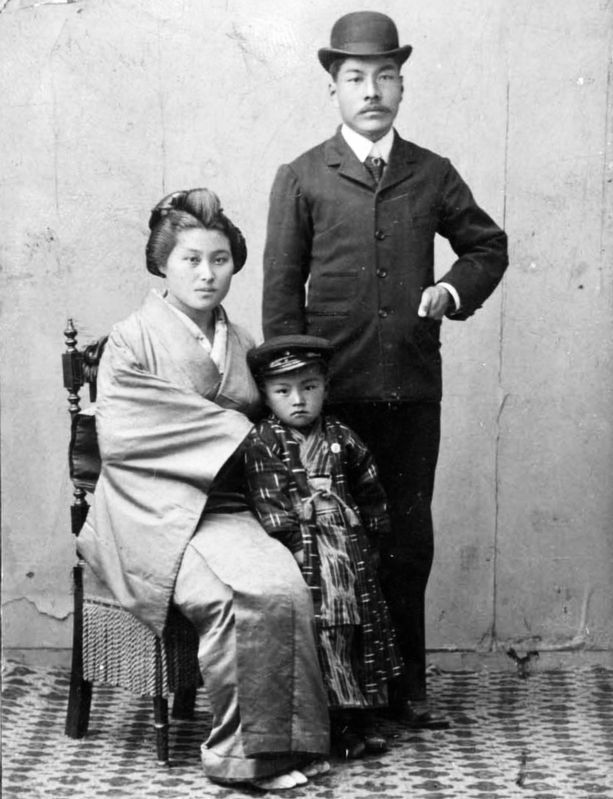
4. Harada Family in 1905
courtesy Riverside Metropolitan Museum
5. Headlines — 1916 Lawsuit
Photo shows the house before the second floor was added.
courtesy Riverside Metropolitan Museum
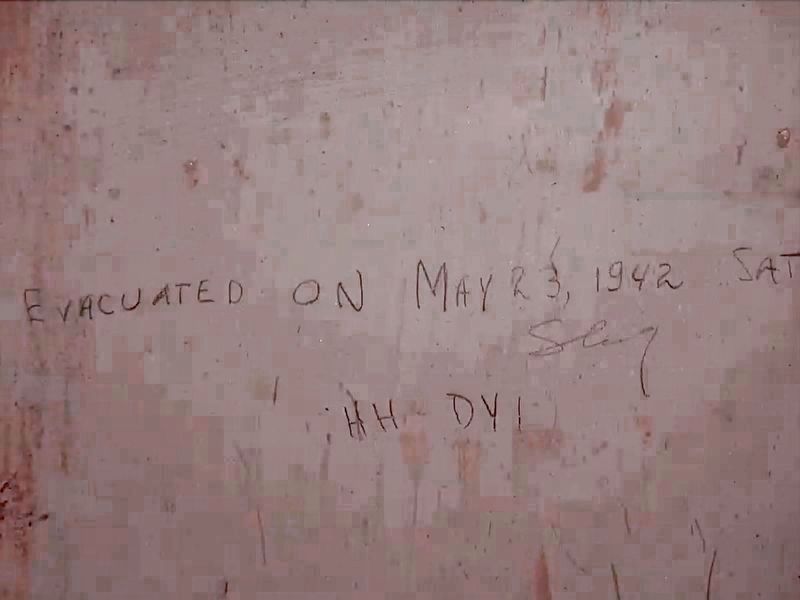
6. Departure Date written on bedroom wall
“Evacuated on May 23, 1942 Sat - HH” [Harold Harada]
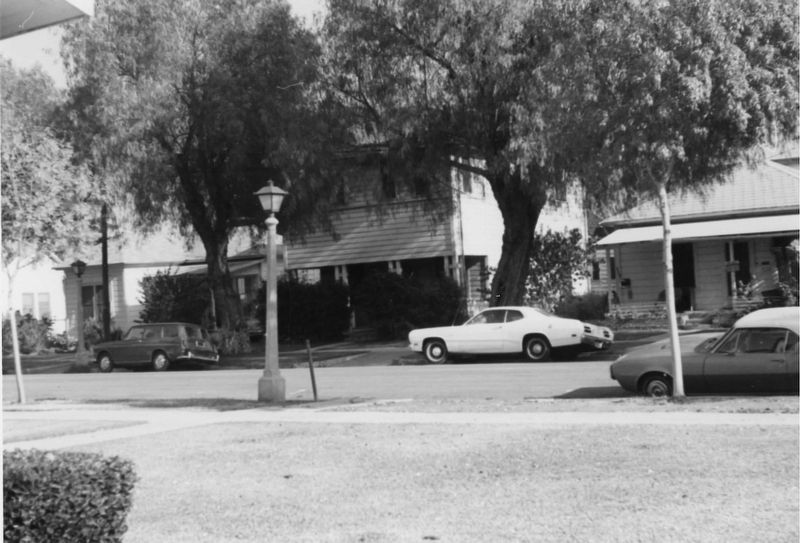
National Register of Historic Places, 1977
7. Harada House
Credits. This page was last revised on July 9, 2026. It was originally submitted on August 14, 2020, by Craig Baker of Sylmar, California. This page has been viewed 1,313 times since then and 45 times this year. Last updated on June 20, 2026, by Volt Craft of Riverside, California. Photos: 1, 2, 3, 4, 5, 6. submitted on August 14, 2020, by Craig Baker of Sylmar, California. 7. submitted on June 26, 2026, by Volt Craft of Riverside, California. • Devry Becker Jones was the editor who published this page.
