New Paltz in Ulster County, New York — The American Northeast (Mid-Atlantic)
Bearing Witness to the History of Enslavement
Photographed by Devry Becker Jones (CC0), June 19, 2026
1. Bearing Witness to the History of Enslavement Marker
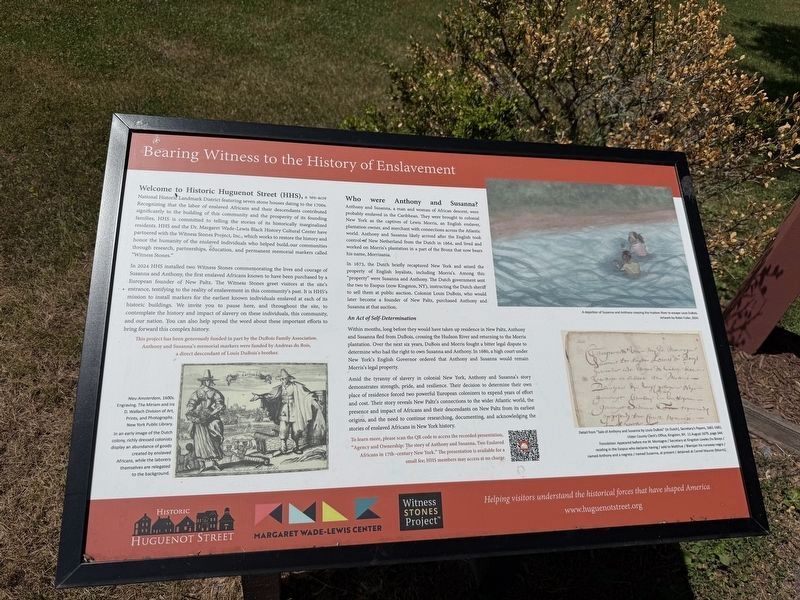
Welcome to Historic Huguenot Street (HHS), a ten-acre National Historic Landmark District featuring seven stone houses dating to the 1700s. Recognizing that the labor of enslaved Africans and their descendants contributed significantly to the building of this community and the prosperity of its founding families, HHS is committed to telling the stories of its historically marginalized residents. HHS and the Dr. Margaret Wade-Lewis Black History Cultural Center have partnered with the Witness Stones Project, Inc., which works to restore the history and honor the humanity of the enslaved individuals who helped build our communities through research, partnerships, education, and permanent memorial markers called "Witness Stones."
In 2024 HHS installed two Witness Stones commemorating the lives and courage of Susanna and Anthony, the first enslaved Africans known to have been purchased by a European founder of New Paltz. The Witness Stones greet visitors at the site's entrance, testifying to the reality of enslavement in this community's past. It is HHS's mission to install markers for the earliest known individuals enslaved
this page online
Who were Anthony and Susanna?
Anthony and Susanna, a man and woman of African descent, were probably enslaved in the Caribbean. They were brought to colonial New York as the captives of Lewis Morris, an English enslaver, plantation owner, and merchant with connections across the Atlantic world. Anthony and Susanna likely arrived after the English took control of New Netherland from the Dutch in 1664, and lived and worked on Morris's plantation in a part of the Bronx that now bears his name, Morrisania.
In 1673, the Dutch briefly recaptured New York and seized the property of English loyalists, including Morris's. Among this "property" were
Photographed by Devry Becker Jones (CC0), June 19, 2026
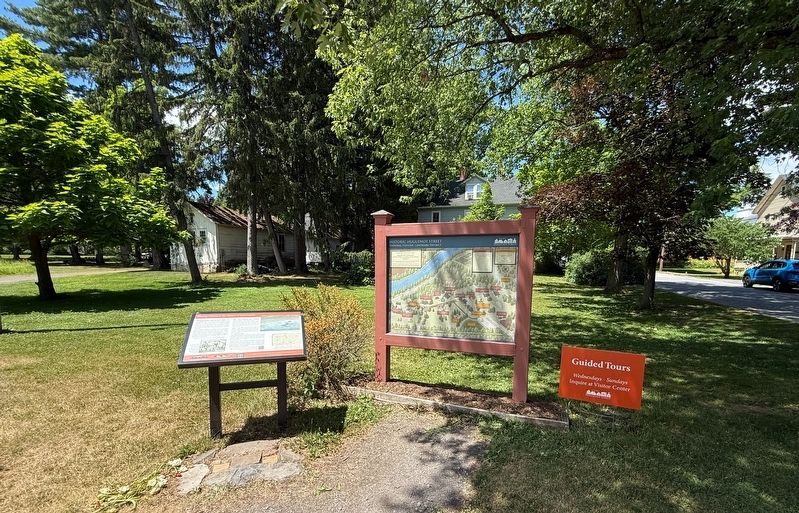
2. Signage in the parking lot for Historic Huguenot Street
An Act of Self-Determination
Within months, long before they would have taken up residence in New Paltz, Anthony and Susanna fled from DuBois, crossing the Hudson River and returning to the Morris plantation. Over the next six years, DuBois and Morris fought a bitter legal dispute to determine who had the right to own Susanna and Anthony. In 1680, a high court under New York's English Governor ordered that Anthony and Susanna would remain Morris's legal property.
Amid the tyranny of slavery in colonial New York, Anthony and Susanna's story demonstrates strength, pride, and resilience. Their decision to determine their own place of residence forced two powerful European colonizers to expend years of effort and cost. Their story reveals New Paltz's connections to the wider Atlantic world, the presence and impact of Africans and their descendants on New Paltz from its earliest origins, and the need to continue researching, documenting, and acknowledging the stories of enslaved Africans in New York history.
[Captions:]
Nieu Amsterdam, 1600s. Engraving. The Miriam and Ira D. Wallach Division of Art, Prints, and Photographs. New York Public Library.
In an early image of the Dutch colony, richly dressed colonists display and abundance of goods created by enslaved Africans, while the laborers themselves are relegated to the background.
A depiction of Susanna and Anthony crossing the Hudson River to escape Louis DuBois. Artwork by Robing Fuller, 2024.
Detail from "Sale of Anthony and Susanna by Louis DuBois" (in Dutch), Secretary's Papers, 1661-1681. Ulster County Clerk's Office, Kingston, NY. 11 August 1679, page 344.
Translation: Appeared before me W. Montagne / Secretary at Kingston Lowies Du Booys / resideing in the Esopus who declares having / sold to Matthue / Blansjan his runaway negro / named Anthony and a negress / named Susanna, at present / detained at Cornel Maures [Morris].
Erected by Historic Huguenot Street; Margaret Wade-Lewis Center; Witness Stones Project.
Topics and series. This historical marker is listed in these topic lists: African Americans • Colonial Era • Industry & Commerce • Settlements & Settlers. In addition, it is included in the National Historic Landmarks series list. A significant historical date for this entry is August 11, 1679.
Location. 41° 45.114′ N, 74° 5.198′ W. Marker is in New Paltz, New York, in Ulster County. It is on Broadhead Avenue west of Empire State Trail, on the left when traveling west. Touch for map. Marker is at or near this postal address: 6 Broadhead Ave, New Paltz NY 12561, United States of America. Touch for directions.

Regionally, this marker is in Upstate New York and in the Hudson Valley. It is also in the American Northeast, in the Mid-Atlantic, and on the Eastern Seaboard. Globally, it is in the North Atlantic Region, North America, the Western Hemisphere, the Western World, and the Anglosphere. Historically, it finds itself in what was once New Netherland and also one of the original Thirteen Colonies.
Other nearby markers. At least 8 other markers are within walking distance of this marker: Huguenot Patriotic, Historical and Monumental Society (a few steps from this marker); Die Pfalz (a few steps from this marker); Historic Huguenot Street (within shouting distance of this marker); Bevier House (about 400 feet away, measured in a direct line); The First Black Residents of New Paltz - Jack and Betty (about 500 feet away); Jack (about 500 feet away); Betty (about 500 feet away); Dubois House (about 500 feet away). Touch for a list and map of all markers in New Paltz.
Additional keywords. human trafficking; enslaved labor
Credits. This page was last revised on June 22, 2026. It was originally submitted on June 22, 2026, by Devry Becker Jones of Washington, District of Columbia. This page has been viewed 12 times since then. Photos: 1, 2. submitted on June 22, 2026, by Devry Becker Jones of Washington, District of Columbia.
