New Paltz in Ulster County, New York — The American Northeast (Mid-Atlantic)
Reformed Dutch Church
New Paltz, N.Y.
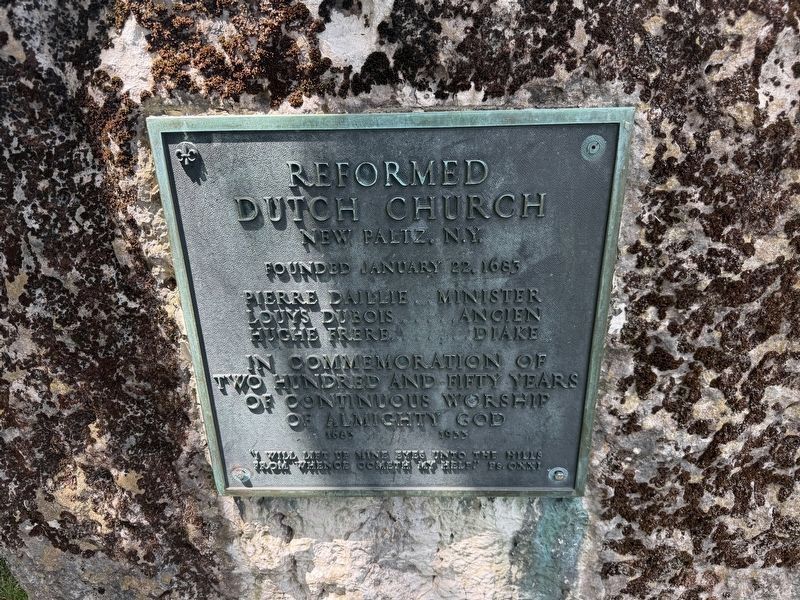
Pierre Daille, Minister • Louys DuBois, Ancien • Hughe Frefre, Diake
In commemoration of two hundred and fifty years of continuous worship of Almighty God
"I will lift up mine eyes unto the hills from whence cometh my help." Ps. CXXI
Topics. This historical marker is listed in these topic lists: Colonial Era • Religion & Religious Structures. A significant historical date for this entry is January 22, 1683.
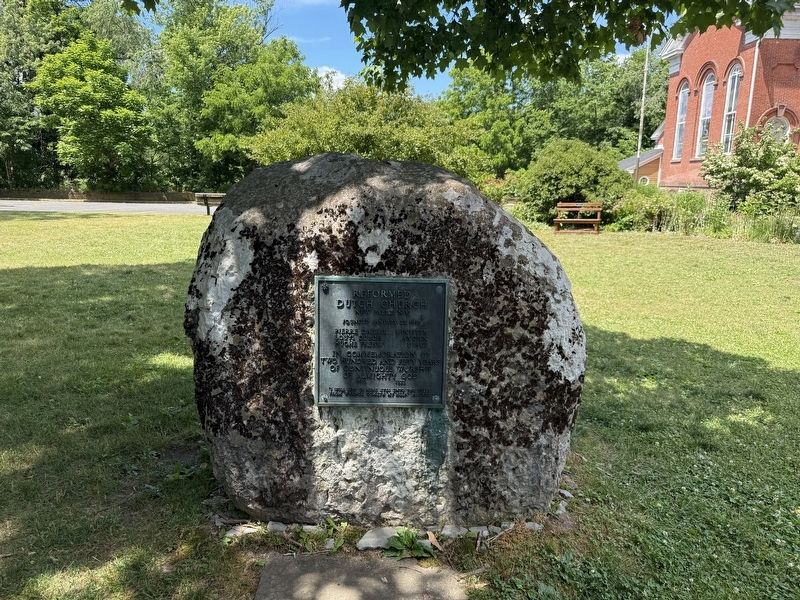
Location. 41° 45.135′ N, 74° 5.306′ W. Marker is in New Paltz, New York, in Ulster County. It is on Huguenot Street north of Broadhead Avenue, on the left when traveling north. Touch for map. Marker is at or near this postal address: 88 Huguenot St, New Paltz NY 12561, United States of America. Touch for directions.

Regionally, this marker is in Upstate New York and in the Hudson Valley. It is also in the American Northeast, in the Mid-Atlantic, and on the Eastern Seaboard. Globally, it is in the North Atlantic Region, North America, the Western Hemisphere, the Western World, and the Anglosphere. Historically, it finds itself in what was once New Netherland and
this page online
Other nearby markers. At least 8 other markers are within walking distance of this marker: Stone Church-1773 (here, next to this marker); Site of Lefevre House (a few steps from this marker); The Reformed Church (within shouting distance of this marker); Bevier House (within shouting distance of this marker); Hasbrouck House (within shouting distance of this marker); Freer House (within shouting distance of this marker); Dubois House (within shouting distance of this marker); Historic Huguenot Street (about 400 feet away, measured in a direct line). Touch for a list and map of all markers in New Paltz.
Another marker is no longer nearby. The Reformed Church (was within shouting distance of this marker but has been replaced with another marker now near it).
Also see . . . Our Church History page on the church site.
Our congregation is proud of its 343 year history, but also deeply aware of our responsibility to continue to build upon the foundations created by earlier generations of Christians in New Paltz. The New Paltz Reformed Church traces its roots to 1683, five(Submitted on June 22, 2026, by Devry Becker Jones of Washington, District of Columbia.)years after the settlement of the village by French-speaking Huguenots from northern France and Flanders who had left their homeland to find religious freedom and a livelihood in the Dutch-settled Hudson Valley. According to a translation of the earliest church record, on January 22 1683, “Mr. Pierre Daille, minister of the Word of God, arrived at New Paltz and preached twice on the following Sunday,” while proposing that the heads of families vote to select an elder and deacon to assist the minister. Worship was in French for 50 years, then in Dutch for some 70 years before English was adopted. (The change from French to Dutch to English can be traced in our church records, many of which are preserved in our document room.) In 1717 the Huguenots of New Paltz began a “stone house of prayer,” a plain building comparable to a Puritan meeting house. (Demolished in the 1770s, the House of Prayer was reconstructed by the local historical society in 1972.) A larger stone church was constructed in the early 1770s; its bell was cast by John Bailey of New York, maker of a battle sword for George Washington.
Our present church, a fine example of Greek Revival architecture with its four-column portico and two-stage clock and bell tower, was erected in 1839. The Rev. Douw van Olinda was instrumental in overseeing successful completion of the 1839 building; in 1833 he had had a prominent role in organizing and building the New Paltz Academy, ancestor of today’s SUNY New Paltz. Transepts and a shallow chancel with central pulpit were added in 1872. In 1952 the chancel was enlarged, and the pulpit shifted to the side, while the communion table was given central prominence. In the 1980s the present fine organ was purchased, and the long-lost Bailey bell recovered and installed near the chancel.
Credits. This page was last revised on June 22, 2026. It was originally submitted on June 22, 2026, by Devry Becker Jones of Washington, District of Columbia. This page has been viewed 10 times since then. Photos: 1, 2. submitted on June 22, 2026, by Devry Becker Jones of Washington, District of Columbia.
