Stockade District in Kingston in Ulster County, New York — The American Northeast (Mid-Atlantic)
Three Centuries of Senate House
| — | Senate House State Historic Site | — |
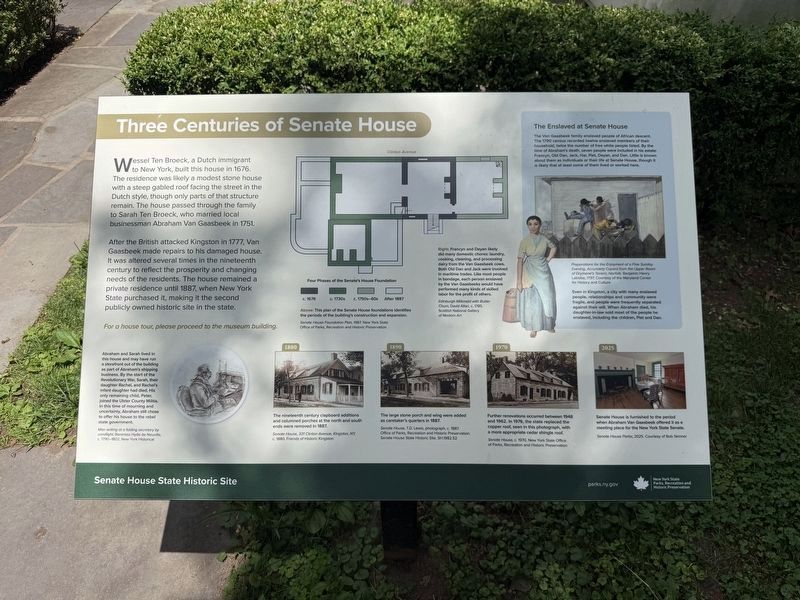
Wessel Ten Broeck, a Dutch immigrant to New York, built this house in 1676. The residence was likely a modest stone house with a steep gabled roof facing the street in the Dutch style, though only parts of that structure remain. The house passed through the family to Sarah Ten Broeck, who married local businessman Abraham Van Gaasbeek in 1751.
After the British attacked Kingston in 1777, Van Gaasbeek made repairs to his damaged house. It was altered several times in the nineteenth century to reflect the prosperity and changing needs of the residents. The house remained a private residence until 1887, when New York State purchased it, making it the second publicly owned historic site in the state.
For a house tour, please proceed to the museum building.
[Sidebar:]
The Enslaved at Senate House
The Van Gaasbeek family enslaved people of African descent. The 1790 census recorded twelve enslaved members of their household, twice the number of free white people listed. By the time of Abraham's death, seven people were included in his estate: Francyn, Old Dan, Jack, Har, Piet, Deyan, and Dan. Little is known about them as individuals or their life at Senate House, though it is likely that at least some of them lived or worked here.
Even in Kingston, a city with many enslaved people, relationships and community were fragile, and people were frequently separated against their will. When Abraham died, his daughter-in-law sold most of the people he enslaved, including the children, Piet and Dan.
[Captions:]
Above: This plan of the Senate House foundations identifies the periods o the building's construction and expansion.
Right: Francyn and Deyan likely did many domestic chores: laundry, cooking, cleaning, and processing dairy from the Van Gaasbeek cows. Both Old Dan and Jack were involved in maritime trades. Like most people in bondage, each person enslaved by the Van Gaasbeeks would have performed many kinds of skilled labor for the profit of others.
Abraham and Sarah lived in this house and may have run a storefront out of the building as part of Abraham's shipping business. By the start of the Revolutionary War, Sarah, their daughter Rachel, and Rachel's infant daughter had died. His only remaining child, Peter, joined the Ulster County Militia. In this time of mourning and uncertainty, Abraham still chose to offer his house to the rebel state government.
1880 The nineteenth century clapboard additions and columned porches at the north and south ends were removed in 1887.
1890 The large stone porch and wing were added as caretaker's quarters in 1887.
1970 Further renovations occurred between 1948 and 1962. In 1976, the state replaced the copper roof, seen in this photograph, with a more appropriate cedar shingle roof.
2025 Senate House is furnished to the period when Abraham Van Gaasbeek offered it as a meeting place for the New York State Senate.
Erected by New
this page online
Topics. This historical marker is listed in these topic lists: African Americans • Colonial Era • Settlements & Settlers • War, US Revolutionary. A significant historical year for this entry is 1676.
Location. 41° 56.1′ N, 74° 1.122′ W. Marker is in Kingston, New York, in Ulster County. It is in the Stockade District. It is on Clinton Avenue south of North Front Street, on the right when traveling south. Touch for map. Marker is at or near this postal address: 325 Clinton Ave, Kingston NY 12401, United States of America. Touch for directions.

Regionally, this marker is in Upstate New York and in the Hudson Valley. It is also in the American Northeast, in the Mid-Atlantic, and on the Eastern Seaboard. Globally, it is in the North Atlantic Region, North America, the Western Hemisphere, the Western World, and the Anglosphere. Historically, it finds itself in what was once New Netherland and also one of the original Thirteen Colonies.
Other nearby markers. At least 8 other markers are within walking distance of this marker: Senate House (a few steps from
Other markers no longer nearby. The Evolution of the Senate House (was here, next to this marker but has been replaced with another marker now near it); A Community Attic (was within shouting distance of this marker but has been replaced with another marker now near it); A Radical Idea: Government by the People (was within shouting distance of this marker but has been replaced with another marker now near it).
Additional keywords. enslaved labor; human trafficking
Credits. This page was last revised on June 22, 2026. It was originally submitted on June 22, 2026, by Devry Becker Jones of Washington, District of Columbia. This page has been viewed 16 times since then. Photos: 1, 2. submitted on June 22, 2026, by Devry Becker Jones of Washington, District of Columbia.
