Stockade District in Kingston in Ulster County, New York — The American Northeast (Mid-Atlantic)
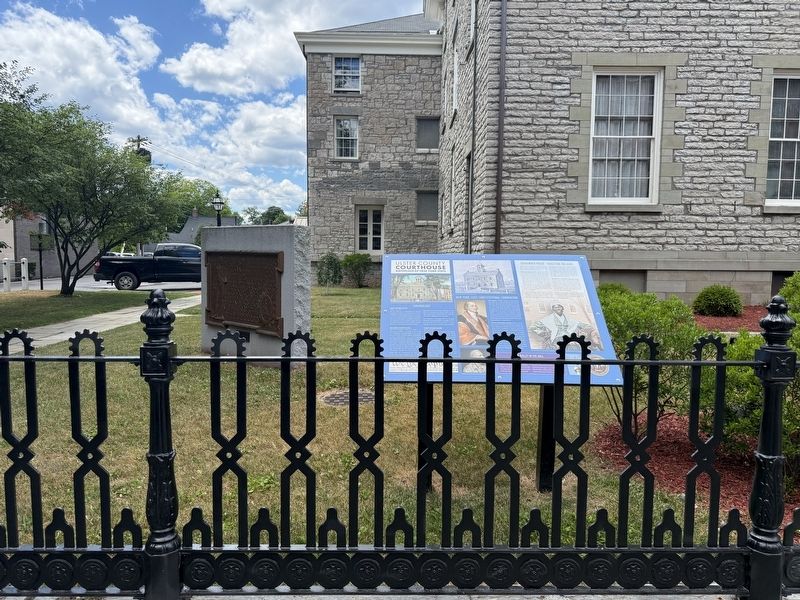
Ulster County Courthouse
Birthplace of New York State
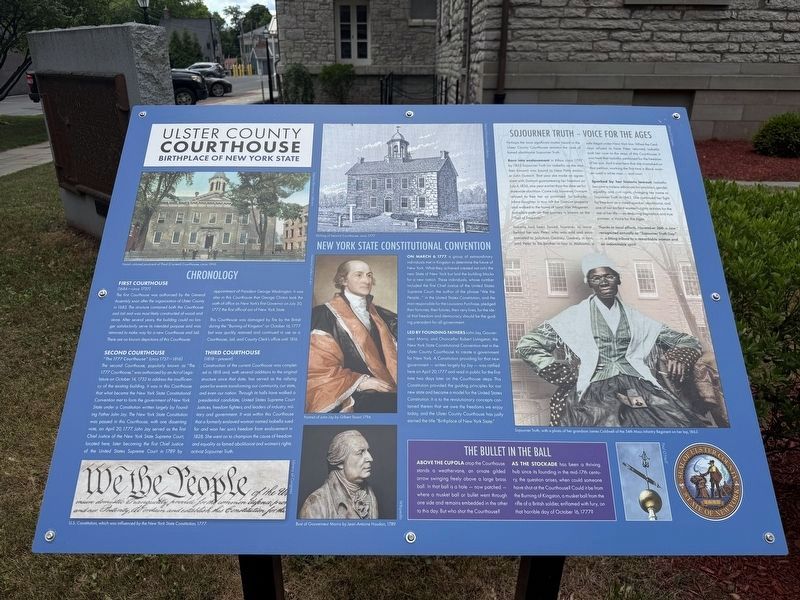
(1684 – circa 1777)
The first Courthouse was authorized by the General Assembly soon after the organization of Ulster County in 1683. The structure contained both the Courthouse and Jail and was most likely constructed of wood and stone. After several years, the building could no longer satisfactorily serve its intended purpose and was removed to make way for a new Courthouse and Jail. There are no known depictions of this Courthouse.
Second Courthouse
(“the 1777 Courthouse,” circa 1737–1816)
The second Courthouse, popularly known as the “1777 Courthouse,” was authorized by an Act of Legislature on October 14, 1732 to address the insufficiency of the existing building. It was in this Courthouse that became the New York State Constitutional Convention met to form the government of New York State under a Constitution written largely by Founding Father John Jay. The New York State Constitution was passed in this Courthouse, with one dissenting vote, on April 20, 1777. John Jay served as the first Chief Justice of the New York State Supreme Court, located here, later becoming the first Chief
this page online
This Courthouse was damaged by fire by the British during the “Burning of Kingston” on October 16, 1777 but was quickly restored and continued in use as a Courthouse, Jail, and County Clerk’s office until 1816.
Third Courthouse
(1818 – present)
Construction of the current Courthouse was completed in 1818 and, with several additions to the original structure since that date, has served as the focal point for events transforming our community, our state, and even our nation. Through its halls have walked a presidential candidate, United States Supreme Court justices, freedom fighters, and leaders of industry, military, and government, as well as many who struggled for a formerly enslaved woman named Isabella and for her son’s freedom from enslavement in 1828. She went on to champion the cause of freedom and equality as famed abolitionist and women’s rights activist Sojourner
Led by Founding Fathers John Jay, Governor Morris, and Chancellor Robert Livingston, the New York State Constitutional Convention met in the Ulster County Courthouse to create a government for New York. A Constitution providing for that new government—written largely by Jay—was ratified here on April 20, 1777 and read in public for the first time two days later on the Courthouse steps. This Constitution provided the guiding principles for our new state and became a model for the United States Constitution. It is to the revolutionary concepts contained therein that we owe the freedoms we enjoy today, and the Ulster County Courthouse has justly earned the title “Birthplace of New York State.”
Born into enslavement in Rifton circa 1797, by 1825 Sojourner Truth (or Isabella, as she was then known) was bound to New Paltz enslaver John Dumont. That year she made an agreement with Dumont guaranteeing her freedom on July 4, 1826, one year earlier set than the date set for statewide abolition. Come July, however, Dumont refused to free her as promised. So Isabella, infant daughter in tow, left the Dumont property and walked to the home of Isaac Van Wagenen. Isabella's path on that journey is known as the "Trail of Freedom."
Isabella had been forced, however, to leave behind her son, Peter, who was sold and soon entrusted to Solomon Gedney. Gedney, in turn, sold Peter to his brother-in-law in Alabama, a sale illegal under New York law. When the Gedneys refused to have Peter returned, Isabella took her case to the steps of this Courthouse. It was here that Isabella petitioned for the freedom of her son. And it was here that she triumphed on that petition, marking the first time a Black woman sued a white man — and won.
Sparked by her historic lawsuit, Isabella became a tireless advocate for abolition, gender equality, and civil rights, changing her name to Sojourner Truth in 1843. She continued her fight for freedom as a noted speaker, abolitionist, and one of our earliest women's rights activists for the rest of her life — an enduring inspiration and true pioneer, a Voice for the Ages.
Thanks to local efforts, November 26th is now recognized annually as "Sojourner Truth Day" — a fitting tribute to a remarkable woman and an indomitable spirit.
As the stockade has been a thriving hub since its founding in the mid-17th century, the question arises, when could someone have shot at the Courthouse? Could it be from the Burning of Kingston, a musketball from the rifle of a British soldier, enflamed with fury, on that horrible day of October 16, 1777?
Erected by Ulster County, New York.
Topics. This historical marker is listed in these topic lists: Abolition & Underground RR • Government & Politics • Industry & Commerce • War, US Revolutionary. A significant historical date for this entry is March 6, 1777.
Location. 41° 55.99′ N, 74° 1.176′ W. Marker is in Kingston, New York, in Ulster County. It is in the Stockade District. It is on Wall Street south of John Street, on the left when traveling north. Touch for map. Marker is at or near this postal address: 285 Wall St, Kingston NY 12401, United States of America. Touch for directions.

Regionally, this marker is in Upstate New York and in the Hudson Valley. It is also in the American Northeast, in the Mid-Atlantic, and on the Eastern Seaboard. Globally, it is in the North Atlantic Region, North America, the Western Hemisphere, the Western World, and the Anglosphere. Historically, it finds itself in what was once New Netherland and also one of the original Thirteen Colonies.
Other nearby markers. At least 8 other markers are within walking distance of this marker: Beginning of the State of New York (here, next to this marker); We The People (a few steps from this marker); Sojourner Truth (a few steps from this marker); a different marker also named Sojourner Truth (a few steps from this marker); The Story of Historic Kingston (within shouting distance of this marker); “The Reformed Protestant Dutch Church of the Town of Kingston in Ulster County” (within shouting distance of this marker); Old Stockade 1658 (within shouting distance of this marker); Old Dutch Church (within shouting distance of this marker). Touch for a list and map of all markers in Kingston.
Additional keywords. human trafficking
Credits. This page was last revised on June 22, 2026. It was originally submitted on June 22, 2026, by Devry Becker Jones of Washington, District of Columbia. This page has been viewed 15 times since then. Photos: 1, 2. submitted on June 22, 2026, by Devry Becker Jones of Washington, District of Columbia.
