Buffalo in Harding County, South Dakota — The American Midwest (Upper Plains)
Medora - Deadwood Stage Line
Photographed by Cosmos Mariner, August 24, 2023
1. Medora - Deadwood Stage Line Marker
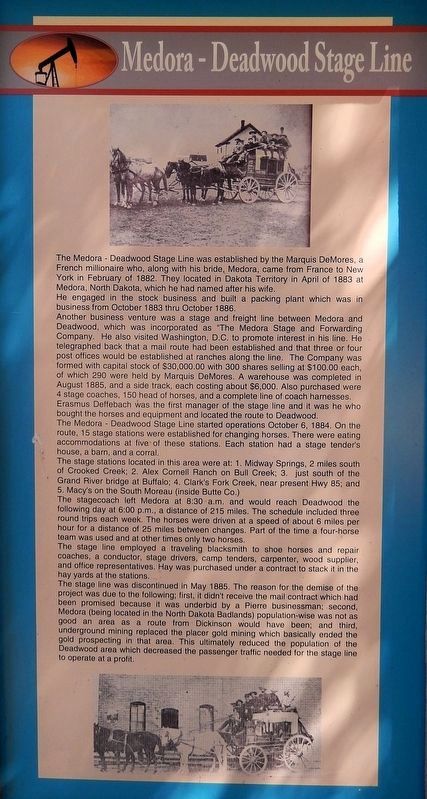
The Medora - Deadwood Stage Line was established by the Marquis DeMores, a French millionaire who, along with his bride, Medora, came from France to New York in February of 1882. They located in Dakota Territory in April of 1883 at Medora, North Dakota, which he had named after his wife.
He engaged in the stock business and built a packing plant which was in business from October 1883 thru October 1886.
Another business venture was a stage and freight line between Medora and Deadwood, which was incorporated as “The Medora Stage and Forwarding Company.” He also visited Washington, D.C. to promote interest in his line. He telegraphed back that a mail route had been established and that three or four post offices would be established at ranches along the line. The Company was formed with capital stock of $30,000 with 300 shares selling at $100 each, of which 290 were held by Marquis DeMores. A warehouse was completed in August 1885, and a side track, each costing about $6,000. Also purchased were 4 stage coaches, 150 head of horses, and a complete line of coach harnesses. Erasmus Deffebach was the first manager of the stage line and it was he who bought the horses and equipment and located the route to Deadwood.
The Medora - Deadwood Stage Line started operations October 6, 1884. On the route, 15 stage stations were established for changing horses. There were eating accommodations at five of these stations. Each station had a stage tender's house, a barn, and a corral.
The stage stations located in this area were at: 1. Midway Springs, 2 miles south of Crooked Creek; 2. Alex Cornell Ranch on Bull Creek; 3. just south of the Grand River bridge at Buffalo; 4. Clark's Fork Creek, near present Hwy 85; and 5. Macy's on the South Moreau (inside Butte Co.)
The stagecoach left Medora at 8:30 a.m. and would reach Deadwood
this page online
The stage line employed a traveling blacksmith to shoe horses and repair coaches, a conductor, stage drivers, camp tenders, carpenter, wood supplier, and office representatives. Hay was purchased under a contract to stack it in the hay yards at the stations.
The stage line was discontinued in May 1885. The reason for the demise of the project was due to the following; first, it didn't receive the mail contract which had been promised because it was underbid by a Pierre businessman; second, Medora (being located in the North Dakota Badlands) population-wise was not as good an area as a route from Dickinson would have been; and third, underground mining replaced the placer gold mining which basically ended the gold prospecting in that area. This ultimately reduced the population of the Deadwood area which decreased the passenger traffic needed for

Photographed by Cosmos Mariner, August 24, 2023
2. Medora - Deadwood Stage Line Marker
The marker is on the heritage walkway in Centennial Park.
Erected by Theodore Roosevelt Expressway (CanAm Highway).
Topics. This historical marker is listed in these topic lists: Industry & Commerce • Roads & Vehicles • Settlements & Settlers. A significant historical date for this entry is October 6, 1884.
Location. 45° 34.855′ N, 103° 32.779′ W. Marker is in Buffalo, South Dakota, in Harding County. It can be reached from Theodore Roosevelt Expressway (CanAm Highway) (U.S. 85) just south of Connel Street (State Highway 20), on the left when traveling north. The marker is in Centennial Park. Touch for map. Marker is at or near this postal address: 91 US Highway 85, Buffalo SD 57720, United States of America. Touch for directions.

Regionally, this marker is in West River. It is also in the American Lewis & Clark Corridor, on the prairies, and on the Northern Plains. Globally, it is in North America, the Western Hemisphere, the Western World, and the Anglosphere. Historically, it finds itself in what was once Rupert’s Land and also the Louisiana Purchase.
Other nearby markers. At least 8 other markers are within walking distance of this marker: The Homesteaders (here, next to this marker); The Custer Black Hills Expedition of 1874 (here, next to this marker); Ludlow Cave (here, next to this marker); Cattle Ranching in Harding County (here, next to this marker); The Buffalo "Paints Himself Red" (here, next to this marker); Battle of the Slim Buttes (here, next to this marker); Battle of the Crow Buttes (here, next to this marker); The Establishment of Harding County (here, next to this marker). Touch for a list and map of all markers in Buffalo.
Related markers. Click here for a list of markers that are related to this marker. Medora Stage and Forwarding Company
Also see . . .
1. The Medora to Deadwood Stage (Prairie Public NewsRoom).
(by Carole Butcher) Excerpt: The cost for the stage was 10 cents per mile. The average trip cost $21.50. That was a substantial amount of money at the time. The full trip took 36 hours. The journey could not be considered an easy one. A stagecoach was not a very comfortable mode of transportation. The lack of springs resulted in a jarring ride. Relay stations were located every ten to fifteen miles. The horses were changed at these stations. Passengers took the opportunity to get off the stage and stretch their legs. They could purchase food at some of the stations, but the travelers found the refreshments high-priced and of questionable quality. Accommodations were far from luxurious. The stage line only ran for two years. As a money-making scheme, it was less than successful. In the end, the venture lost money.(Submitted on June 24, 2026, by Cosmos Mariner of Cape Canaveral, Florida.)
2. Marquis de Morès (Wikipedia).
Excerpt: Antoine Amédée-Marie-Vincent Manca-Amat, Marquis de Morès (1858–1896) was a French duelist, frontier ranchman in the Badlands of Dakota Territory during the final years of the American Old West era, a railroad pioneer in Vietnam, and antisemitic politician in his native France.(Submitted on June 24, 2026, by Cosmos Mariner of Cape Canaveral, Florida.)He resigned from the cavalry in 1882 and married Medora von Hoffman (1856–1921), sometimes called the Marquise, the daughter of a New York banker. Soon thereafter, he moved to the North Dakota badlands to begin ranching, purchasing 44,500 acres for that purpose. He also opened a stagecoach business. He tried to revolutionize the ranching industry by shipping refrigerated meat to Chicago by railroad, thus bypassing the Chicago stockyards. He built a meat-packing plant for this purpose in Medora, the town he founded in 1883 and named for his wife.
Credits. This page was last revised on June 26, 2026. It was originally submitted on June 22, 2026, by Cosmos Mariner of Cape Canaveral, Florida. This page has been viewed 25 times since then. Photos: 1, 2. submitted on June 24, 2026, by Cosmos Mariner of Cape Canaveral, Florida.
