Waterford in County Waterford, Munster, Ireland — Irish South-West ((Éire) North Atlantic Ocean)
Lewis Chess Set
Waterford Treasures
Photographed by Ian Lefkowitz, May 16, 2026
1. Lewis Chess Set Marker
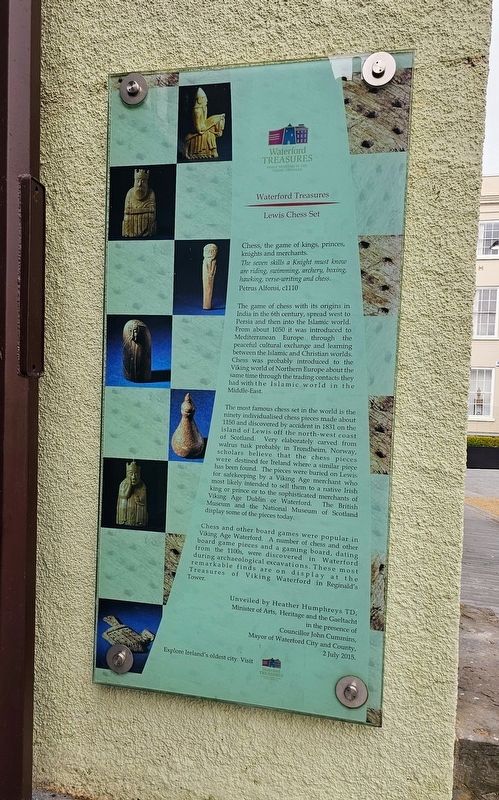
Chess, the game of kings, princes, knights and merchants.
The seven skills a Knight must know are riding, swimming, archery, boxing, hawking, verse-writing and chess.
Petrus Alfonsi, c1110
The game of chess with its origins in India in the 6th century, spread west to Persia and then into the Islamic world. From about 1050 it was introduced to Mediterranean Europe through the peaceful cultural exchange and learning between the Islamic and Christian worlds. Chess was probably introduced to the Viking world of Northern Europe about the same time through the trading contacts they had with the Islamic world in the Middle-East.
The most famous chess set in the world is the ninety individualised chess pieces made about 1150 and discovered by accident in 1831 on the island of Lewis off the north-west coast of Scotland. Very elaborately carved from walrus tusk probably in Trondheim, Norway, scholars believe that the chess pieces were destined for Ireland where a similar piece has been found. The pieces were buried on Lewis for safekeeping by a Viking Age merchant who most likely intended to sell them to a native Irish king or prince or to the sophisticated merchants of Viking Age Dublin or Waterford. The British Museum and the National Museum of Scotland display some of the pieces today.
Chess and other board games were popular in Viking Age Waterford. A number of chess and other board game pieces and a gaming board, dating from the 1100s, were discovered in Waterford during archaeological excavations. These most remarkable finds are on display at the Treasures of Viking Waterford in Reginald’s Tower.
Unveiled by Heather Humphreys TD,
Minister of Arts, Heritage and the Gaeltacht
in the presence of
Councillor John Cummins,
Mayor of Waterford City and County,
2 July 2015.
Erected 2015 by Waterford Treasures.
Topics.
this page online
Location. 52° 15.613′ N, 7° 6.446′ W. Marker is in Waterford, Munster, in County Waterford. It is on Cathedral Square east of Henrietta Street, on the left when traveling east. Touch for map. Marker is at or near this postal address: 6 Cathedral Square, Waterford, Munster, Ireland. Touch for directions.

Regionally, this marker is in the Ancient East. Globally, it is on the Atlantic Ocean, in the North Atlantic Region, in Europe, on the Island of Ireland, on the Celtic Fringe, in the European Union, in Atlantic Europe, on one of the British Isles, in the Western World, and in the Anglosphere.
Other nearby markers. At least 8 other markers are within walking distance of this marker: God’s People’s House (here, next to this marker); John Roberts (within shouting distance of this marker); Stephen De Fulburn (within shouting distance of this marker); Madness and Loss in WWI (within shouting distance of this marker); Choristers’ Hall and Mayor’s Wine Vault (within shouting distance
Photographed by Ian Lefkowitz, May 16, 2026
2. Lewis Chess Set Marker
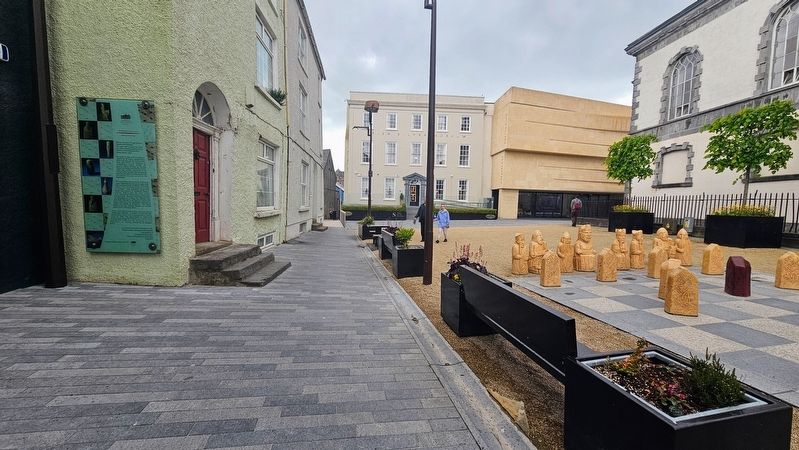
The marker is located next to a giant chess set in Waterford's Constitution Square.
Also see . . .
1. Lewis chessmen (Wikipedia).
The Lewis chessmen or Uig chessmen, named after the island or the bay where they were found, are a group of distinctive 12th-century chess pieces, along with other game pieces, most of which are carved from walrus ivory. Discovered in 1831 on the Isle of Lewis in the Outer Hebrides of Scotland, they may constitute some of the few surviving medieval chess sets, although it is not clear if a single complete period-accurate set can be assembled from the pieces.(Submitted on June 23, 2026, by Ian Lefkowitz of New York, New York.)
2. Checkmate at Waterford 800 festival (The Munster Express, July 10 2015).
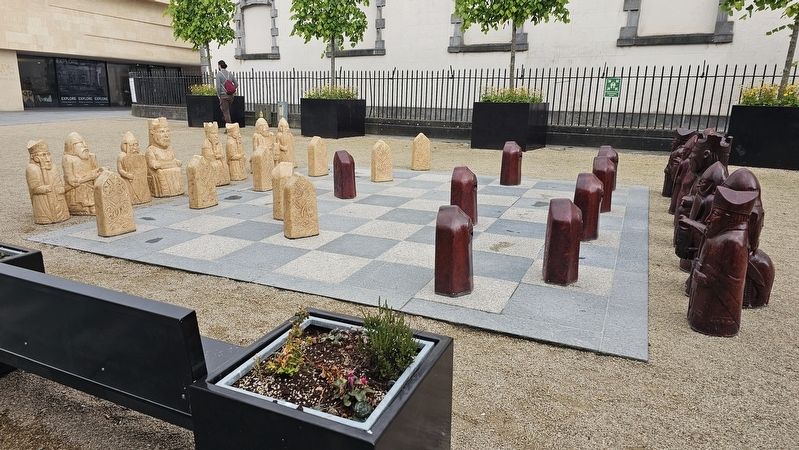
Among the innovations unveiled last week in tandem with the Festival was a special giant chess set on Cathedral Square which was modelled on an original chess set found on the Island of Lewis in the 19th Century, which(Submitted on June 23, 2026, by Ian Lefkowitz of New York, New York.)is said to date back to Vikings in the 11th Century.Photographed by Ian Lefkowitz, May 16, 20263. Giant Chess Set of WaterfordWhite appears to be in a commanding position in today's chess match.
“The style will be familiar to many of you, but I must commend the creator of this particular set, Kevin Harlow,” said the Minister. “It will act as a living, interactive symbol of Waterford’s past brought to the present in a fun way, and I am sure it will be enjoyed by all ages.”
Credits. This page was last revised on June 23, 2026. It was originally submitted on June 23, 2026, by Ian Lefkowitz of New York, New York. This page has been viewed 12 times since then. Photos: 1, 2, 3. submitted on June 23, 2026, by Ian Lefkowitz of New York, New York. • Andrew Ruppenstein was the editor who published this page.
