Buffalo in Harding County, South Dakota — The American Midwest (Upper Plains)
Cattle Ranching in Harding County
Photographed by Cosmos Mariner, August 24, 2023
1. Cattle Ranching in Harding County Marker
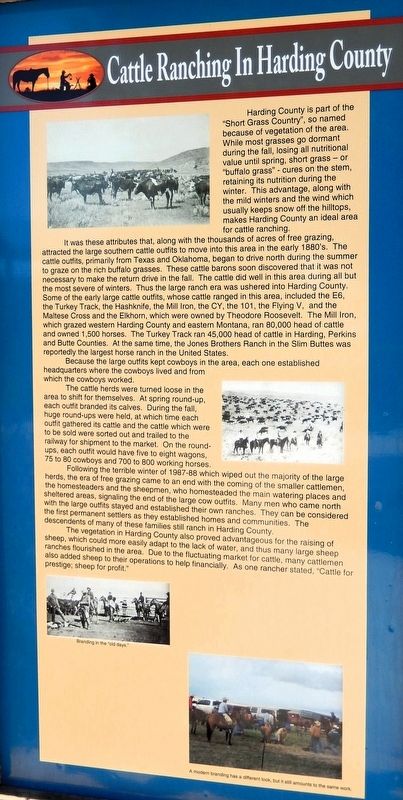
Harding County is part of the "Short Grass Country", so named because of vegetation of the area. While most grasses go dormant during the fall, losing all nutritional value until spring, short grass — or "buffalo grass" — cures on the stem, retaining its nutrition during the winter. This advantage, along with the mild winters and the wind which usually keeps snow off the hilltops, makes Harding County an ideal area for cattle ranching.
It was these attributes that, along with the thousands of acres of free grazing, attracted the large southern cattle outfits to move into this area in the early 1880's. The cattle outfits, primarily from Texas and Oklahoma, began to drive north during the summer to graze on the rich buffalo grasses. These cattle barons soon discovered that it was not necessary to make the return drive in the fall. The cattle did well in this area during all but the most severe of winters. Thus the large ranch era was ushered into Harding County. Some of the early large cattle outfits, whose cattle ranged in this area, included the E6, the Turkey Track, the Hashknife, the Mill Iron, the CY, the 101, the Flying V, and the Maltese Cross and the Elkhorn, which were owned by Theodore Roosevelt. The Mill Iron, which grazed western Harding County and eastern Montana, ran 80,000 head of cattle and owned 1,500 horses. The Turkey Track ran 45,000 head of cattle in Harding, Perkins and Butte Counties. At the same time, the Jones Brothers Ranch in the Slim Buttes was reportedly the largest horse ranch in the United States.
Because the large outfits kept cowboys in the area, each one established headquarters where the cowboys lived and from which the cowboys worked.
The cattle herds were turned loose in the area to shift for themselves. At spring roundup, each outfit branded its calves. During the fall,
this page online
Following the terrible winter of 1887-88 which wiped out the majority of the large herds, the era of free grazing came to an end with the coming of the smaller cattlemen, the homesteaders and the sheepmen, who homesteaded the main watering places and sheltered areas, signaling the end of the large cow outfits. Many men who came north with the large outfits stayed and established their own ranches. They can be considered the first permanent settlers as they established homes and communities. The descendants of many of these families still ranch in Harding County.
The vegetation in Harding County also proved advantageous for the raising of sheep, which could more easily adapt to the lack of water, and thus many large sheep ranches flourished in the area. Due to the fluctuating market for cattle, many cattlemen also added sheep to their operations to help
Photographed by Cosmos Mariner, August 24, 2023
2. Cattle Ranching in Harding County Marker
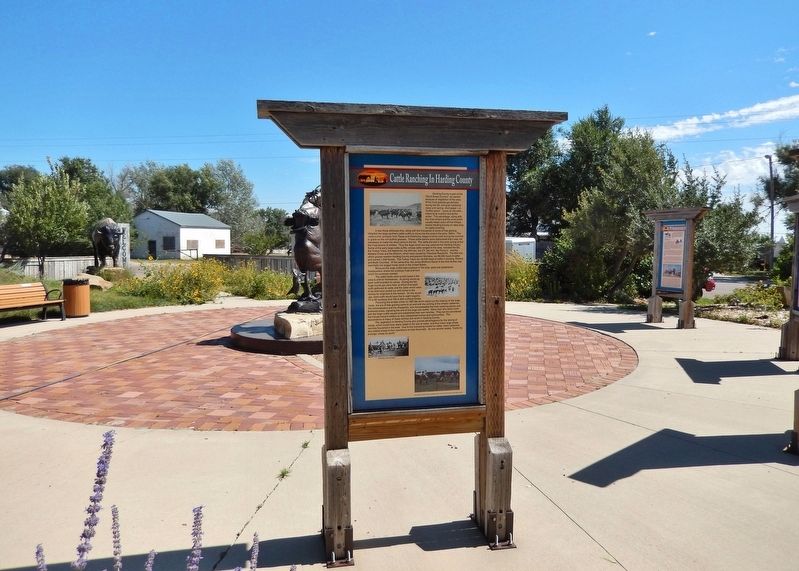
The marker is on the heritage walkway in Centennial Park.
[captions]
• Branding in the “old days.”
• A modern branding has a different look, but it still amounts to the same work.
Erected by Buffalo & Harding County, South Dakota.
Topics. This historical marker is listed in these topic lists: Agriculture • Animals • Industry & Commerce • Settlements & Settlers.
Location. 45° 34.857′ N, 103° 32.777′ W. Marker is in Buffalo, South Dakota, in Harding County. It can be reached from Theodore Roosevelt Expressway (CanAm Highway) (U.S. 85) just south of Connel Street (State Highway 20), on the left when traveling north. The marker is in Centennial Park. Touch for map. Marker is at or near this postal address: 91 US Highway 85, Buffalo SD 57720, United States of America. Touch for directions.

Regionally, this marker is in West River. It is also in the American Lewis & Clark Corridor, on the prairies, and on the Northern Plains. Globally, it is in North America, the Western Hemisphere, the Western World, and the Anglosphere. Historically, it finds itself in what was once Rupert’s Land and also the Louisiana Purchase.
Other nearby markers. At least 8 other markers are within walking distance of this marker: The Buffalo "Paints Himself Red" (here, next to this marker); Energy Production in Harding County (here, next to this marker); The Establishment of Harding County (here, next to this marker); The Homesteaders (here, next to this marker); Medora - Deadwood Stage Line (here, next to this marker); Centennial Park (here, next to this marker); The Custer Black Hills Expedition of 1874 (here, next to this marker); Ludlow Cave (here, next to this marker). Touch for a list and map of all markers in Buffalo.
Also see . . .
1. Elkhorn Ranch (Wikipedia).
Excerpt: The Elkhorn Ranch was established by Theodore Roosevelt on the banks of the Little Missouri River 35 miles north of Medora, North Dakota in the summer of 1884. Roosevelt hired Bill Sewall and Wilmot Dow, two Maine woodsmen, to run the ranch. The Elkhorn Ranch was Theodore Roosevelt's "main ranch", and his preferred ranch house because it was larger and more private than his Maltese Cross Ranch cabin, established in 1883. Roosevelt particularly enjoyed sitting in the veranda in a rocking chair, reading in the shade of the cottonwood trees. His enjoyment is evident in his books, Ranch Life and the Hunting Trail, Hunting Trips of a Ranchman, and The Wilderness Hunter. Roosevelt quit the ranch in 1887 after losing 60% of his stock in the starvation winter of 1886–87, and returned only a handful of times to the badlands after that. He kept a small share of the cattle until 1898 at the outset of the Spanish–American War.(Submitted on June 25, 2026, by Cosmos Mariner of Cape Canaveral, Florida.)
2. Winter of 1886–87 in the United States (Wikipedia).
Excerpt: Hundreds of thousands of cattle died in the Big Die-Up during the unusually cold and snowy winters of 1885–1886 and 1886–1887. Extreme cold killed humans and animals. Some people got lost near their houses and froze to death very near their front doors. The loss of livestock was not discovered until spring, when many cattle carcasses were spread across the fields and washed down streams. The few remaining cattle were in poor health, emaciated and suffering from frostbite. This resulted in the cattle being sold for much less, in some cases leading businesses to bankruptcy. "Many of them were big ranches that focused on short-term profits". This winter marked the end of the open range era and led to the entire reorganization of ranching.(Submitted on June 25, 2026, by Cosmos Mariner of Cape Canaveral, Florida.)
Credits. This page was last revised on June 27, 2026. It was originally submitted on June 24, 2026, by Cosmos Mariner of Cape Canaveral, Florida. This page has been viewed 14 times since then. Photos: 1, 2. submitted on June 25, 2026, by Cosmos Mariner of Cape Canaveral, Florida.
