Buffalo in Harding County, South Dakota — The American Midwest (Upper Plains)
The Buffalo "Paints Himself Red"
Photographed by Cosmos Mariner, August 24, 2023
1. The Buffalo "Paints Himself Red" Marker
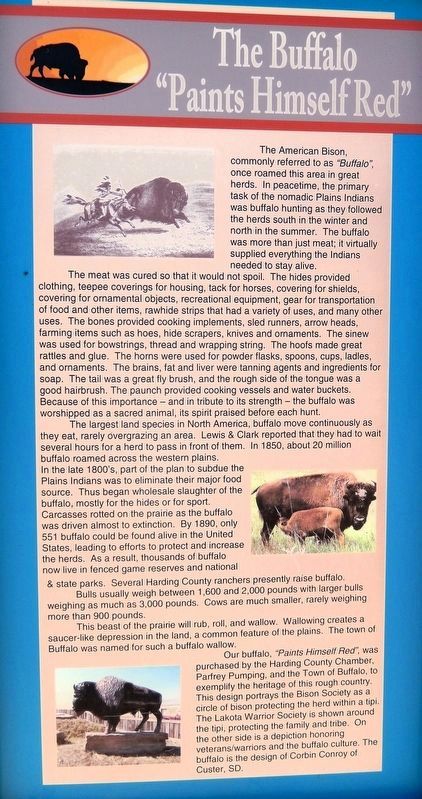
The American Bison, commonly referred to as “Buffalo”, once roamed this area in great herds. In peacetime, the primary task of the nomadic Plains Indians was buffalo hunting as they followed the herds south in the winter and north in the summer. The buffalo was more than just meat; it virtually supplied everything the Indians needed to stay alive.
The meat was cured so that it would not spoil. The hides provided clothing, teepee coverings for housing, tack for horses, covering for shields, covering for ornamental objects, recreational equipment, gear for transportation of food and other items, rawhide strips that had a variety of uses, and many other uses. The bones provided cooking implements, sled runners, arrow heads, farming items such as hoes, hide scrapers, knives and ornaments. The sinew was used for bowstrings, thread and wrapping string. The hoofs made great rattles and glue. The horns were used for powder flasks, spoons, cups, ladles, and ornaments. The brains, fat and liver were tanning agents and ingredients for soap. The tail was a great fly brush, and the rough side of the tongue was a good hairbrush. The paunch provided cooking vessels and water buckets. Because of this importance — and in tribute to its strength — the buffalo was worshipped as a sacred animal, its spirit praised before each hunt.
The largest land species in North America, buffalo move continuously as they eat, rarely overgrazing an area. Lewis & Clark reported that they had to wait several hours for a herd to pass in front of them. In 1850, about 20 million buffalo roamed across the western plains. In the late 1800's, part of the plan to subdue the Plains Indians was to eliminate their major food source. Thus began wholesale slaughter of the buffalo, mostly for the hides or for sport. Carcasses rotted on the prairie as the
this page online
Bulls usually weigh between 1,600 and 2,000 pounds with larger bulls weighing as much as 3,000 pounds. Cows are much smaller, rarely weighing more than 900 pounds.
This beast of the prairie will rub, roll, and wallow. Wallowing creates a saucer-like depression in the land, a common feature of the plains. The town of Buffalo was named for such a buffalo wallow.
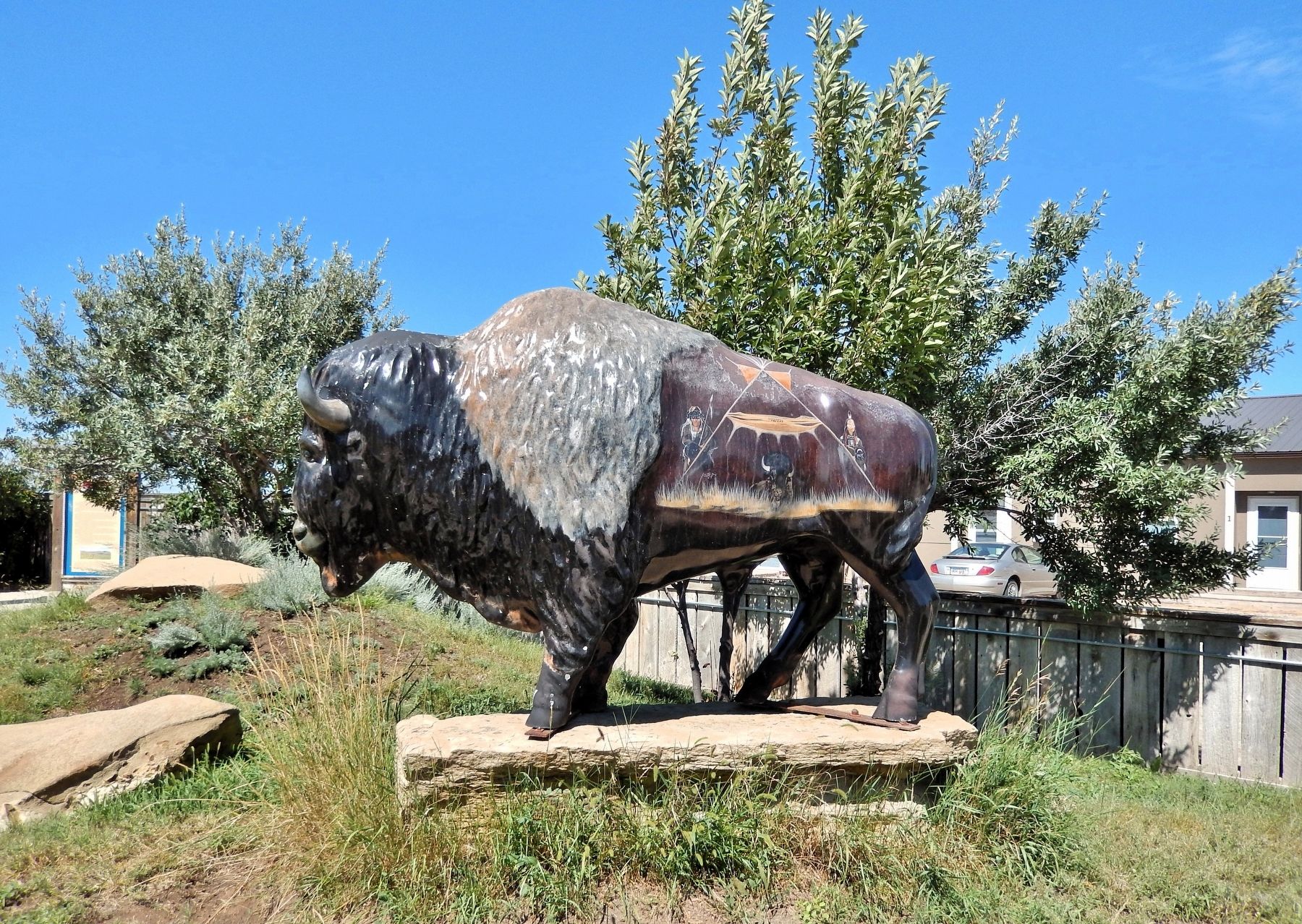
Our buffalo, “Paints Himself Red”, was purchased by the Harding County Chamber, Parfrey Pumping, and the Town of Buffalo, to exemplify the heritage of this rough country. This design portrays the Bison Society as a circle of bison protecting the herd within a tipi. The Lakota Warrior Society is shown around the tipi, protecting the family and tribe. On the other side is a depiction honoring veterans/warriors and the buffalo culture. The buffalo is the design of Corbin
Photographed by Cosmos Mariner, August 24, 2023
2. The Buffalo "Paints Himself Red" Marker
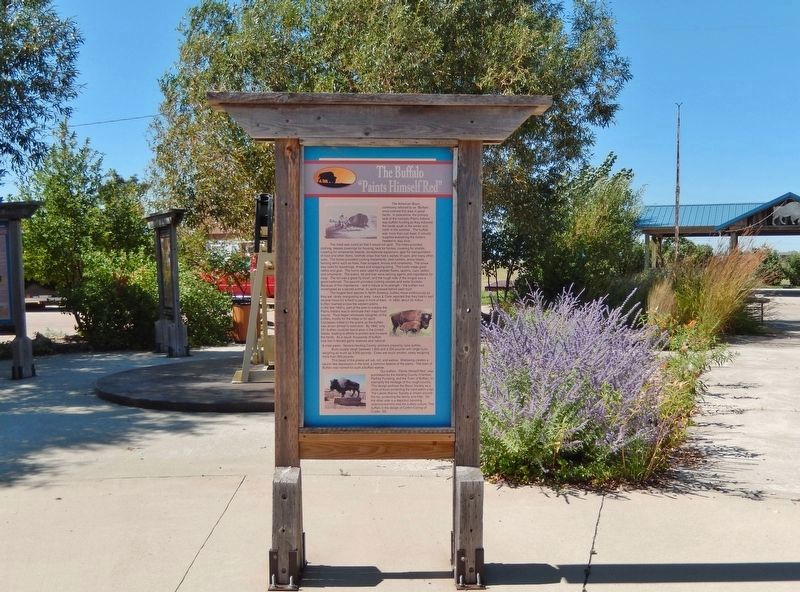
The marker is on the heritage walkway in Centennial Park.
Erected by Buffalo & Harding County, South Dakota.
Topics. This historical marker is listed in these topic lists: Animals • Indigenous Peoples and Communities. A significant historical year for this entry is 1850.
Location. 45° 34.857′ N, 103° 32.777′ W. Marker is in Buffalo, South Dakota, in Harding County. It can be reached from Theodore Roosevelt Expressway (CanAm Highway) (U.S. 85) just south of Connel Street (State Highway 20), on the left when traveling north. The marker is in Centennial Park. Touch for map. Marker is at or near this postal address: 91 US Highway 85, Buffalo SD 57720, United States of America. Touch for directions.

Regionally, this marker is in West River. It is also in the American Lewis & Clark Corridor, on the prairies, and on the Northern Plains. Globally, it is in North America, the Western Hemisphere, the Western World, and the Anglosphere. Historically, it finds itself in what was once Rupert’s Land and also the Louisiana Purchase.
Other nearby markers. At least 8 other markers are within walking distance of this marker: Cattle Ranching in Harding County (here,
Photographed by Cosmos Mariner, August 24, 2023
3. “Paints Himself Red”
It is located a few meters north of the marker, near the northwest corner of Centennial Park.
Also see . . . American bison (Wikipedia).
Excerpt: Once roaming in vast herds, the species nearly became extinct by a combination of commercial hunting and slaughter in the 19th century and introduction of bovine diseases from domestic cattle. With an estimated population of 60 million in the late 18th century, the species was reduced to 541 animals by 1889 as part of the genocide of the Native Americans, because the American bison was a major resource for their traditional way of life (food source, hides for clothing and shelter, and horns and bones for tools). Recovery efforts expanded in the mid-20th century, with a resurgence to roughly 31,000 wild bison as of March 2019. For many years, the population was primarily found in a few national parks and reserves. Through multiple reintroductions, the species now freely roams wild in several regions in the United States, Canada and Mexico. Others are kept in smaller natural areas as conservation herds, while some are also kept in private commercial herds.(Submitted on June 25, 2026, by Cosmos Mariner of Cape Canaveral, Florida.)Spanning back millennia, Indigenous peoples of the Great Plains have had cultural and spiritual connections to the American bison. It is the national mammal of the United States.
Credits. This page was last revised on June 27, 2026. It was originally submitted on June 25, 2026, by Cosmos Mariner of Cape Canaveral, Florida. This page has been viewed 21 times since then. Photos: 1, 2, 3. submitted on June 25, 2026, by Cosmos Mariner of Cape Canaveral, Florida.
