Buffalo in Harding County, South Dakota — The American Midwest (Upper Plains)
Centennial Park
Photographed by Cosmos Mariner, August 24, 2023
1. Centennial Park Marker
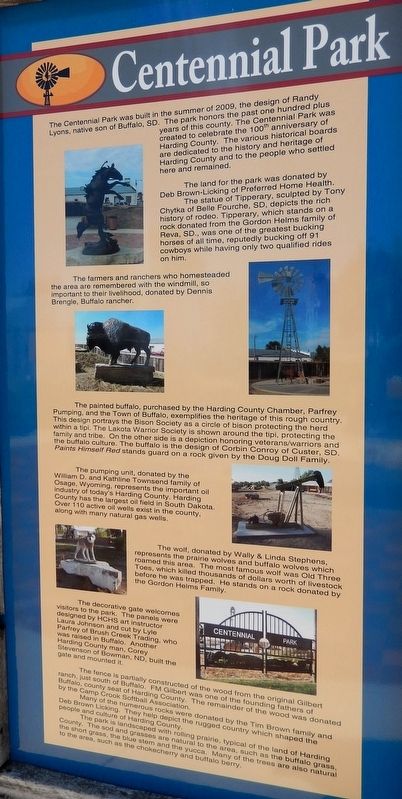
The Centennial Park was built in the summer of 2009, the design of Randy Lyons, native son of Buffalo, SD. The park honors the past one hundred plus years of this county. The Centennial Park was created to celebrate the 100 anniversary of Harding County. The various historical boards are dedicated to the history and heritage of Harding County and to the people who settled here and remained.
The land for the park was donated by Deb Brown-Licking of Preferred Home Health.
The statue of Tipperary, sculpted by Tony Chytka of Belle Fourche, SD, depicts the rich history of rodeo. Tipperary, which stands on a rock donated from the Gordon Helms family of Reva, SD., was one of the greatest bucking horses of all time, reputedly bucking off 91 cowboys while having only two qualified rides on him.
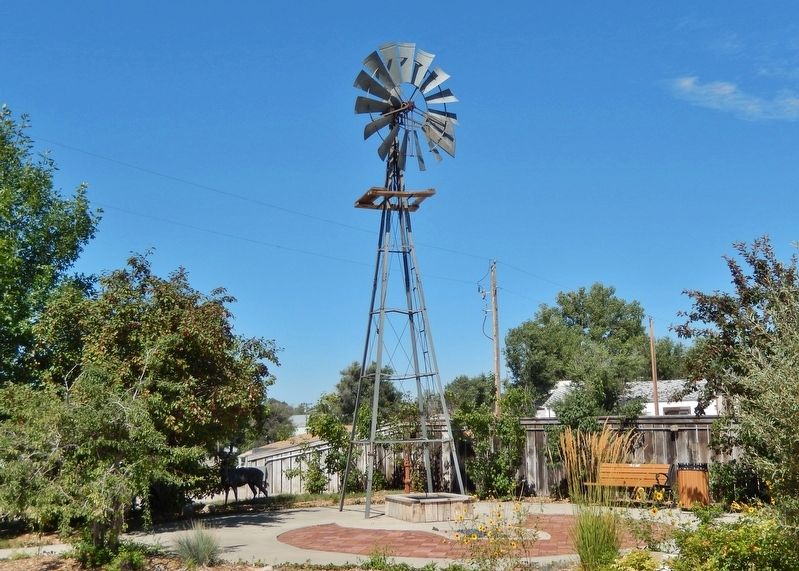
The farmers and ranchers who homesteaded the area are remembered with the windmill, so important to their livelihood, donated by Dennis Brengle, Buffalo rancher.
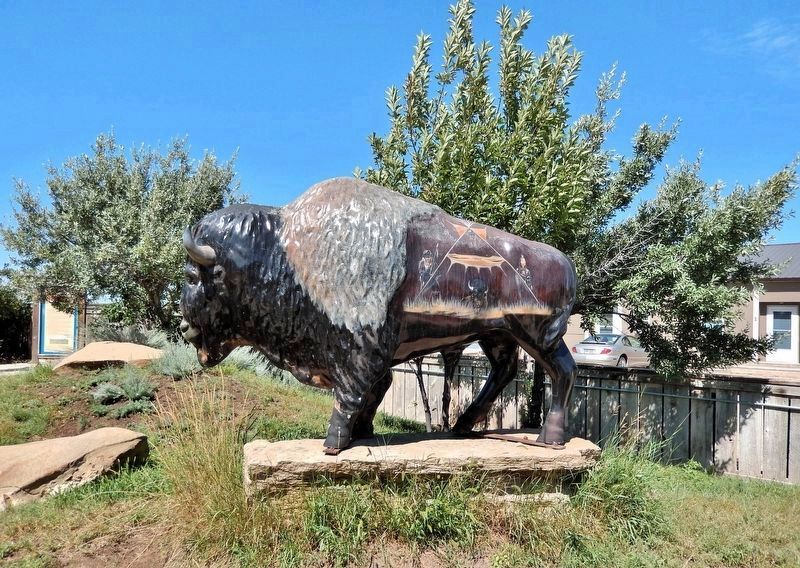
The painted buffalo, purchased by the Harding County Chamber, Parfrey Pumping, and the Town of Buffalo, exemplifies the heritage of this rough country. This design portrays the Bison Society as a circle of bison protecting the herd within a tipi. The Lakota Warrior Society is shown around the tipi, protecting the family and tribe. On the other side is a depiction honoring veterans/warriors and the buffalo culture. The buffalo is the design of Corbin Conroy of Custer, SD. “Paints Himself Red” stands guard on a rock given by the Doug Doll Family.
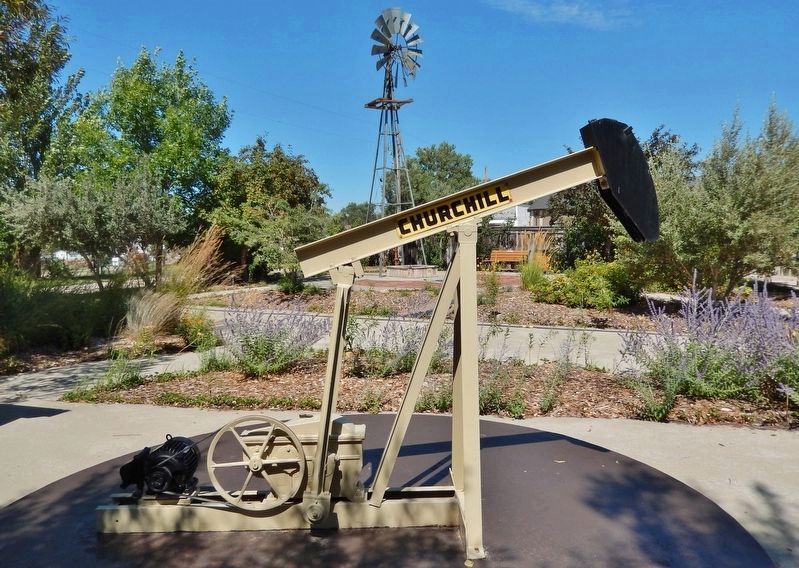
The pumping unit, donated by the William D. and Kathline Townsend family of Osage, Wyoming, represents the important oil industry of today's Harding County. Harding County has the largest oil field in South Dakota. Over 110 active oil wells exist in the county, along with many natural gas wells.
The wolf, donated by Wally & Linda
this page online
The decorative gate welcomes visitors to the park. The panels were designed by HCHS art instructor Laura Johnson and cut by Lyle Parfrey of Brush Creek Trading, who was raised in Buffalo. Another Harding County man, Corey Stevenson of Bowman, ND, built the gate and mounted it.
The fence is partially constructed of the wood from the original Gilbert ranch, just south of Buffalo. F.M. Gilbert was one of the founding fathers of Buffalo, county seat of Harding County. The remainder of the wood was donated by the Camp Crook Softball Association.
Many of the numerous rocks were donated by the Tim Brown family and Deb Brown Licking. They help depict the rugged country which shaped the people and culture of Harding County.
The park is landscaped with rolling prairie, typical of the land of Harding County. The sod and grasses are natural to the area, such as the buffalo grass, the short grass,
Photographed by Cosmos Mariner, August 24, 2023
2. Centennial Park Marker
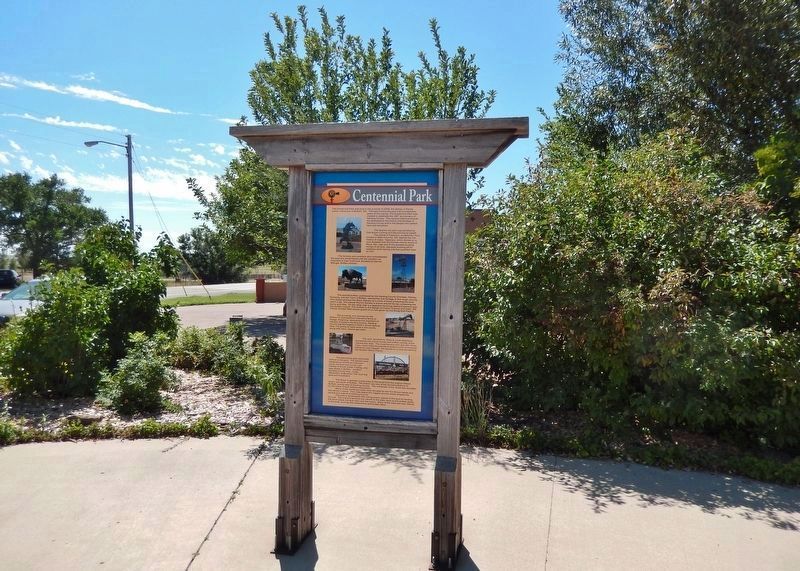
The marker is on the heritage walkway in Centennial Park.
Erected by Buffalo & Harding County, South Dakota.
Topics. This historical marker is listed in these topic lists: Charity & Public Work • Industry & Commerce • Parks & Recreational Areas • Settlements & Settlers. A significant historical year for this entry is 2009.
Location. 45° 34.856′ N, 103° 32.773′ W. Marker is in Buffalo, South Dakota, in Harding County. It can be reached from Theodore Roosevelt Expressway (CanAm Highway) (U.S. 85) just south of Connel Street (State Highway 20), on the left when traveling north. The marker is in Centennial Park. Touch for map. Marker is at or near this postal address: 91 US Highway 85, Buffalo SD 57720, United States of America. Touch for directions.

Regionally, this marker is in West River. It is also in the American Lewis & Clark Corridor, on the prairies, and on the Northern Plains. Globally, it is in North America, the Western Hemisphere, the Western World, and the Anglosphere. Historically, it finds itself in what was once Rupert’s Land and

Photographed by Cosmos Mariner, August 24, 2023
3. Tipperary
The statue of Tipperary, sculpted by Tony Chytka of Belle Fourche, SD, honors the rich history of rodeo.
Other nearby markers. At least 8 other markers are within walking distance of this marker: The Establishment of Harding County (here, next to this marker); Energy Production in Harding County (here, next to this marker); Three-Toes, The Wolf (here, next to this marker); Tipperary (here, next to this marker); Cattle Ranching in Harding County (here, next to this marker); The Buffalo "Paints Himself Red" (here, next to this marker); The Homesteaders (a few steps from this marker); Medora - Deadwood Stage Line (a few steps from this marker). Touch for a list and map of all markers in Buffalo.
Related markers. Click here for a list of markers that are related to this marker. Centennial Park
Also see . . . Harding County (Wikipedia).
Excerpt: Harding County was established as a county in the Dakota Territory on March 5, 1881, but was not organized at that time. Its name recognized J. A. Harding, who had been Speaker of the House of Dakota Territory. Its boundaries were altered in 1883, in 1889, and in 1894. On November 8, 1898, Harding County was dissolved and its territory assigned(Submitted on June 27, 2026, by Cosmos Mariner of Cape Canaveral, Florida.)to Butte County. However, on November 3, 1908, it was again created (with altered boundaries) from Butte County's area, and on February 17, 1909, its governing organization was completed.Photographed by Cosmos Mariner, August 24, 20234. Centennial Park WindmillDonated by Dennis Brengle, Buffalo rancher.
Photographed by Cosmos Mariner, August 24, 2023
5. “Paints Himself Red”
The buffalo is the design of Corbin Conroy of Custer, SD.
Photographed by Cosmos Mariner, August 24, 2023
6. Oil Pumping Unit
Donated by the William D. and Kathline Townsend family of Osage, Wyoming.

Photographed by Cosmos Mariner, August 24, 2023
7. Centennial Park Gate
Corey Stevenson of Bowman, ND, built the gate and mounted it.
Credits. This page was last revised on June 27, 2026. It was originally submitted on June 25, 2026, by Cosmos Mariner of Cape Canaveral, Florida. This page has been viewed 29 times since then. Photos: 1, 2, 3, 4, 5, 6, 7. submitted on June 27, 2026, by Cosmos Mariner of Cape Canaveral, Florida.
