Saint Marys in Perth County, Ontario — Central Canada (North America)
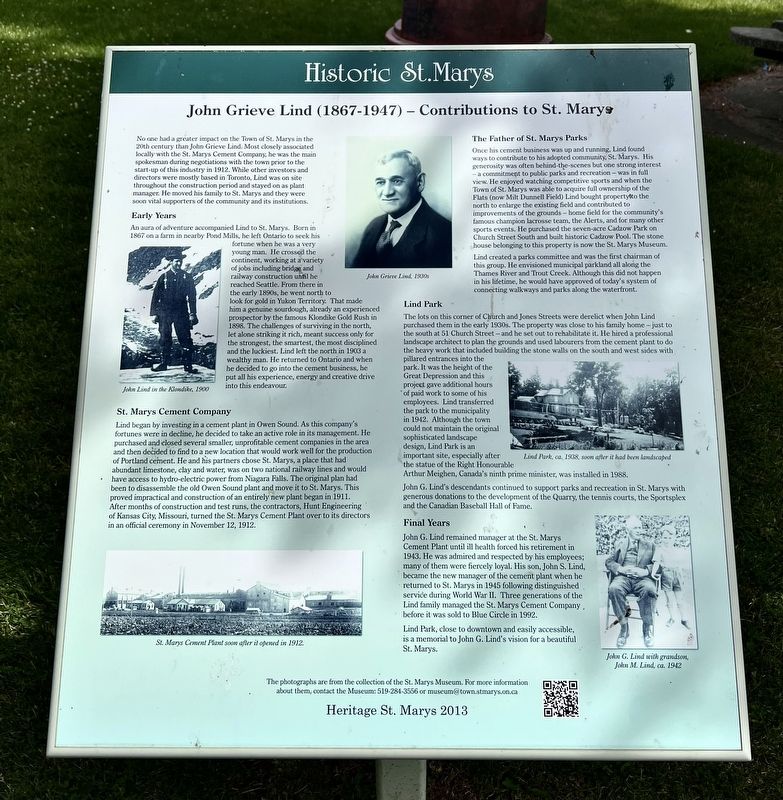
John Grieve Lind (1867-1947) - Contributions to St. Marys
Photographed by Tim Boyd, June 21, 2026
1. John Grieve Lind (1867-1947) - Contributions to St. Marys Marker
Early Years
An aura of adventure accompanied Lind to St. Marys. Born in 1867 on a farm in nearby Pond Mills, he left Ontario to seek his fortune when he was a very young man. He crossed the continent, working at a variety of jobs including bridge and railway construction until he reached Seattle. From there in the early 1890s, he went north to look for gold in Yukon Territory. That made him a genuine sourdough, already an experienced prospector by the famous Klondike Gold Rush in 1898. The challenges of surviving in the north, let alone striking it rich, meant success only for the strongest, the smartest,
this page online
St. Marys Cement Company
Lind began by investing in a cement plant in Owen Sound. As this company's fortunes were in decline, he decided to take an active role in its management. He purchased and closed several smaller, unprofitable cement companies in the area and then decided to find to a new location that would work well for the production of Portland cement. He and his partners chose St. Marys, a place that had abundant limestone, clay and water, was on two national railway lines and would have access to hydro-electric power from Niagara Falls. The original plan had been to disassemble the old Owen Sound plant and move it to St. Marys. This proved impractical and construction of an entirely new plant began in 1911. After months of construction and test runs, the contractors, Hunt Engineering of Kansas City, Missouri, turned the St. Marys Cement Plant over to its directors in an official ceremony in
Photographed by Tim Boyd, June 21, 2026
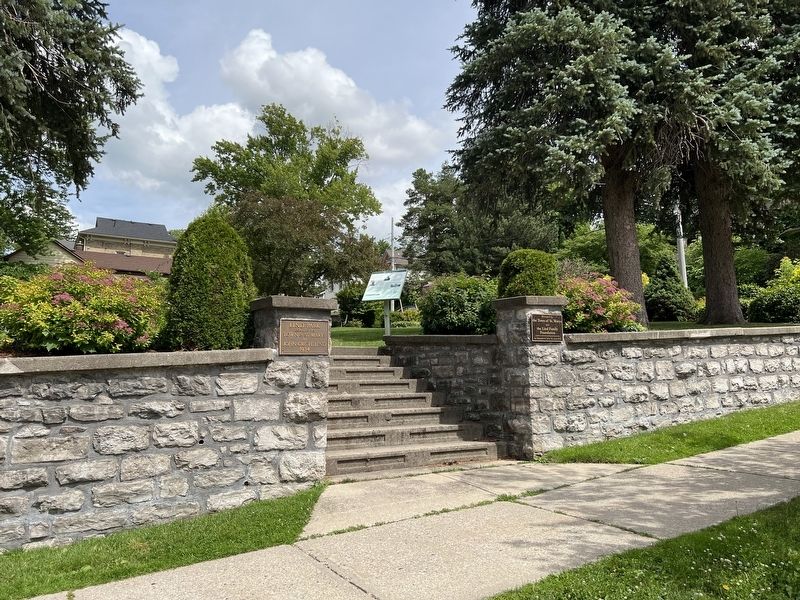
2. John Grieve Lind (1867-1947) - Contributions to St. Marys Marker
From Church Street
The Father of St. Marys Parks
Once his cement business was up and running, Lind found ways to contribute to his adopted community, St. Marys. His generosity was often behind-the-scenes but one strong interest - a commitment to public parks and recreation - was in full view. He enjoyed watching competitive sports and when the Town of St. Marys was able to acquire full ownership of the Flats (now Milt Dunnell Field) Lind bought property to the north to enlarge the existing field and contributed to improvements of the grounds - home field for the community’s famous champion lacrosse team, the Alerts, and for many other sports events. He purchased the seven-acre Cadzow Park on Church Street South and built historic Cadzow Pool. The stone house belonging to this property is now the St. Marys Museum.
Lind created a parks committee and was the first chairman of this group. He envisioned municipal parkland all along the Thames River and Trout Creek. Although this did not happen in his lifetime, he would have approved of today's system of connecting walkways and parks along the waterfront.
Lind Park
The lots on
Photographed by Tim Boyd, June 21, 2026
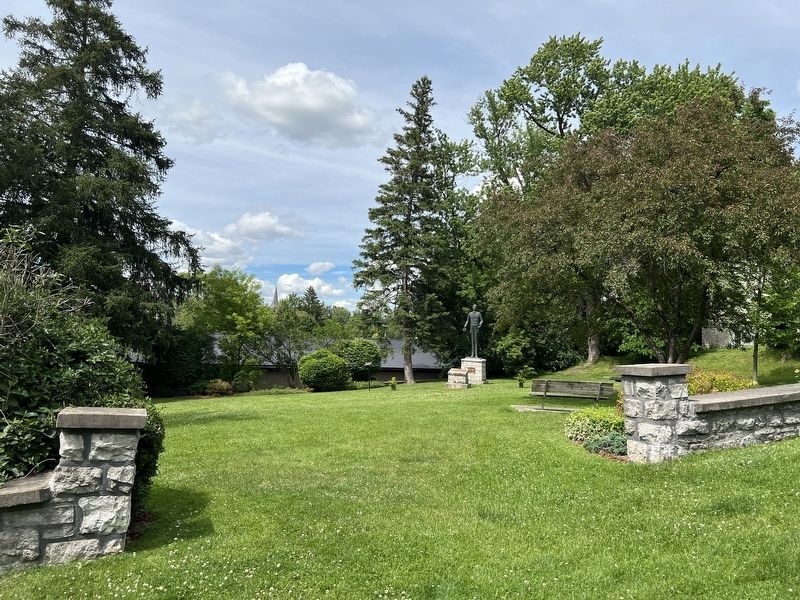
3. Lind Park in 2026
John G. Lind's descendants continued to support parks and recreation in St. Marys with generous donations to the development of the Quarry, the tennis courts, the Sportsplex and the Canadian Baseball Hall of Fame.
Final Years
John G. Lind remained manager at the St. Marys Cement Plant until ill health forced his retirement in 1943. He was admired and respected by his employees; many of them were fiercely loyal. His son, John S. Lind, became the new manager of the cement plant when he returned to St. Marys in 1945 following distinguished service during World War II. Three generations of the Lind family managed the St. Marys Cement Company before it was sold to Blue Circle in 1992.
Lind Park, close to downtown and easily accessible, is a memorial to John G. Lind's vision for a beautiful St. Marys.
Erected 2013 by Heritage St. Marys.
Topics. This historical marker is listed in these topic lists: Charity & Public Work • Industry & Commerce • Parks & Recreational Areas. A significant historical date for this entry is November 12, 1912.
Location. 43° 15.528′ N, 81° 8.424′ W. Marker is in Saint Marys, Ontario, in Perth County. It is at the intersection of Church Street South and Jones Street East, on the right when traveling north on Church Street South. Touch for map. Marker is at or near this postal address: 27 Church Street S, Saint Marys ON N4X N4X, Canada. Touch for directions.

Regionally, this marker is in the Huron-Perth-Waterloo-Wellington Area and in Southwestern Ontario. It is also in Central Canada. Globally, it is in North America, the Western Hemisphere, the Western World, and the Anglosphere. Historically, it finds itself in what was once a British colony, the Viceroyalty of New France, the Haudenosaunee (Iroquois) Confederacy, and Rupert’s Land.
Other nearby markers. At least 8 other markers are within walking distance of this marker: Arthur Meighen (within shouting distance of this marker); Town Hall (about 120 meters away, measured in a direct line); Robert Eaton Building (about 120 meters away); The A. Workman Building (about 120 meters away); Andrews Jeweller (about 150 meters away); St. Marys Public Library (about 150 meters away); John McDonald Block (about 210 meters away); The Church Street Bridge (about 240 meters away). Touch for a list and map of all markers in Saint Marys.
Credits. This page was last revised on June 27, 2026. It was originally submitted on June 26, 2026, by Tim Boyd of Hamilton, Ontario. This page has been viewed 14 times since then. Photos: 1, 2, 3. submitted on June 26, 2026, by Tim Boyd of Hamilton, Ontario. • Andrew Ruppenstein was the editor who published this page.
