Midtown - Downtown in Columbia in Richland County, South Carolina — The American South (South Atlantic)
Seibels House
Photographed by Mike Stroud, 2010
1. Seibels House Marker
National Register of Historic Places:
Hale-Elmore-Seibels House (added 1971 - Building - #71000804)
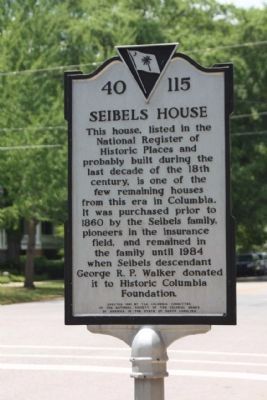
This house, listed in the National Register of Historic Places and probably built during the last decade of the 18th century, is one of the few remaining houses from this era in Columbia. It was purchased prior to 1860 by the Seibels family, pioneers in the insurance field, and remained in the family until 1984 when Seibels descendant George R. P. Walker donated it to Historic Columbia Foundation.
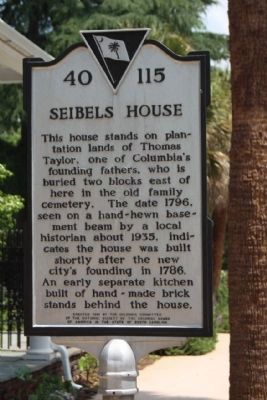
This house stands on plantation lands of Thomas Taylor, one of Columbia's founding fathers, who is buried two blocks east of here in the old family cemetery. The date 1796, seen on a hand-hewn basement beam by a local historian about 1935, indicates the house was built shortly after the new city's founding in 1786. An early separate kitchen built of hand-made brick stands behind the house.
Erected 1991 by South Carolina Department of Archives and History, sponsored by The Columbia Committee of the National Society of the Colonial Dames of America in the State of South Carolina. (Marker Number 40-115.)
Topics and series. This historical marker is listed in these topic lists: Agriculture • Settlements & Settlers. In addition, it is included in the South Carolina Historical Markers, and the The Colonial Dames of America, National Society of series lists. A significant historical year for this entry is 1860.
Location. 34° 0.77′ N, 81° 1.845′ W. Marker is in Columbia, South Carolina, in Richland County. It is in Midtown - Downtown. It is on Richland Street, on the right when traveling west. Located between Henderson and Pickens Streets. Touch for map. Marker is in this post office area: Columbia SC 29201, United States of America. Touch for directions.

Regionally, this marker is in the Midlands. It is also in the American South and specifically in the Deep South. Globally, it is in North America,
this page online
Other nearby markers. At least 8 other markers are within walking distance of this marker: By Any Other Name Would Smell as Sweet (a few steps from this marker); Rooted in the Past, Enhancing the Future (a few steps from this marker); A Horticultural Heritage (a few steps from this marker); A View Worth Remembering (within shouting distance of this marker); A Nurturing Nature (within shouting distance of this marker); Colonel Thomas Taylor (within shouting distance of this marker); Links to the Past (within shouting distance of this marker); a different marker also named An Enduring Landmark (about 300 feet away, measured in a direct line). Touch for a list and map of all markers in Columbia.
Other markers no longer nearby. An Enduring Landmark (was within shouting distance of this marker but has been replaced with another marker now near it); Pieces of the Past
Photographed by Mike Stroud, 2010
2. Seibels House Marker, reverse side
Regarding Seibels House. Hale-Elmore-Seibels House,
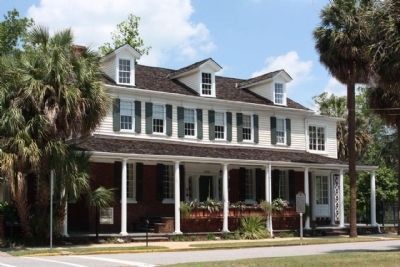
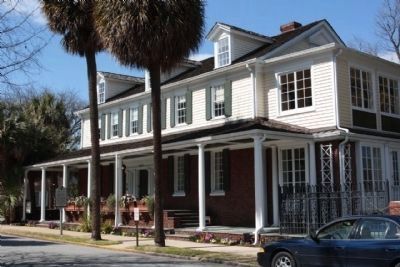
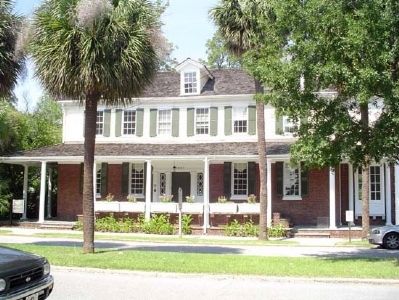
(Seibels House) Possibly the oldest house in Columbia, the Seibels House was built entirely of hand-hewn timber by A. M. Hale on a portion of the Thomas Taylor Plantation. Due to loss of state and local records by fire, the exact date of the house cannot be determined. However, there is record of the date 1796 carved on one of the hand-hewn timbers in the basement. The house was later purchased by Captain Benjamin Elmore, who then sold it to Mr. John Jacob Seibels. It is two-and-one-half-stories with Georgian lines. The first story, with wide doorway and sidelights, is of brick with four large shuttered windows. The second story is clapboard with six unshuttered windows. Piazzas on the front and the west sides of the house are supported by slender Doric columns. Piazzas formerly extended on three sides; east piazza replaced ca. 1900 by the addition of a sun porch on the first floor and a room on the second floor. Other additions include extensions enlarging the first and second
Photographed by Mike Stroud, May 6, 2010
3. Seibels House
Historic Significance: Architecture/Engineering •
Period of Significance: 1750-1799
National Register of Historic Places:
Hale-Elmore-Seibels House (added 1971 - - #71000804)
♦ Also known as Picriccorn House
♦ Historic Significance: Architecture/Engineering
♦ Architect, builder, or engineer: Hale,A.M.
♦ Architectural Style: Georgian
♦ Area of Significance: Architecture
♦ Period of Significance: 1750-1799
♦ Owner: Private
♦ Historic Function: Domestic
♦ Historic Sub-function: Single Dwelling
Photographed by Mike Stroud, February 28, 2010
4. Seibels House and Marker
Photographed by Mike Stroud, February 28, 2010
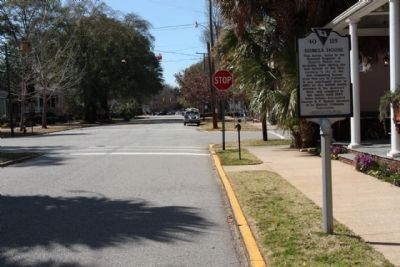
5. Seibels House Marker, looking west along Richland Street
South Carolina Department of Archives and History, September 21, 2006
6. Seibels House Marker
South Carolina Department of Archives and History, September 21, 2006
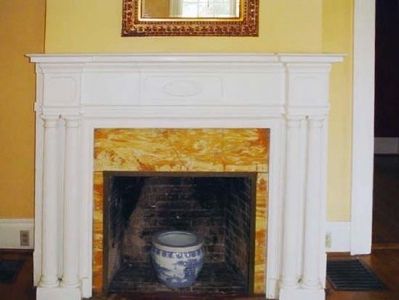
7. Parlor Mantle, as mentioned
Photographed by Devry Becker Jones (CC0), January 17, 2026
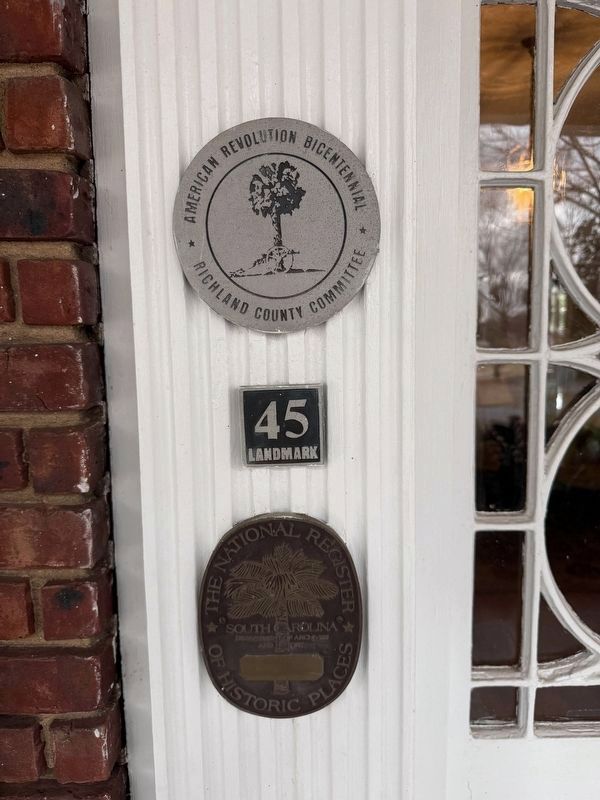
8. Several plaques on the house
Richland County Committee
45
Landmark
The National Register
of Historic Places
Seibel House
Credits. This page was last revised on January 24, 2026. It was originally submitted on May 7, 2010, by Mike Stroud of Bluffton, South Carolina. This page has been viewed 1,559 times since then and 59 times this year. Photos: 1, 2, 3, 4, 5, 6, 7. submitted on May 7, 2010, by Mike Stroud of Bluffton, South Carolina. 8. submitted on January 24, 2026, by Devry Becker Jones of Washington, District of Columbia.
