Rochester in Beaver County, Pennsylvania — The American Northeast (Mid-Atlantic)
Stepping into Historic Rochester
Hotels
Photographed by Bradley Owen, June 20, 2026
1. Stepping into Historic Rochester Marker
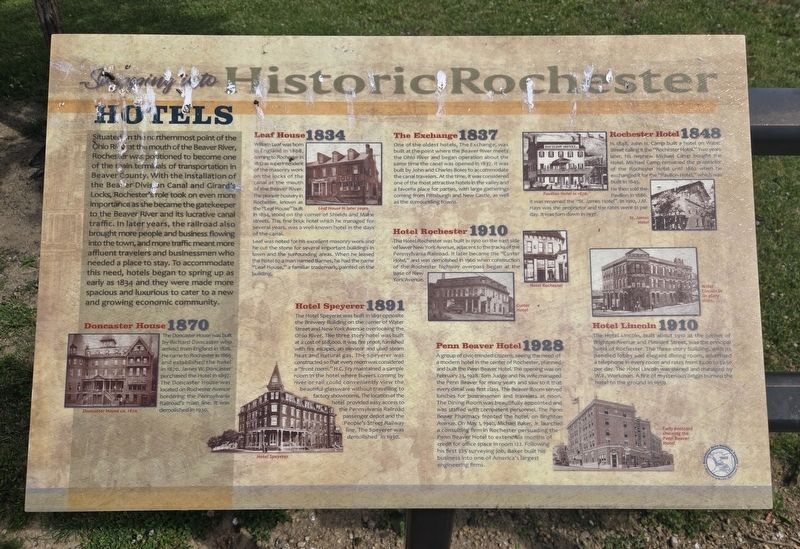
Situated on the northernmost point of the Ohio River at the mouth of the Beaver River, Rochester was positioned to become one of the main terminals of transportation in Beaver County. With the installation of the Beaver Division Canal and Girard's Locks, Rochester's role took on even more importance as she became the gatekeeper to the Beaver River and its lucrative canal traffic. In later years, the railroad also brought more people and business flowing into the town, and more traffic meant more affluent travelers and businessmen who needed a place to stay. To accommodate this need, hotels began to spring up as early as 1834 and they were made more spacious and luxurious to cater to a new and growing economic community.
Doncaster House 1870
The Doncaster House was built by Richard Doncaster who arrived from England in 1826. He came to Rochester in 1865 and established the hotel in 1870. James W. Doncaster purchased the Hotel in 1897. The Doncaster House was located on Rochester Avenue bordering the Pennsylvania Railroad's main line. It was demolished in 1930.
Leaf House 1834
William Leaf was born in England in
this page online
Leaf was noted for his excellent masonry work and he cut the stone for several important buildings in town and the surrounding areas. When he leased the hotel to a man named Barnes, he had the name "Leaf House," a familiar trademark, painted on the building.
The Exchange 1837
One of the oldest hotels, The Exchange, was built at the point where the Beaver River meets the Ohio River and began operation about the same time the canel was opened in 1837. It was built by John and Charles Boles to accommodate the canal travelers. At the time, it was considered one of the most attractive hotels in the valley and a favorite place for parties, with large gatherings coming from Pittsburgh and New Castle, as well as the surrounding towns.
Rochester Hotel 1848
In 1848, John H.
Photographed by Bradley Owen, June 20, 2026
2. Stepping into Historic Rochester Marker
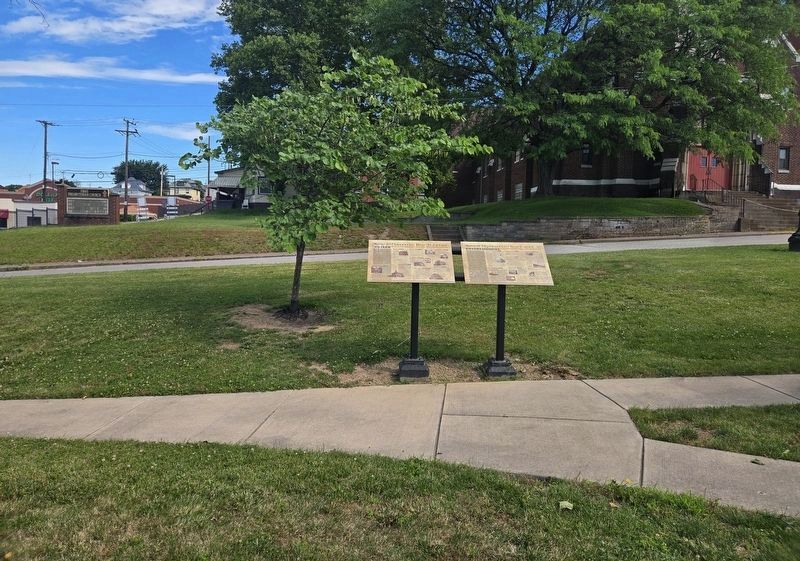
Marker is on the left.
Hotel Rochester 1910
The Hotel Rochester was built in 1910 on the east side of lower New York Avenue, adjacent to the tracks of the Pennsylvania Railroad. It later became the "Custer Hotel," and was demolished in 1960 when construction of the Rochester highway overpass began at the base of New York Avenue.
Hotel Lincoln 1910
The Hotel Lincoln, built about 1910 at the corner of Brighton Avenue and Pleasant Street, was the principal hotel of Rochester. The three-story building, with its paneled lobby and elegant dining room, advertised a telephone in every room and rates from $2.00 to $2.50 per day. The Hotel Lincoln was owned and managed by W.F. Workman. A fire of mysterious origin burned the hotel to the ground in 1959.
Penn Beaver Hotel 1928
A group of civic-minded citizens, seeing the need of a modern hotel in the center of Rochester, planned and built the Penn Beaver Hotel. The opening was on February 23, 1928. Tom Judge and his wife managed the Penn Beaver for many years and saw to it that every detail was first class. The Beaver Room served lunches for businessmen and travelers at noon. The Dining Room was beautifully appointed and was staffed with competent personnel. The Penn Beaver Pharmacy fronted the hotel, on Brighton Avenue. On May 1, 1940, Michael Baker, Jr. launched a consulting firm in Rochester persuading the Penn Beaver Hotel to extend six months of credit for office space in room 122. Following his first $25 surveying job, Baker built his business into one of America's largest engineering firms.
Erected by Rochester Area Heritage Society.
Topics. This historical marker is listed in these topic lists: Disasters • Industry & Commerce • Waterways & Vessels. A significant historical year for this entry is 1834.
Location. 40° 42.126′ N, 80° 17.123′ W. Marker is in Rochester, Pennsylvania, in Beaver County. It is at the intersection of North Park Street and Brighton Avenue (Pennsylvania Route 18), on the right when traveling east on North Park Street. Touch for map. Marker is at or near this postal address: 50 North Park Street, Rochester PA 15074, United States of America. Touch for directions.

Regionally, this marker is in Greater Pittsburgh. It is also in the American Northeast, in the Mid-Atlantic, and in the Ohio River Valley. Globally, it is in North America, the Western Hemisphere, the Western World, and the Anglosphere. Historically, it finds itself in what was once the Haudenosaunee (Iroquois) Confederacy and also one of the original Thirteen Colonies.
Other nearby markers. At least 8 other markers are within walking distance of this marker: A different marker also named Stepping into Historic Rochester (here, next to this marker); a different marker also named Stepping into Historic Rochester (here, next to this marker); a different marker also named Stepping into Historic Rochester (a few steps from this marker); Major General Joseph H. Pendleton (a few steps from this marker); a different marker also named Stepping into Historic Rochester (a few steps from this marker); a different marker also named Stepping into Historic Rochester (a few steps from this marker); History of the Rochester Fire Department (a few steps from this marker); a different marker also named Stepping into Historic Rochester (a few steps from this marker). Touch for a list and map of all markers in Rochester.
Credits. This page was last revised on June 29, 2026. It was originally submitted on June 28, 2026, by Bradley Owen of Morgantown, West Virginia. This page has been viewed 18 times since then. Photos: 1. submitted on June 28, 2026, by Bradley Owen of Morgantown, West Virginia. 2. submitted on June 29, 2026, by Bradley Owen of Morgantown, West Virginia.
