Lawnside in Camden County, New Jersey — The American Northeast (Mid-Atlantic)
Peter Mott House Underground Railroad Museum
Photographed by Devry Becker Jones (CC0), June 21, 2026
1. Peter Mott House Underground Railroad Museum Marker
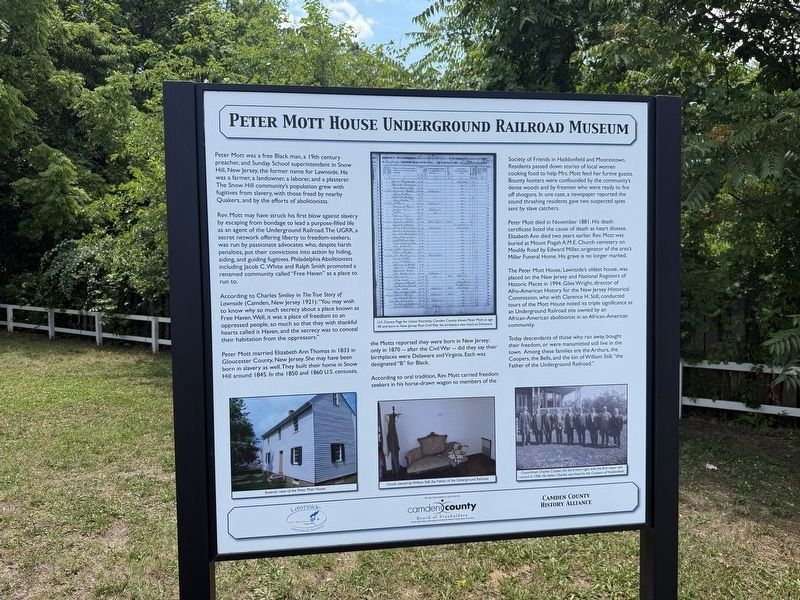
Peter Mott was a free Black man, a 19th century preacher, and Sunday School superintendent in Snow Hill, New Jersey, the former name for Lawnside. He was a farmer, a landowner, a laborer, and a plasterer. The Snow Hill community's population grew with fugitives from slavery, with those freed by nearby Quakers, and by the efforts of abolitionists.
Rev. Mott may have struck his first blow against slavery by escaping from bondage to lead a purpose-filled life as an agent of the Underground Railroad. The UGRR, a secret network offering liberty to freedom-seekers, was run by passionate advocates who, despite harsh penalties, put their convictions into action by hiding, aiding, and guiding fugitives. Philadelphia Abolitionists including Jacob C. White and Ralph Smith promoted a renamed community called "Free Haven" as a place to run to.
According to Charles Smiley in The True Story of Lawnside (Camden, New Jersey 1921): "You may wish to know why so much secrecy about a place known as Free Haven. Well, it was a place of freedom to an oppressed people, so much so that they with thankful hearts called it Haven, and the secrecy
this page online
Peter Mott married Elizabeth Ann Thomas in 1833 in Gloucester County, New Jersey. She may have been born in slavery as well. They built their home in Snow Hill around 1845. In the 1850 and 1860 U.S. censuses, the Motts reported they were born in New Jersey; only in 1870 -- after the Civil War -- did they say their birthplaces were Delaware and Virginia. Each was designated "B" for Black.
According to oral tradition, Rev. Mott carried freedom seekers in his horse-drawn wagon to members of the Society of Friends in Haddonfield and Moorestown. Residents passed down stories of local women cooking food to help Mrs. Mott feed her fugitive guests. Bounty hunters were confounded by the community's dense woods and by freemen who were ready to fire off shotguns. In one case, a newspaper reported the sound thrashing residents gave two suspected spies sent by slave catchers.
Peter Mott died in November 1881. His death certificate listed the cause of death as heart disease. Elizabeth Ann died two years earlier. Rev. Mott was buried at Mount Pisgah A.M.E. Church cemetery on Mouldy Road
Photographed by Devry Becker Jones (CC0), June 21, 2026
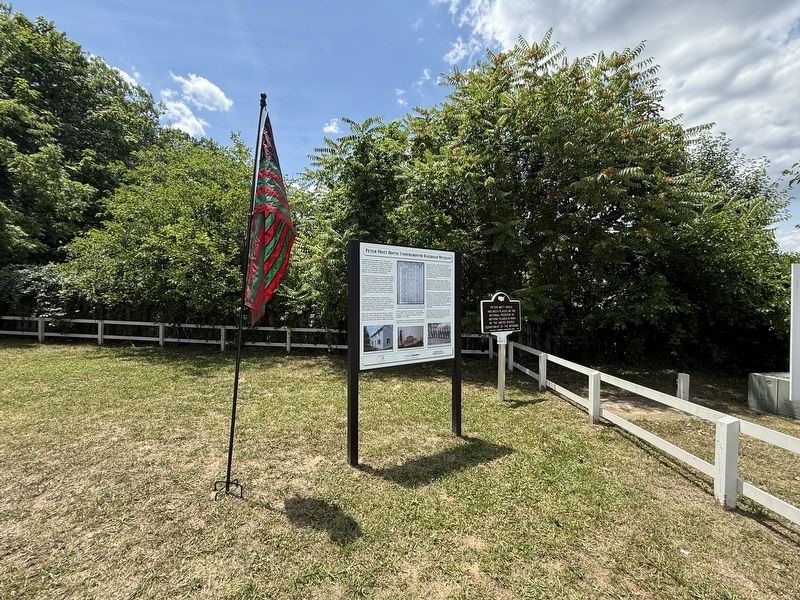
2. Plaques interpreting the Peter Mott House
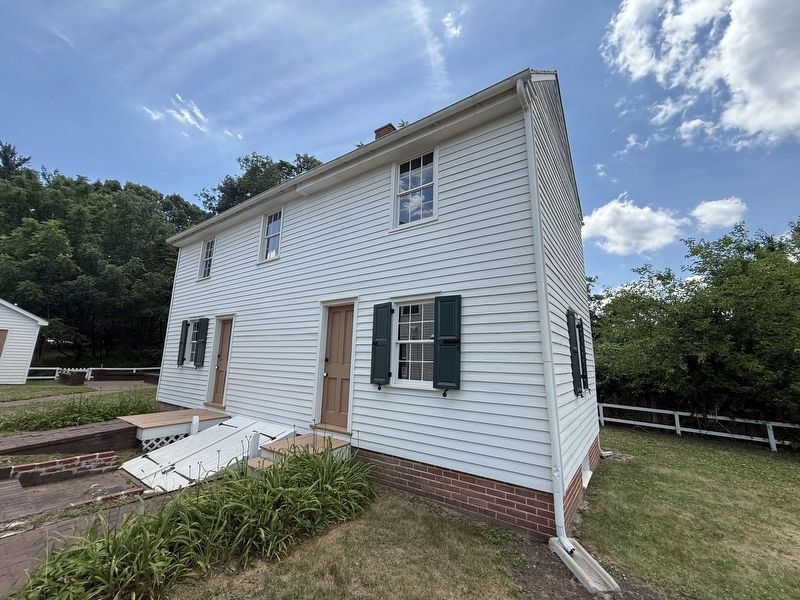
The Peter Mott House, Lawnside's oldest house, was placed on the New Jersey and National Registers of Historic Places in 1994. Giles Wright, director of Afro-American History for the New Jersey Historical Commission, who with Clarence H. Still, conducted tours of the Mott House noted its triple significance as an Underground Railroad site owned by an African-American abolitionist in an African-American community.
Today descendants of those who ran away, bought their freedom, or were manumitted still live in the town. Among these families are the Arthurs, the Coopers, the Bells, and the kin of William Still, "the Father of the Underground Railroad."
Erected by Lawnside Historical Society; Camden County Board of Freeholders; Camden County Historical Alliance.
Topics and series. This historical marker is listed in these topic lists: Abolition & Underground RR • African Americans • Religion & Religious Structures • Settlements & Settlers. In addition, it is included in the African Methodist Episcopal (AME) Church,
Location. 39° 52.038′ N, 75° 2.225′ W. Marker is in Lawnside, New Jersey, in Camden County. It is on Kings Court west of Moore Avenue, on the left when traveling west. Touch for map. Marker is at or near this postal address: 26 Kings Ct, Lawnside NJ 08045, United States of America. Touch for directions.

Regionally, this marker is in South Jersey and in Greater Philadelphia. It is also in the American Northeast, in the Mid-Atlantic, and on the Eastern Seaboard. Globally, it is in the North Atlantic Region, North America, the Western Hemisphere, the Western World, and the Anglosphere. Historically, it finds itself in what was once New Netherland and also one of the original Thirteen Colonies.
Other nearby markers. At least 8 other markers are within walking distance of this marker: Peter Mott House (here, next to this marker); Historically Black Borough of Lawnside (approx. 0.2 miles away); Lawnside World War I Memorial (approx. ¼ mile away); Roll of Honor (approx. ¼ mile away); Jarena Lee (approx. ¼ mile away); Mount Peace Cemetery (approx. 0.3 miles away); Barrington Airport (approx. 0.6 miles away); Vietnam War Memorial (approx. 0.6 miles away). Touch for a list and map of all markers in Lawnside.
Another marker is no longer nearby. The Story of the Peter Mott House (was a few steps from this marker but has been replaced with another marker now near it).
Credits. This page was last revised on June 28, 2026. It was originally submitted on June 28, 2026, by Devry Becker Jones of Washington, District of Columbia. This page has been viewed 16 times since then. Photos: 1, 2, 3. submitted on June 28, 2026, by Devry Becker Jones of Washington, District of Columbia.
