Collingwood in Simcoe County, Ontario — Central Canada (North America)
Collingwood - An Overview
⎯⎯⎯
Collingwood Elevators
Photographed by Cosmos Mariner, June 4, 2024
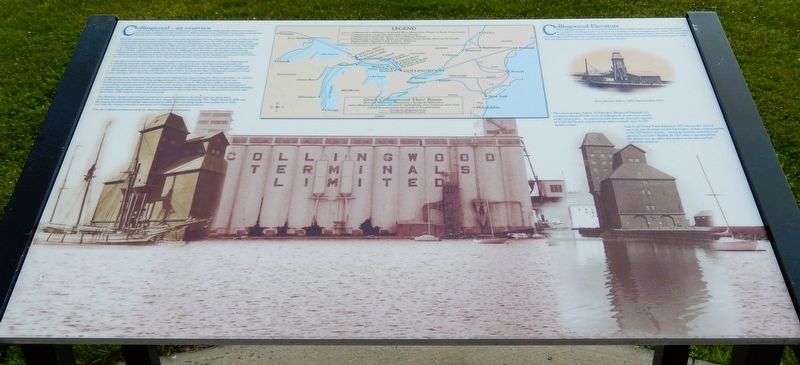
1. Collingwood - An Overview / Collingwood Elevators Marker
Collingwood - An Overview
First known as Hen and Chickens Harbour, with Hurontario Mills and the mill pond located at the east side, Collingwood was renamed in 1854 to honour one of Britain's most noted naval heroes, Admiral Lord Cuthbert Collingwood, second in command to Admiral Horatio Nelson.
While the townships around Collingwood were sparsely populated by few immigrant families as early as 1832, the settlements were far apart, with miles of dense woods between them. By 1843 settlers had arrived and located on the shores of Georgian Bay near to where Collingwood is now situated. A saw mill and a flour mill were erected on the shores of the bay by 1846 near the mouth of the Pretty River on the east side. The mills were a blessing to the settlers, since previously they had to carry their wheat and grains for grinding on their backs to Barrie, a distance of more than 36 miles. Although there had been talk for years of connecting Collingwood and Toronto by railway, it wasn't until 1851 that a company was formed and money obtained to begin the actual construction work after Collingwood was chosen as the northern terminus
this page online
It was the arrival of the railroad in 1855 that cemented Collingwood's worth as a centre for shipping and shipbuilding, since the rail line offered the ability to transport goods, materials and people easily and efficiently through the Great Lakes and points west. Shipping began to gain importance with Collingwood being an early transfer point for emigration to the United States or western Canada. Freight and passenger traffic between American ports and the town was so heavy at one point, that Collingwood boasted a United Sates consulate. For a brief time Collingwood was promoted as “Chicago of the North”.
Shipping by water meant that local wooden boat building flourished during the 1850's and 1860's. In addition to the activity in the harbour during navigation season, dozens of steamers wintered there every year. Following the completion of the Queen's Dry Dock at the foot of St. Paul Street in 1883, the corporate shipbuilding industry prospered. By the turn of the century, Collingwood was fast gaining an international reputation for
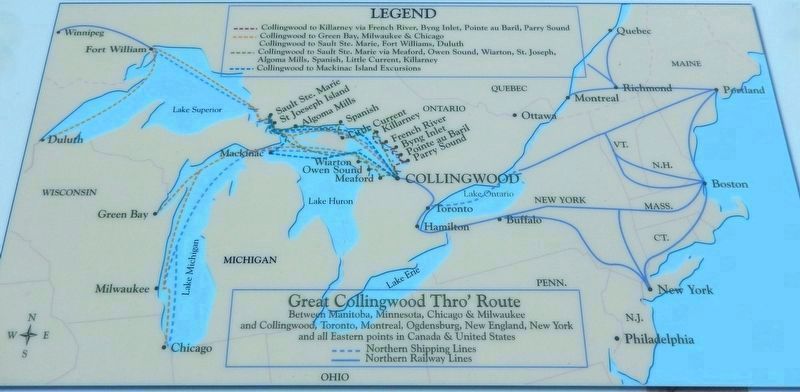
2. Marker detail: Collingwood Map
The shipyard, elevator and railroad continued to provide activity at the water front for many years, until they were all deemed unprofitable by their owners and were terminated. The “Yard” closed in 1986 and the remaining shipyard buildings were removed in 1998. The remaining tracks were pulled up in 1997, and only the elevator remains, a reminder of Collingwood’s once great harbour.
Visit the Collingwood Museum at 45 St. Paul Street for more information.
Collingwood Elevators
The Collingwood grain elevators have dominated the harbourfront since 1854 and have served as a symbol of Collingwood's importance as a supplier of grain throughout the world. Prior to 1854 surplus grain reached markets only after long and often impossible routes. Between 1855 and 1929 the Collingwood elevators were rebuilt three times. The last railroad car was loaded at the elevator in 1986. The spit had space for 70

3. Marker detail: First elevator, built in 1855, burned before 1871
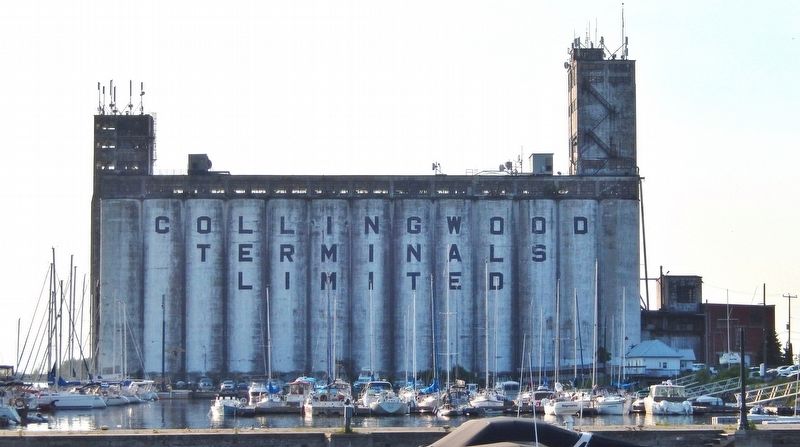
The cement elevator, built in 1929 for the Collingwood Terminals Ltd, a company financed by the Town of Collingwood, was the most modern on the Great Lakes. In response to trade demands, they had a capacity of 2,000,000 bushels of grain and the ability to handle up to 30,000 bushels an hour.
Built by the Grand Trunk Railway in 1871 the wooden elevator was at the time the largest on the Great Lakes. It had a storing capacity of 160,000 bushels of grain, serving the domestic market by road, rail and Great Lakes shipping. In 1937 when it was demolished, this elevator was the oldest and smallest on the lakes and had outlived its usefulness.
Topics. This historical marker is listed in these topic lists: Industry & Commerce • Railroads & Streetcars • Settlements & Settlers • Waterways & Vessels. A significant historical year for this entry is 1854.
Location. 44° 30.205′ N, 80° 12.858′ W. Marker is in Collingwood, Ontario, in Simcoe County. It is at the intersection of Huron Street (Provincial Highway 26) and Heritage Drive, on the right when traveling east on Huron Street. Touch for map.

4. Marker detail: Wooden elevator built by the Grand Trunk Railway in 1871

Regionally, this marker is in Central Ontario Cottage Country and specifically in Georgian Bay Country. It is also in Central Canada. Globally, it is in North America, on the Great Lakes, in the Western Hemisphere, in the Western World, and in the Anglosphere. Historically, it finds itself in what was once a British colony, the Viceroyalty of New France, the Haudenosaunee (Iroquois) Confederacy, and Rupert’s Land.
Other nearby markers. At least 8 other markers are within walking distance of this marker: Water Transportation via Collingwood 1854-1900 (here, next to this marker); The Associated Country Women of the World / L'union mondiale des femmes rurales (within shouting distance of this marker); The Northern Railway Company of Canada (within shouting distance of this marker); Collingwood World War I Cenotaph (about 90 meters away, measured in a direct line); Simcoe Street - Late 1890's (approx. 0.2 kilometers away); Pride Flag (approx. 0.3 kilometers away); All Saints' Anglican Church (approx. 0.4 kilometers away); St. Mary's Collingwood, 1858

Photographed by Cosmos Mariner, June 4, 2024
5. Collingwood - An Overview / Collingwood Elevators Marker
Looking west along Huron Street.
Also see . . . Collingwood, Ontario (Wikipedia).
Excerpt: In 1855, the Ontario, Simcoe & Huron (later called the Northern) Railway came into Collingwood, and the harbour became the shipment point for goods destined for the upper Great Lakes ports of Chicago and Port Arthur-Fort William (now Thunder Bay). Grain was one of the primary products by tonnage shipped, and a large grain elevator; Collingwood Terminals Limited; was built on the waterfront for transshipment of grain from trains and later trucks to lake freighters in 1929, and operated for 64 years until 1993. It still stands today.(Submitted on June 29, 2026, by Cosmos Mariner of Cape Canaveral, Florida.)Shipping produced a need for ship repairs and so it was not long before an organized shipbuilding business was created. On May 24, 1883, the Collingwood Shipyards, formally known as Collingwood Dry Dock Shipbuilding and Foundry Company Limited, opened with a special ceremony. On September 12, 1901, the Huronic, the first steel-hulled ship in Canada, was launched in Collingwood. The shipyards produced lake freighters and during World War II contributed
to the production of corvettes for the Royal Canadian Navy. Shipbuilding was one of the principal industries in the town, employing as much as 10% of the total labour force. However, overseas competition and overcapacity in shipbuilding in Canada led to the demise of shipbuilding in Collingwood in September 1986.Photographed by Cosmos Mariner, June 4, 20246. Collingwood Elevators (southeast elevation)

Photographed by Cosmos Mariner, June 4, 2024
7. Collingwood Elevators / Collingwood Terminal (northwest elevation)
Credits. This page was last revised on June 29, 2026. It was originally submitted on June 28, 2026, by Cosmos Mariner of Cape Canaveral, Florida. This page has been viewed 15 times since then. Photos: 1, 2, 3, 4, 5, 6, 7. submitted on June 29, 2026, by Cosmos Mariner of Cape Canaveral, Florida.
