Franklin in Williamson County, Tennessee — The American South (East South Central)
Revolutionary Roots
of Franklin & Williamson County
| — | 1776-2026 | — |
Photographed by Darren Jefferson Clay, June 22, 2026
1. Revolutionary Roots Marker
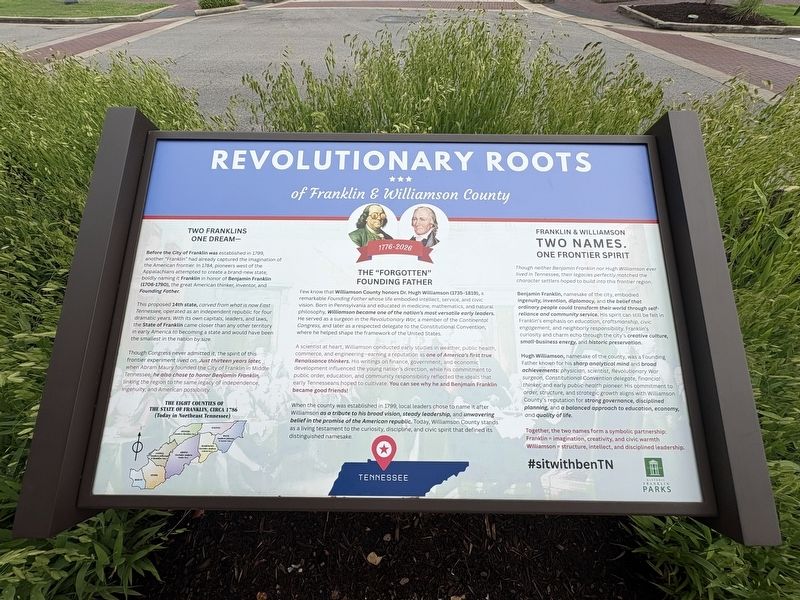
Two Franklins, One Dream
Before the City of Franklin was established in 1799, another "Franklin" had already captured the imagination of the American frontier. In 1784, pioneers west of the Appalachians attempted to create a brand-new state, boldly naming it Franklin in honor of Benjamin Franklin (1706-1790), the great American thinker, inventor, and Founding Father.
This proposed 14th state, carved from what is now East Tennessee, operated as an independent republic for four dramatic years with its own capitals, leaders, and laws, the State of Franklin came closer than any other territory in early America to becoming a state and would have been the smallest in the nation by size.
Though Congress never admitted it, the spirit of this frontier experiment lived on. Just thirteen years later, when Abram Maury founded the City of Franklin in Middle Tennessee, he also chose to honor Benjamin Franklin, linking the region to the same legacy of independence, ingenuity, and American possibility.
The "Forgotten" Founding Father
Few know that Williamson County honors Dr. Hugh Williamson (1735-1819), a remarkable
this page online
A scientist at heart, Williamson conducted early studies in weather, public health, commerce, and engineering-earning a reputation as one of America's first true Renaissance thinkers. His writings on finance, government, and economic development influenced the young nation's direction, while his commitment to public order, education, and community responsibility reflected the ideals that early Tennesseans hoped to cultivate. You can see why he and Benjamin Franklin became good friends!
When the county was established in 1799, local leaders chose to name it after Williamson as a tribute to his broad vision, steady leadership, and unwavering belief in the promise of the American republic.
Photographed by Darren Jefferson Clay, June 22, 2026
2. Revolutionary Roots Marker
Franklin & Williamson, Two Names. One Frontier Spirit
Though neither Benjamin Franklin nor Hugh Williamson ever lived in Tennessee, their legacies perfectly matched the character settlers hoped to build into this frontier region.
Benjamin Franklin, namesake of the city, embodied ingenuity, invention, diplomacy, and the belief that ordinary people could transform their world through self-reliance and community service. His spirit can still be felt in Franklin's emphasis on education, craftsmanship, civic engagement, and neighborly responsibility. Franklin's curiosity and charm echo through the city's creative culture, small-business energy, and historic preservation.
Hugh Williamson, namesake of the county, was a Founding Father known for his sharp analytical mind and broad achievements: physician, scientist, Revolutionary War surgeon, Constitutional Convention delegate, financial thinker, and early public-health pioneer. His commitment to order, structure, and strategic growth aligns with Williamson County's reputation for strong governance, disciplined planning, and a balanced approach to education, economy, and quality of life.
Together, the two names form a symbolic partnership: Franklin = imagination, creativity, and civic warmth Williamson = structure, intellect, and disciplined leadership
#sitwithbenTN
Erected by Historic Franklin Parks.
Topics. This historical marker is listed in this topic list: Notable Places. A significant historical year for this entry is 1799.
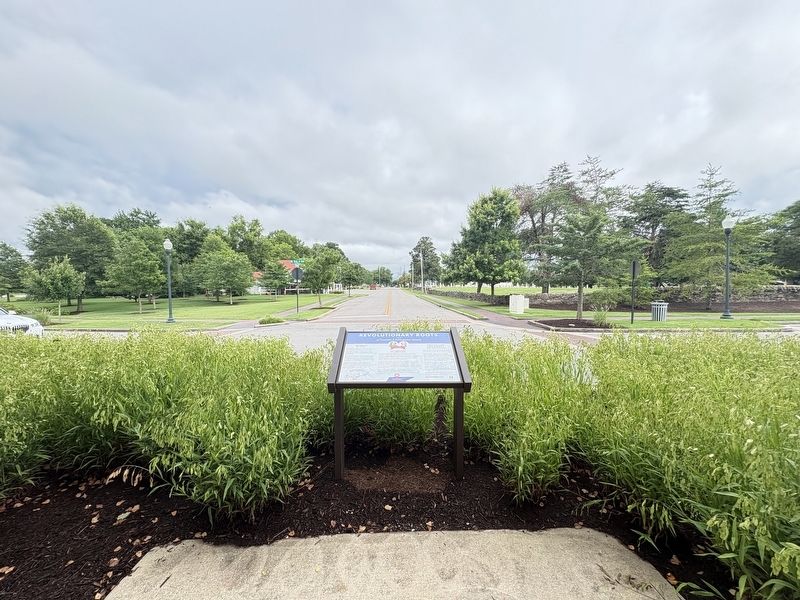
Location. 35° 55.773′ N, 86° 52.434′ W. Marker is in Franklin, Tennessee, in Williamson County. It is at the intersection of 3rd Avenue North and 4th Avenue North, on the left when traveling east on 3rd Avenue North. Touch for map. Marker is in this post office area: Franklin TN 37064, United States of America. Touch for directions.

Regionally, this marker is in Middle Tennessee and in Greater Nashville. It is also in the American South and specifically in the Upper South. Globally, it is in North America, the Western Hemisphere, the Western World, and the Anglosphere. Historically, it finds itself in what was once the territory of the Mississippian Culture, one of the Confederate States of America, and the Antebellum South.
Other nearby markers. At least 8 other markers are within walking distance of this marker: Liberty and Justice for All, Denied (within shouting distance of this marker); Rest Haven Cemetery (about 500 feet away, measured in a direct line); Unknown Civil War Soldier (about 600 feet away); City Cemetery (about 700 feet away); First Burying Ground in Franklin (about 700 feet away); a different marker also named Liberty and Justice for All, Denied (approx. 0.2 miles away); Toussaint L'Ouverture Cemetery (approx. ¼ mile away); Harpeth Academy (approx. ¼ mile away). Touch for a list and map of all markers in Franklin.
Credits. This page was last revised on August 17, 2026. It was originally submitted on June 29, 2026, by Darren Jefferson Clay of Duluth, Georgia. This page has been viewed 17 times since then. Photos: 1, 2. submitted on August 6, 2026, by Darren Jefferson Clay of Duluth, Georgia. • James Hulse was the editor who published this page.
