Downtown Riverside in Riverside County, California — The American West (Pacific Coastal)
Chinese Memorial Pavilion

Photographed by Volt Craft, June 29, 2026
1. Chinese Memorial Pavilion Marker
Topics. This historical marker is listed in these topic lists: Asian Americans • Immigration.
Location. 33° 58.961′ N, 117° 22.343′ W. Marker is in Riverside, California, in Riverside County. It is in Downtown Riverside. It is on Orange Street just north of Mission Inn Avenue, on the right when traveling north. Touch for map. Marker is at or near this postal address: 710 Orange Street, Riverside CA 92501, United States of America. Touch for directions.

Regionally, this marker is in Greater Los Angeles, in the Inland Empire, and in the Peninsular Ranges. It is also in the American Southwest. Globally, it is in North America, on the Ring of Fire, on the Pacific Rim, in the Western Hemisphere, in the Western World, and in the Anglosphere. Historically, it finds itself in what was once New Spain and also Mexico’s Alta California.
Other nearby markers. At least 8 other markers are within walking distance of this marker: This Olive Tree (a few steps from
this page online
Also see . . .
1. The Chinese Pavilion (Asian American Riverside - UCR). Excerpt:
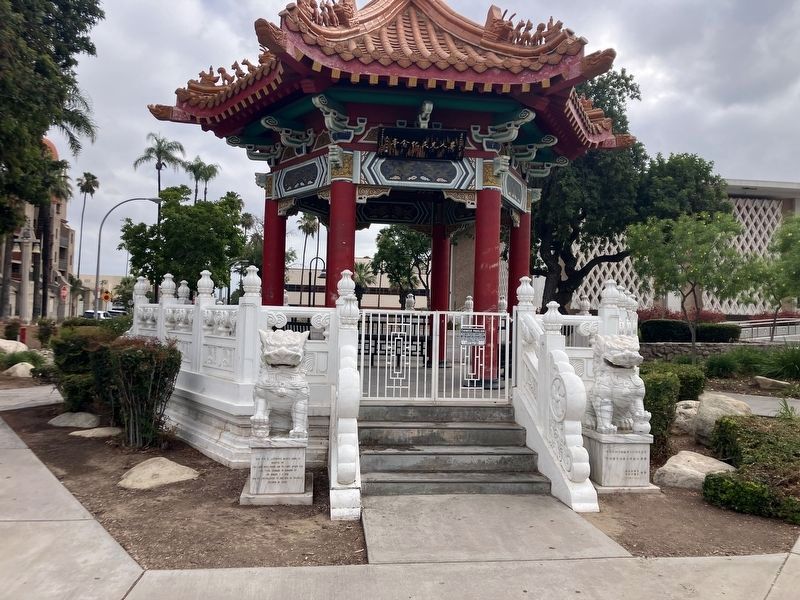
The Chinese Pavilion was built in 1985-86 and stands in front of the Riverside Central Library, at the corner of Mission Inn Avenue and Orange Street. It was built in honor of the Chinese settlers who came to Riverside in the late 19th and early 20th centuries.(Submitted on July 3, 2026.)
The Pavilion is located within a block or two of the cluster of Chinese businesses that constituted Riverside's "first" Chinatown. Ironically, this neighborhood was relocated to Tequesquite Arroyo- the "second" Chinatown- on the rural outskirts of town in 1885 after a suspicious fire swept through it, destroying Chinese businesses.
2. Riverside’s Chinatowns (Asian American Riverside - UCR).
Photographed by Volt Craft, June 29, 2026
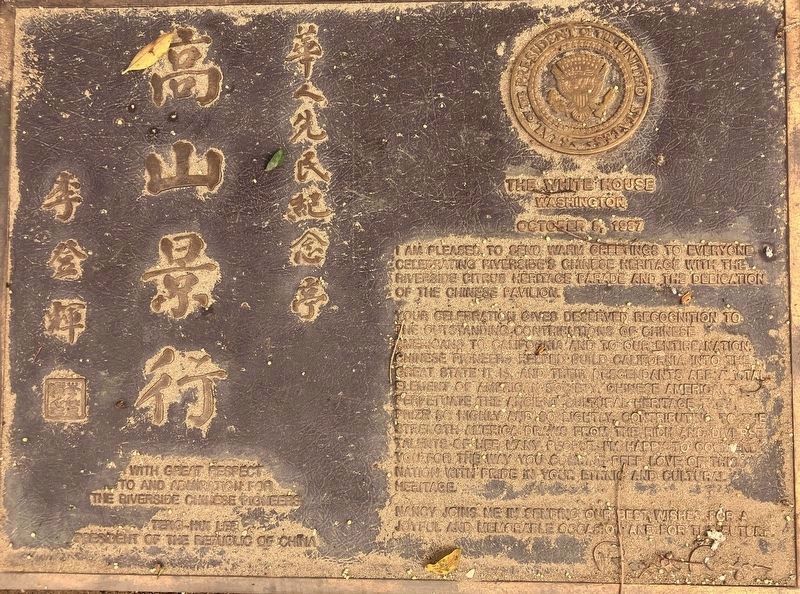
2. Congratulatory Plaque with letter from President Ronald Reagan
Some immigrant Chinese settled in Riverside in the late 19th century, but many more came to work in the citrus groves that were the economic powerhouse of Riverside 's economy. At certain times of year, as many as 3,000 Chinese laborers lived here while they picked and packed fruit for wages. Many lived in temporary housing in or near the groves.(Submitted on July 3, 2026.)
The first Chinatown in Riverside was in the downtown area, centered on Ninth Street. It included laundries, small restaurants, and more. A fire destroyed most of its structures and led to the establishment of a second Chinatown in 1885 in the Tequesquite Arroyo, in the shadow of Mt. Rubidoux on the outskirts of the city. This small community had as many as four hundred Chinese residents at some points. Many of them were from Gom-Benn, a village in the Toishan region of southern China; many had the family name Wong. Chinatown was sometime referred to as "Little Gom-Benn."
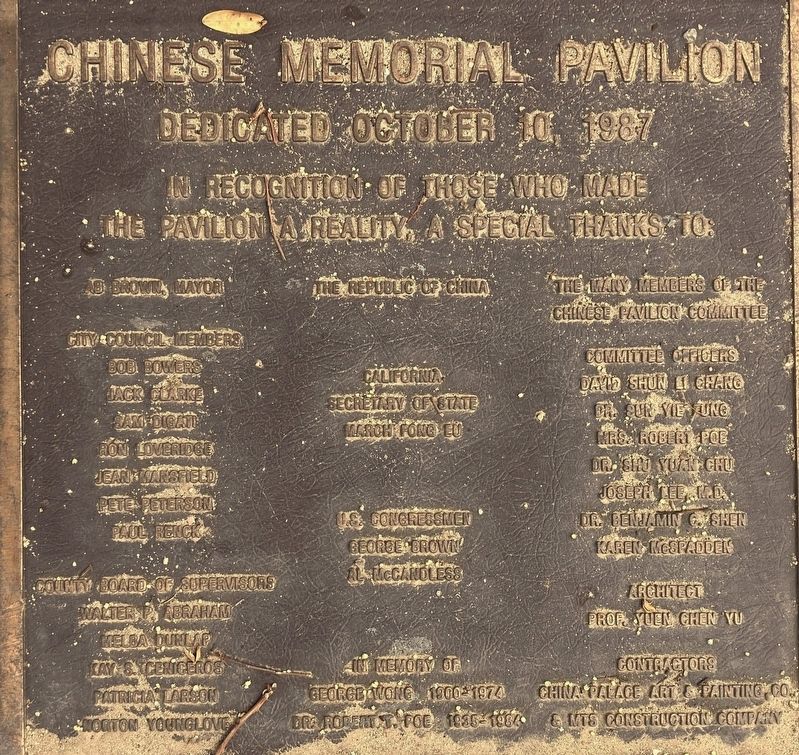
Another fire destroyed this Chinatown in 1893 but it was again rebuilt, featuring brick and wooden buildings, including a small temple. It included shops, a butcher, laundries, and residences, and it provided a number of services for migrant Chinese laborers. By the 1930s, it was in decline due to the Chinese Exclusion Act of 1882 and dwindling numbersof Chinese in the area.Photographed by Volt Craft, June 29, 20263. Dedication Plaque

Photographed by Volt Craft, June 29, 2026
4. Chinese Memorial Pavilion Marker
Photographed by Volt Craft, June 29, 2026
5. Chinese Memorial Pavilion
Photographed by Volt Craft, June 29, 2026
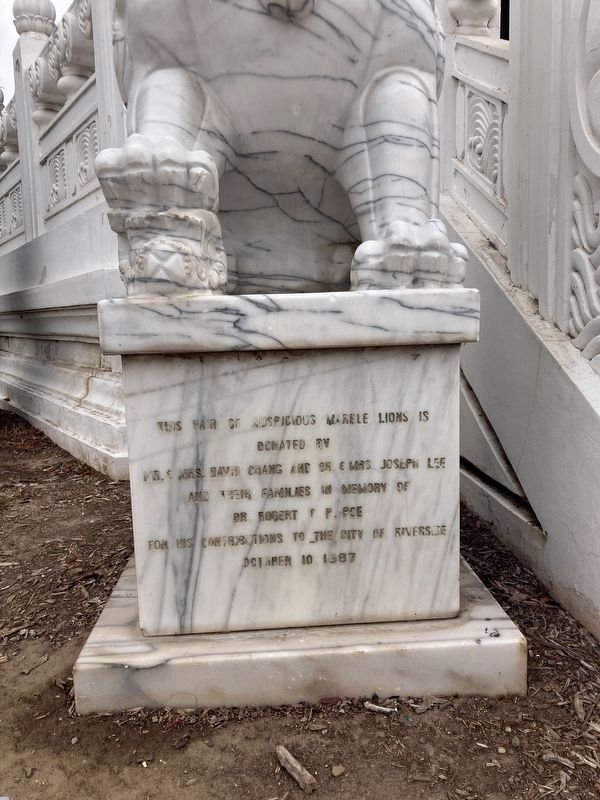
6. Lion donation plaque
Credits. This page was last revised on July 5, 2026. It was originally submitted on June 30, 2026, by Volt Craft of Riverside, California. This page has been viewed 17 times since then. Photos: 1, 2, 3, 4, 5, 6. submitted on June 30, 2026, by Volt Craft of Riverside, California. • Andrew Ruppenstein was the editor who published this page.
