Rochester in Beaver County, Pennsylvania — The American Northeast (Mid-Atlantic)
Stepping into Historic Rochester
Transportation
Photographed by Bradley Owen, June 20, 2026
1. Stepping into Historic Rochester Marker
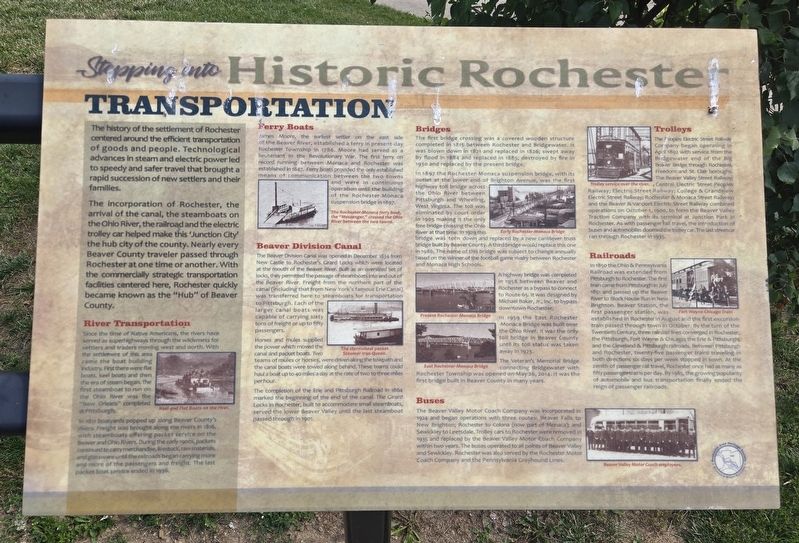
The history of the settlement of Rochester centered around the efficient transportation of goods and people. Technological advances in steam and electric power led to speedy and safer travel that brought a rapid succession of new settlers and their families.
The incorporation of Rochester, the arrival of the canal, the steamboats on the Ohio River, the railroad and the electric trolley car helped make this 'Junction City' the hub city of the county. Nearly every Beaver County traveler passed through Rochester at one time or another. With the commercially strategic transportation facilities centered here, Rochester quickly became known as the "Hub" of Beaver County.
River Transportation
Since the time of Native Americans, the rivers have served as superhighways through the wildemess for settlers and traders moving west and north. With the settlement of this area came the boat building industry. First there were flat boats, keel boats and then the era of steam began. The first steamboat to run on the Ohio River was the "New Orleans" completed at Pittsburgh.
In 1811 boatyards popped up along Beaver County's rivers.
this page online
Ferry Boats
James Moore, the earliest settler on the east side of the Beaver River, established a ferry in present-day Rochester Township in 1786. Moore had served as a lieutenant in the Revolutionary War. The first ferry on record running between Monaca and Rochester was established in 1847. Ferry boats provided the only established means of communication between the two towns and were in continuous operation until the building of the Rochester-Monaca suspension bridge in 1897.
Beaver Division Canal
The Beaver Division Carnal was opened in December 1834 from New Castle to Rochester's Girard Locks which were located at the mouth of the Beaver River. Built as an oversized set of locks, they permitted the passage of steamboats into and out of the Beaver River. Freight from the northern part
Photographed by Bradley Owen, June 20, 2026
2. Stepping into Historic Rochester Marker
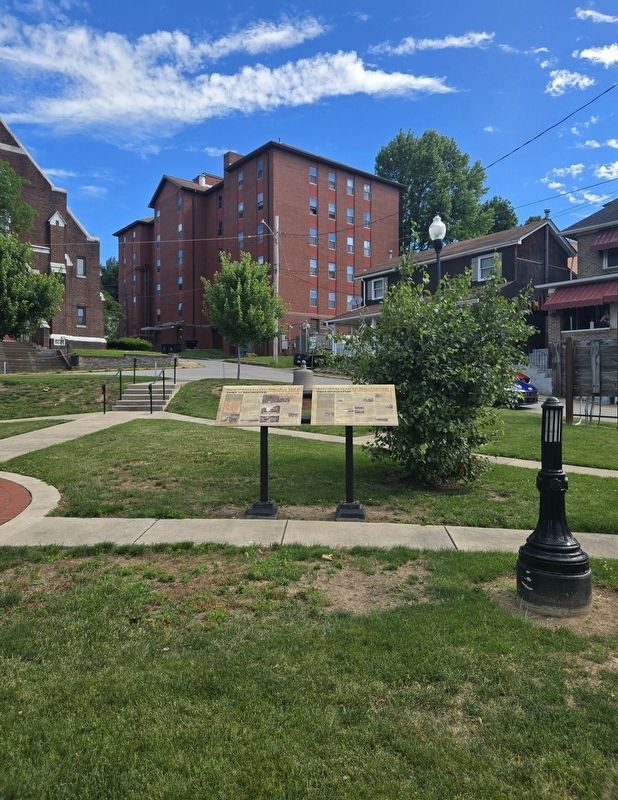
Marker is on the right.
Horses and mules supplied the power which moved the canal and packet boats. Two teams of mules or horses, were driven along the towpath and the canal boats were towed along behind. These teams could haul a boat up to 40 miles a day at the rate of two to three miles per hour.
The completion of the Erie and Pittsburgh Railroad in 1864 marked the beginning of the end of the canal. The Girard Locks in Rochester, built to accommodate small steamboats, served the lower Beaver Valley until the last steamboat passed through in 1901.
Bridges
The first bridge crossing was a covered wooden structure completed in 1815 between Rochester and Bridgewater. It was blown down in 1821 and replaced in 1826; swept away by flood in 1884 and replaced in 1885; destroyed by fire in 1930 and replaced by the present bridge.
In 1897 the Rochester-Monaca suspension bridge, with its outlet at the lower end of Brighton Avenue, was the first highway toll bridge across the Ohio River between Pittsburgh and Wheeling, West Virginia. The toll was eliminated by court order in 1905 making it the only free bridge crossing the Ohio River at that time. In 1929 this bridge was torn down and replaced by a new cantilever truss bridge built by Beaver County. A third bridge would replace this one in 1986. The name of this bridge was subject to change annually based on the winner of the football game rivalry between Rochester and Monaca High Schools.
A highway bridge was completed in 1958 between Beaver and Rochester as a bypass to connect to Route 65. It was designed by Michael Baker, Jr., Inc. to bypass downtown Rochester.
In 1959 the East Rochester-Monaca Bridge was built over the Ohio River. It was the only toll bridge in Beaver County until its toll status was taken away in 1973.
The Veteran's Memorial Bridge connecting Bridgewater with Rochester Township was opened on May 26, 2014. It was the first bridge built in Beaver County in many years.
Buses
The Beaver Valley Motor Coach Company was incorporated in 1924 and began operations with three routes: Beaver Falls to New Brighton; Rochester to Colona (now part of Monaca); and Sewickley to Leetsdale. Trolley cars to Rochester were removed in 1935 and replaced by the Beaver Valley Motor Coach Company within two years. The buses operated to all points of Beaver Valley and Sewickley. Rochester was also served by the Rochester Motor Coach Company and the Pennsylvania Greyhound Lines.
Trolleys
The Peoples Electric Street Railway Company began operating in April 1892 with service from the Bridgewater end of the Big Beaver Bridge through Rochester, Freedom and St. Clair boroughs. The Beaver Valley Street Railway; Central Electric Street Peoples Railway; Electric Street Railway; College & Grandview Electric Street Railway; Rochester & Monaca Street Railway; and the Beaver & Vanport Electric Street Railway combined operations on October 1, 1900, to form the Beaver Valley Traction Company with its terminal at Junction Park in Rochester. As with passenger rail travel, the introduction of buses and automobiles doomed the trolley car. The last streetcar ran through Rochester in 1935.
Railroads
In 1850 the Ohio & Pennsylvania Railroad was extended from Pittsburgh to Rochester. The first train came from Pittsburgh in July 1851 and passed up the Beaver River to Block House Run in New Brighton. Beaver Station, the first passenger station, was established in Rochester in August and the first excursion train passed through town in October. By the turn of the Twentieth Century, three railroad lines converged in Rochester, the Pittsburgh, Fort Wayne & Chicago; the Erie & Pittsburgh, and the Cleveland & Pittsburgh railroads. Between Pittsburgh and Rochester, twenty-five passenger trains traveling in both directions six days per week stopped in town. At the zenith of passenger rail travel, Rochester once had as many as fifty passenger trains per day. By 1985, the growing popularity of automobile and bus transportation finally ended the reign of passenger railroads.
Erected by Rochester Area Heritage Society.
Topics. This historical marker is listed in these topic lists: Bridges & Viaducts • Industry & Commerce • Railroads & Streetcars • Waterways & Vessels. A significant historical date for this entry is May 26, 2014.
Location. 40° 42.124′ N, 80° 17.109′ W. Marker is in Rochester, Pennsylvania, in Beaver County. It is at the intersection of North Park Street and Brighton Avenue (Pennsylvania Route 18), on the right when traveling east on North Park Street. Touch for map. Marker is at or near this postal address: 50 North Park Street, Rochester PA 15074, United States of America. Touch for directions.

Regionally, this marker is in Greater Pittsburgh. It is also in the American Northeast, in the Mid-Atlantic, and in the Ohio River Valley. Globally, it is in North America, the Western Hemisphere, the Western World, and the Anglosphere. Historically, it finds itself in what was once the Haudenosaunee (Iroquois) Confederacy and also one of the original Thirteen Colonies.
Other nearby markers. At least 8 other markers are within walking distance of this marker: A different marker also named Stepping into Historic Rochester (here, next to this marker); a different marker also named Stepping into Historic Rochester (here, next to this marker); a different marker also named Stepping into Historic Rochester (here, next to this marker); a different marker also named Stepping into Historic Rochester (a few steps from this marker); History of the Rochester Fire Department (a few steps from this marker); a different marker also named Stepping into Historic Rochester (a few steps from this marker); a different marker also named Stepping into Historic Rochester (a few steps from this marker); a different marker also named Stepping into Historic Rochester (a few steps from this marker). Touch for a list and map of all markers in Rochester.
Credits. This page was last revised on July 1, 2026. It was originally submitted on July 1, 2026, by Bradley Owen of Morgantown, West Virginia. This page has been viewed 12 times since then. Photos: 1, 2. submitted on July 1, 2026, by Bradley Owen of Morgantown, West Virginia.
