Brownsburg in Hendricks County, Indiana — The American Midwest (Great Lakes)
The Civil War
A Salute to Freedom
Photographed by Tom Bosse, June 16, 2026
1. A Salute to Freedom Marker
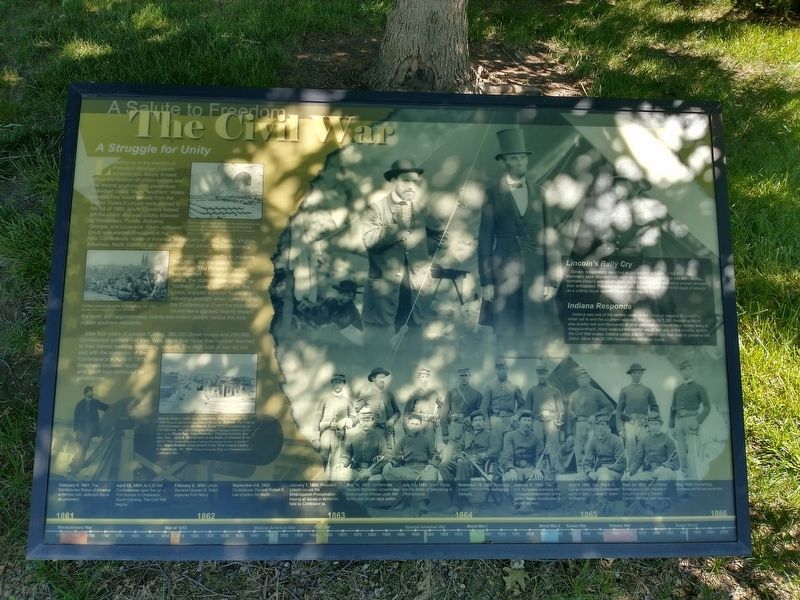
A Struggle for Unity
Leading up the election of President Abraham Lincoln, America was deeply divided about the taxation of cotton exports and the federal government’s power over individual states. Many “southern” states insisted they would secede from the United States if Lincoln were elected in the fall of 1860. South Carolina indeed left the Union and was quickly followed by Mississippi, Florida, Alabama, Georgia, and Louisiana. When Jefferson Davis was elected President of the new ‘Confederate States of American’ in February of 1861, Texas, Virginia, Arkansas, North Carolina, and Tennessee also joined the Confederacy.
Lincoln moved swiftly to preserve the Union, but the peace treaty known as “The Pickwick Papers” was rejected. Instead of choosing peace, the states chose sides. The “northern” states, identified as the Union, enjoyed superior financial and industrial strength when compared to the Confederacy. Even the population counts were stacked heavily toward the north with approximately twenty-two million people versus the nine million southern residents.
After four years of intense fighting, 360,000 Union
this page online
(sidebar)
Lincoln’s Rally Cry
Slavery is commonly identified as the overriding cause of the Civil War. Historians have disputed that claim as a secondary cause that was used to rally northern citizens and abolitionist. As the Confederate resistance proved stronger than anticipated, President Lincoln was force to push the moral issue of slavery as a uniting cause against the southern way of life.
Indiana Responds
Indiana was one the earliest states in the Union to respond to Lincoln’s initial call to end the southern rebellion. The quota for 7,500 Hoosier soldiers was quickly met and thousands other potential volunteers were turned away in disappointment. Many believed the conflict would last only a few months. Before the Civil War ended, Indiana called 208,367 men to risk their lives to preserve the Union. More than 24,000 Hoosiers did
Photographed by Tom Bosse, June 16, 2026
2. A Salute to Freedom Marker
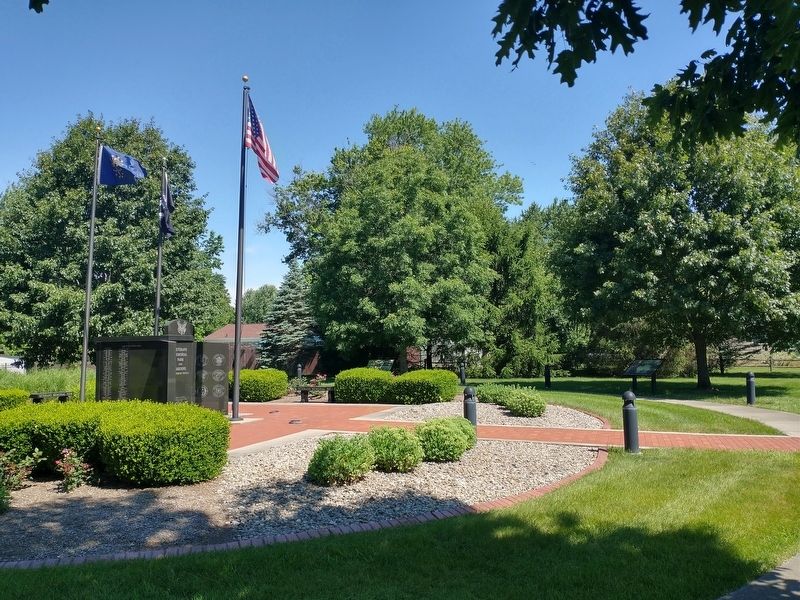
Marker is in the middle background.
(captions)
Piles of ammunition remain in the Arsenal grounds near the Richmond & Petersburg Railroad at Richmond, VA. (Library of Congress, Prints and Photograghs Division, LC-DIG-8817-7419)
Soldiers prepare for battle at Petersburg, VA, 1865. (Courtesy National Archives, photo no. 111-8-157)
Above: Wagon traffic along Peachtree Street in Atlanta, GA, 1864. (Courtesy National Archives, photo no. 165-SC-46) Behind: The Federal Nay advances upon the Atlantic Coast of the Confederacy at Fort Monroe, VA. (Library of Congress, Prints and Photograghs Division, LC-DIG-8817-7419) Right-Top: Allan Pickerton, President Lincoln, ad Maj. Gen. John A. McClearnand at the Battle of Antietam in the fall of 1862. (Library of Congress Prints and Photograghs Division, LC-DIG-8817-7929) Right-Bottom: Detachment of the Third Indiana Cavalry at Petersburg, VA, 1864 (Library of Congress Prints and Photograghs Division, LC-DIG-8817-7068).
(Timeline)
February 9, 1861: The Confederate States of America is formed with Jefferson Davis as president.
April 12, 1861: At 4:300 AM Confederates open fire upon Fort Sumter in Charleston,
Photographed by Tom Bosse, June 16, 2026
3. A Salute to Freedom Marker
February, 1862: Union General Ulysses S. Grant captures Fort Henry.
September 4-9, 1862: Confederate General Robert E. Lee invades the North.
January 1, 1863: President Lincoln issues the Emancipation Proclamation, freeing all slaves in territories held by Confederates.
May 10, 1863: Confederate General Stonewall Jackson dies from wounds inflicted upon him by his own troops days earlier.
July 1-3, 1863: Union forces win the Battle of Gettysburg in Pennsylvania.
November 19, 1863: President Lincoln delivers the Gettysburg Address.
January 31, 1865: The U.S. Congress approves the Thirteenth Amendment to the United States Constitution to abolish slavery.
April 9, 1865: Gen. Robert E. Lee surrenders his Confederate Army to Gen. Ulysses S. Grant in Virginia.
April 14, 1865: John Wilkes Booth shoots President Lincoln at Ford’s Theater. Lincoln dies the next morning.
May, 1865: Remaining Confederate forces surrender.
Erected by Brownsburg Parks.
Topics. This historical marker is listed in this topic list: War, US Civil. A significant historical date for this entry is January 1, 1863.
Location. 39° 49.871′ N, 86° 24.385′ W. Marker is in Brownsburg, Indiana, in Hendricks County. It can be reached from South Locust Lane north of West Foxwood Drive, on the left when traveling north. Marker is located at the Veteran's Memorial Park and Gardens. Touch for map. Marker is at or near this postal address: 940 South Locust Lane, Brownsburg IN 46112, United States of America. Touch for directions.

Regionally, this marker is in Central Indiana and specifically in Greater Indianapolis. It is also in the American Midwest and in the Corn Belt. Globally, it is in North America, the Western Hemisphere, the Western World, and the Anglosphere. Historically, it finds itself in what was once the territory of the Mississippian Culture and also the Northwest Territory.
Other nearby markers. At least 8 other markers are within one mile of this marker, measured as the crow flies: The Vietnam War (here, next to this marker); World War II (a few steps from this marker); The Revolutionary War (a few steps from this marker); The War of 1812 (a few steps from this marker); The Korean War (a few steps from this marker); World War I (within shouting distance of this marker); Robbie Stanley (about 400 feet away, measured in a direct line); Howdy Bell (approx. 1.1 miles away). Touch for a list and map of all markers in Brownsburg.
Related markers. Click here for a list of markers that are related to this marker. A Salute to Freedom
Credits. This page was last revised on July 13, 2026. It was originally submitted on July 1, 2026, by Tom Bosse of Jefferson City, Tennessee. This page has been viewed 10 times since then. Photos: 1, 2, 3. submitted on July 1, 2026, by Tom Bosse of Jefferson City, Tennessee. • Bernard Fisher was the editor who published this page.
