
Den Helder, North Holland, Netherlands — Northwestern Europe
Algemene begraafplaats Den Helder
⎯⎯⎯
Den Helder General Cemetery

Photographed by Andrew Ruppenstein, June 2, 2026
1. Algemene begraafplaats Den Helder / Den Helder General Cemetery Marker - history side

Ontstaansgeschiedenis
De algemene begraafplaats aan de Kerkhoflaan bestaat al ruim vierhonderd jaar. De naam Kerkhoflaan is eigenlijk heel vreemd: er heeft op die plek namelijk nooit een kerk gestaan. Oorspronkelijk bevond de kerk met het kerkhof zich in het dorp op het oude eiland Huisduinen. Dit dorp is steeds verplaatst doordat de zee verder landinwaarts opdrong. In 1594 werd het oude eiland Huisduinen voor het laatst overspoeld door de zee. Toen de kerk en het kerkhof in dat jaar weer in zee verdwenen, heeft men besloten een nieuwe begraafplaats aan te leggen op het hoogste punt van het duingebied midden op het eiland Huisduinen, zonder kerk! De oudste kaart waarop de begraafplaats te zien is, dateert uit 1606; de oudste grafzerk is van 1672.
Uitbreidingen
• In 1824 werd ten westen van de bestaande begraafplaats een Joodse begraafplaats aangelegd, omdat in de Franse tijd de Joodse gemeenschap van Den Helder behoorlijk was gegroeid. In 1936 werd hier aan de rand het metaheerhuisje gebouwd, bedoeld om de doden ritueel te reinigen. Later werd dit gebruikt en bekend als het drenkelingenhuisje.
• In het midden van de negentiende eeuw werd de begraafplaats aan de oostzijde vergroot met ongeveer vier hectare.
• Aan het eind van de negentiende eeuw vond er weer een uitbreiding plaats, nu met een strook land ten zuiden van het oorspronkelijke deel.
• In het begin van de twintigste eeuw is ten oosten van de oude begraafplaats een katholieke begraafplaats (Sint Jozef) aangelegd.
• Rond diezelfde tijd werd de gemeentelijke begraafplaats in noordelijke richting uitgebreid in romantische stijl, naar een ontwerp van L.A. Springer (1855-1940). Tegelijkertijd werd bij de ingang het dienstgebouw gebouwd (rond 1925). Oorspronkelijk bevond zich aan de ene zijde de opzichterwoning, aan de andere zijde de werkplaats, en in het midden de aula. Nu is het hele gebouw in gebruik als aula.
•In de jaren vijftig van de twintigste eeuw is de begraafplaats voor het laatst uitgebreid aan de westzijde. In de jaren zestig werd een deel daarvan in gebruik genomen dat nu wordt aangeduid als 'West'.
• Om Islamitisch begraven mogelijk te maken is in 2012 de begraafplaats uitgebreid op het aangrenzende voormalige volkstuincomplex ten zuiden van het Tuinderspad. Op de uitbreiding is ook ruimte voor ongeveer 240 kindergraven en 400 gewone graven.
Nieuwe manieren
Hoewel cremeren al sinds 1955 in Nederland is toegestaan, volgde pas eind jaren tachtig de eerste aanleg van een columbarium (urnenmuur) op de begraafplaats. Aan de rand van zeskantige verhardingsvlakken werden muren opgetrokken van zeshoekige urnennissen. De belangstelling voor cremeren nam sterk toe, waardoor begin jaren negentig al uitbreiding noodzakelijk bleek. Rond dezelfde tijd werd ten zuiden van de Joodse begraafplaats ruimte vrijgemaakt voor de aanleg van een kinder- begraafplek. Een nieuwe trend volgde midden jaren negentig: het bijzetten van urnen in de grond in een tuinachtige omgeving. Hiervoor werd een urnentuin ontworpen en aangelegd. Begin eenentwintigste eeuw was uitbreiding van kindergraven noodzakelijk. Dit gebeurde in het plantsoen tussen de Joodse begraafplaats en de bestaande kindergraven. Inmiddels begon de urnentuin ook aardig vol te raken en waren er nog maar weinig plekken beschikbaar in het columbarium. Aan de hand van een geintegreerd ontwerp werd in 2006 de enige nog overgebleven ruimte van de begraafplaats benut voor de aanleg van een 'strooibos'. Hier kunnen nabestaanden as van overledenen verstrooien. Het strooibos vormt de koppeling tussah columbarium en urnentuin.
Historische gedenktuin
De locatie die nu als gedenktuin is ingericht, heeft in het verleden gediend als strooiveld. Op deze verzorgde, aantrekkelijke plek kunnen nabestaanden op een respectvolle manier terug denken aan degenen wier as hier werd uitgestrooid.
Den Helder General Cemetery
Origins
The general cemetery on Kerkhoflaan has existed for over four hundred years. The name Kerkhoflaan (literally "Churchyard Avenue") is actually quite peculiar, as a church never stood on that site. Originally, the church and its accompanying graveyard were located in the village on the old island of Huisduinen. This village was repeatedly relocated as the sea encroached further inland. In 1594, the old island of Huisduinen was inundated by the sea for the last time. When the church and graveyard were lost to the sea that year, it was decided to establish a new cemetery—without a church—at the highest point of the dune area in the middle of the island. The oldest map showing the cemetery dates from 1606; the oldest tombstone dates from 1672.
Expansions
• In 1824, a Jewish cemetery was established to the west of the existing cemetery, as the Jewish community of Den Helder had grown significantly during the French period. In 1936, a metaherhuisje (ritual cleansing house) was built on the edge of this section, intended for the ritual purification of the dead. Later, this building was used—and became known—as the drenkelingenhuisje (building for drowning victims).
• In the mid-nineteenth century, the cemetery was expanded on the eastern side by approximately four hectares.
• Another expansion took place at the end of the nineteenth century, this time adding a strip of land to the south of the original section.
• In the early twentieth century, a Catholic cemetery (Saint Joseph) was laid out to the east of the old cemetery.
• Around the same time, the municipal cemetery was expanded northward in the Romantic style, based on a design by L.A. Springer (1855–1940). Simultaneously, the service building was constructed near the entrance (around 1925). Originally, the caretaker's residence was located on one side, the workshop on the other, and the ceremonial hall in the center; today, the entire building serves as a ceremonial hall.
• The cemetery underwent its final expansion on the western side in the 1950s. A portion of this area was brought into use in the 1960s and is now designated as 'West'.
• To accommodate Islamic burials, the cemetery was expanded in 2012 onto the adjacent former allotment garden complex south of Tuinderspad. This extension also provides space for approximately 240 children's graves and 400 standard graves.
New approaches
Although cremation has been permitted in the Netherlands since 1955, the first columbarium (urn wall) at the cemetery was not built until the late 1980s. Walls featuring hexagonal urn niches were erected along the edges of hexagonal paved areas. Interest in cremation grew rapidly, making an expansion necessary as early as the early 1990s. Around the same time, space was cleared south of the Jewish cemetery to create a burial area for children. A new trend emerged in the mid-1990s: interring urns in the ground within a garden-like setting. An urn garden was designed and laid out for this purpose. By the early twenty-first century, more space for children's graves was required; this was created in the green area between the Jewish cemetery and the existing children's graves. By this time, the urn garden was filling up, and few spaces remained in the columbarium. Based on an integrated design, the cemetery's last remaining open space was utilized in 2006 to create a 'scattering wood'—a place where surviving relatives can scatter the ashes of the deceased. This scattering wood serves as a link between the columbarium and the urn garden.
Historic memorial garden
The area now laid out as a memorial garden previously served as a scattering field. In this well-maintained and attractive setting, surviving relatives can respectfully reflect on the loved ones whose ashes were scattered here.
Erected by Gemeente
this page online
Topics. This historical marker is listed in this topic list: Cemeteries & Burial Sites. A significant historical year for this entry is 1594.
Location. 52° 57.084′ N, 4° 44.259′ E. Marker is in Den Helder, Noord-Holland (North Holland). It is on Kerkhoflaan. Touch for map. Marker is at or near this postal address: Kerkhoflaan 4, Den Helder, Noord-Holland 1789 AS, Netherlands. Touch for directions.

Regionally, it is in Europe, the European Union, Atlantic Europe, the Benelux Low Countries, the Schengen Area, Western Europe, and the Western World. Historically, it finds itself in what was once the Holy Roman Empire.
Other nearby markers. At least 8 other markers are within walking distance of this marker: Historische gedenktuin / Historical Memorial Garden (a few steps from this marker); Soortens Graftekens… / Types of Grave Markers… (within shouting distance of this marker); Materialen / Materials (within shouting distance of this marker); Zeevaart, Post, Zeeredder / Navigation, Post, and Sea Rescuers (within shouting distance of this marker); Waddenzee-graftekens / Waddenzee Gravestones (within shouting distance

Photographed by Andrew Ruppenstein, June 2, 2026
2. Algemene Begraafplaats Den Helder / Den Helder General Cemetery Marker - wide view
Also see . . . Verhalen Algemene Begraafplaats (Gemeente Den Helder, in Dutch). The QR code by the leads this page, which is a starting point for learning about the cemetery’s many stories. Excerpt (in translation):
Watch, listen, and read about...(Submitted on July 1, 2026.)
Martie Klaes, Diewer Pieters, Dorus Rijkers, Coen Bot, A.G.A. Verstegen, Gobius and his crew, the victims of WWII air raids, Cornelis Dito, Egbert Loesberg, the Janzen brothers, Kersje Visser, Tabbie, Gorrel and Gul, Louis Boas, Jacob Colthof, and dozens of other renowned heroes and their significance to Den Helder.
Immerse yourself in the stories behind themes such as major monuments, historic stonework, the Jewish cemetery, and the lives of sea rescuers and whalers. Enjoy watching, listening, and reading!
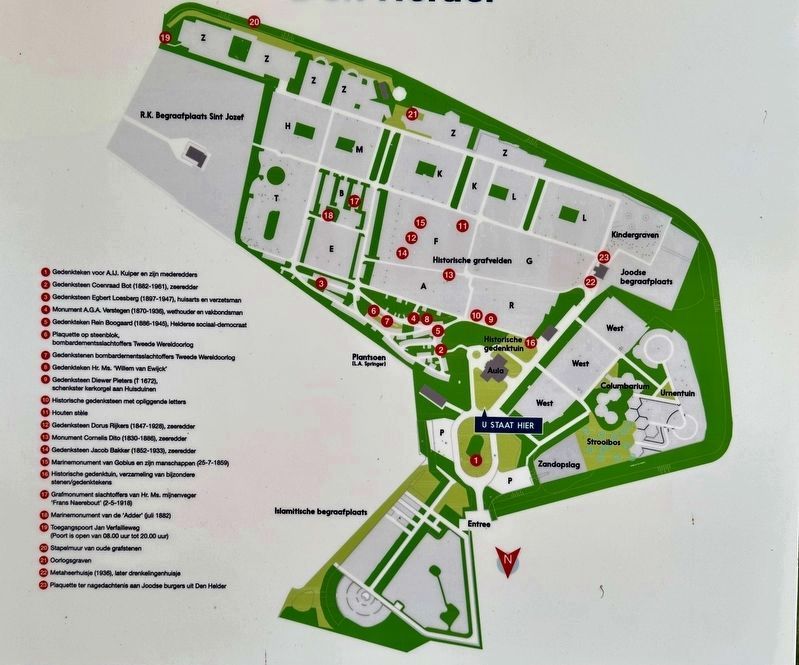
3. Den Helder General Cemetery marker: map side
The reverse side of the marker has a map of the cemetery showing the various sections referenced on the marker, as well as various points of interest. Note that it is this side that is most easily seen in the parking lot - the history side is easy to overlook.
Credits. This page was last revised on July 1, 2026. It was originally submitted on July 1, 2026, by Andrew Ruppenstein of Lamorinda, California. This page has been viewed 11 times since then. Photos: 1, 2, 3. submitted on July 1, 2026, by Andrew Ruppenstein of Lamorinda, California.
