
Den Helder, North Holland, Netherlands — Northwestern Europe
Historische gedenktuin
⎯⎯⎯
Historical Memorial Garden

Photographed by Andrew Ruppenstein, June 2, 2026
1. Historische gedenktuin / Historical Memorial Garden Marker

U bevindt zich hier op een bijzondere plek van de Huisduiner begraafplaats. Vrijwilligers van de stichting Historische Grafmonumenten hebben samen met de beheerders van de begraafplaats gedurende zo'n 25 jaar een verzameling van bijzondere graftekens opgebouwd. De stenen komen allemaal van het oudste gedeelte van de begraafplaats, de velden G, R, A en F. Ze zijn bewaard gebleven uit respect en bewondering voor de toonaangevende personen en/of het ambachtelijk vakmanschap waarmee ze zijn gemaakt. Het resultaat is dit interessante overzicht van de eeuwenoude grafcultuur van de Huisduiner begraafplaats. Deze gedenktuin heeft in het verleden gediend als strooiveld. Nu het een verzorgde, aantrekkelijke plek is, kunnen wij op een respectvolle manier terugdenken aan degenen wier as hier werd uitgestrooid.
Kerkloos
De Huisduiner begraafplaats is uniek in Nederland. Op dit oorspronkelijke Waddeneiland stond in de Middeleeuwen een kerkje, dat keer op keer werd verzwolgen door de zee. Toen rond het jaar 1600 veel door de pest getroffen slachtoffers snel moesten worden begraven, is er voor gekozen dit stukje duin als begraafplaats in te richten, zonder dat er een stond. Een uniek gegeven, want tot circa 1900 werden overal in het land overledenen in of bij de kerk begraven. Het woord "kerkhof' was hier dan eigenlijk ook niet meer op zijn plaats, maar men kende er geen ander woord voor. Vanwege eeuwenlang begraven, is een grote variatie aan graftekens ontstaan.
Archief van steen
De gemeente Den Helder heeft in 2019 circa 50 bewaarde grafstenen herplaatst in deze gedenktuin. Uit dit 'stenen archief' zijn acht groepjes ontstaan, elk met een eigen verhaal. U treft er de gebruikelijke symbolische beplanting aan die bij een begraafplaats hoort. Zo is de omheining afgezet met taxus, symbool voor de dood. De bijzondere, driestammige eik staat voor kracht en onsterfelijkheid. Tussen de grafstenen zijn stinzenplanten, bolletjes en fraaie bloemenmengsels geplant en gezaaid.
De grafstenen die om religieuze redenen van oorsprong op het oosten waren gericht, staan ook nu richting het oosten. Daar waar dat niet speelde zijn de stenen richting het westen geplaatst. Op die manier is een centraal middendeel ontstaan met drie opvallende graftekens.
Historical Memorial Garden
You are standing in a special part of the Huisduinen cemetery. Over the course of some 25 years, volunteers from the Historical Grave Monuments Foundation (Stichting Historische Grafmonumenten), together with the cemetery administrators, have assembled a collection of remarkable grave markers. These stones all originate from the oldest section of the cemetery—specifically, plots G, R, A, and F. They have been preserved out of respect and admiration for the prominent individuals associated with them and for the skilled craftsmanship evident in their creation. The result is this fascinating overview of the centuries-old funerary culture of the Huisduinen cemetery. This memorial garden previously served as a scattering field. Now that it has become a well-maintained and attractive space, we can respectfully reflect on the memory of those whose ashes were scattered here.
Without a Church
The Huisduinen cemetery is unique in the Netherlands. In the Middle Ages, a small church stood on what was originally a Wadden Sea island, but it was repeatedly swallowed by the sea. Around 1600, when large numbers of plague victims required rapid burial, this stretch of dune was designated as a cemetery—even though no church stood there. This was a unique arrangement, as the custom throughout the country until around 1900 was to bury the deceased inside or immediately beside the church. Strictly speaking, the Dutch word for churchyard (kerkhof) was no longer appropriate here, yet there was no other term for it. Centuries of burials have resulted in a wide variety of grave markers.
An Archive of Stone
In 2019, the Municipality of Den Helder relocated approximately 50 preserved gravestones to this memorial garden. This "archive of stone" has been organized into eight groups, each with its own story. You will find the symbolic plantings typically associated with a cemetery; for instance, the perimeter is lined with yew, a symbol of death. A distinctive three-trunked oak tree represents strength and immortality. Stinzen plants (bulbous plants naturalized on historic estates), spring bulbs, and beautiful wildflower mixes have been planted and sown among the gravestones.
Gravestones that were originally oriented towards the east for religious reasons still face east today. Where this factor did not apply, the stones have been positioned facing west. This arrangement has created a central area featuring three striking grave markers.
Erected by Gemeente
this page online
Topics. This historical marker is listed in this topic list: Cemeteries & Burial Sites. A significant historical year for this entry is 1600.
Location. 52° 57.075′ N, 4° 44.251′ E. Marker is in Den Helder, Noord-Holland (North Holland). It is on Kerkhoflaan. The historical memorial garden and marker are located on the north side of the main building. Touch for map. Marker is at or near this postal address: Kerkhoflaan 4, Den Helder, Noord-Holland 1789 AS, Netherlands. Touch for directions.

Regionally, it is in Europe, the European Union, Atlantic Europe, the Benelux Low Countries, the Schengen Area, Western Europe, and the Western World. Historically, it finds itself in what was once the Holy Roman Empire.
Other nearby markers. At least 8 other markers are within walking distance of this marker: Algemene begraafplaats Den Helder / Den Helder General Cemetery (a few steps from this marker); Soortens Graftekens… / Types of Grave Markers… (within shouting distance of this marker); Materialen / Materials (within shouting distance of this marker); Zeevaart, Post, Zeeredder / Navigation, Post, and Sea Rescuers (within
Photographed by Andrew Ruppenstein, June 2, 2026
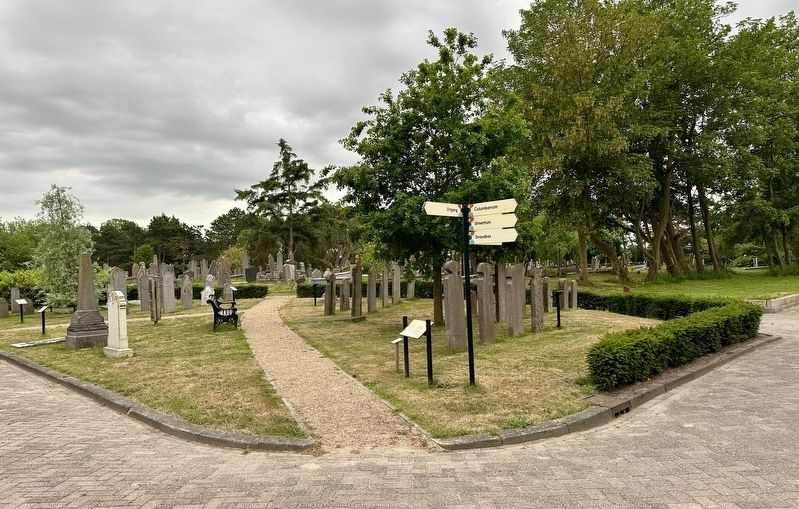
2. Historische gedenktuin / Historical Memorial Garden Marker - wide view
The marker is visible here next to the directional signs. Most, but not all of the subsections of the historical memorial garden, are visible here, each with their own historical marker explaining their significance.
Also see . . .
1. Historische Gedenktuin (Gemeente Den Helder, in Dutch). The QR code on the marker leads this page, which is basically a short overview of the historical memorial garden, plus more detailed information on each of the subsections, (Submitted on July 1, 2026.)
2. Historisch verhaal - Gedenktuin en museum (Verhalen Algemene begraafplaats, in Dutch). The QR code next to the marker (not the same as on the marker) leads to a page with general information on the historical memorial garden, as well as more specific information on the garden’s subsections. Includes a six minute audio section, as well as a six minute video. Excerpt (in translation):
The Memorial Garden is a unique site that took shape over a period of 25 years, thanks to the efforts of the Municipality of Den Helder’s cemetery managers and members of the Historical Grave Monuments Foundation. Originally an area for the scattering of ashes, it has been transformed into a well-maintained, inviting space for respectful remembrance. The garden features various groupings of grave markers, each with its own theme. Notably, the original orientation of the markers has been preserved. The Memorial Garden offers fascinating insight into Den Helder’s burial culture and long-standing Dutch funeral traditions.…(Submitted on July 1, 2026.)
Credits. This page was last revised on July 1, 2026. It was originally submitted on July 1, 2026, by Andrew Ruppenstein of Lamorinda, California. This page has been viewed 14 times since then. Photos: 1, 2. submitted on July 1, 2026, by Andrew Ruppenstein of Lamorinda, California.
